
Ask most leadership teams who owns AI in their organization and they will point to the CTO. Somebody in technology. Somebody else.
Chad Gold disagrees. And he has the results to back it up.
Chad is the CFO of FullStory and was named the 2022 CFO of the Year by the Atlanta Business Chronicle. Before that, he took Salesloft from startup to over $2.3 billion in enterprise value and served as the first CFO at G2. When I sat down with him in Atlanta for The Diary of a CFO podcast, he made an argument I have not been able to stop thinking about: when it comes to using AI to run the business better, the CFO owns it.
"As the CFO, you're one of the primary drivers of AI in the company," he told me. His reasoning is simple. Your CTO is focused on the product, on what you bring to market for customers. But applying AI to internal operations, to efficiency, to decision velocity? "That's squarely in the CFO office."
And honestly, we already know how this works.
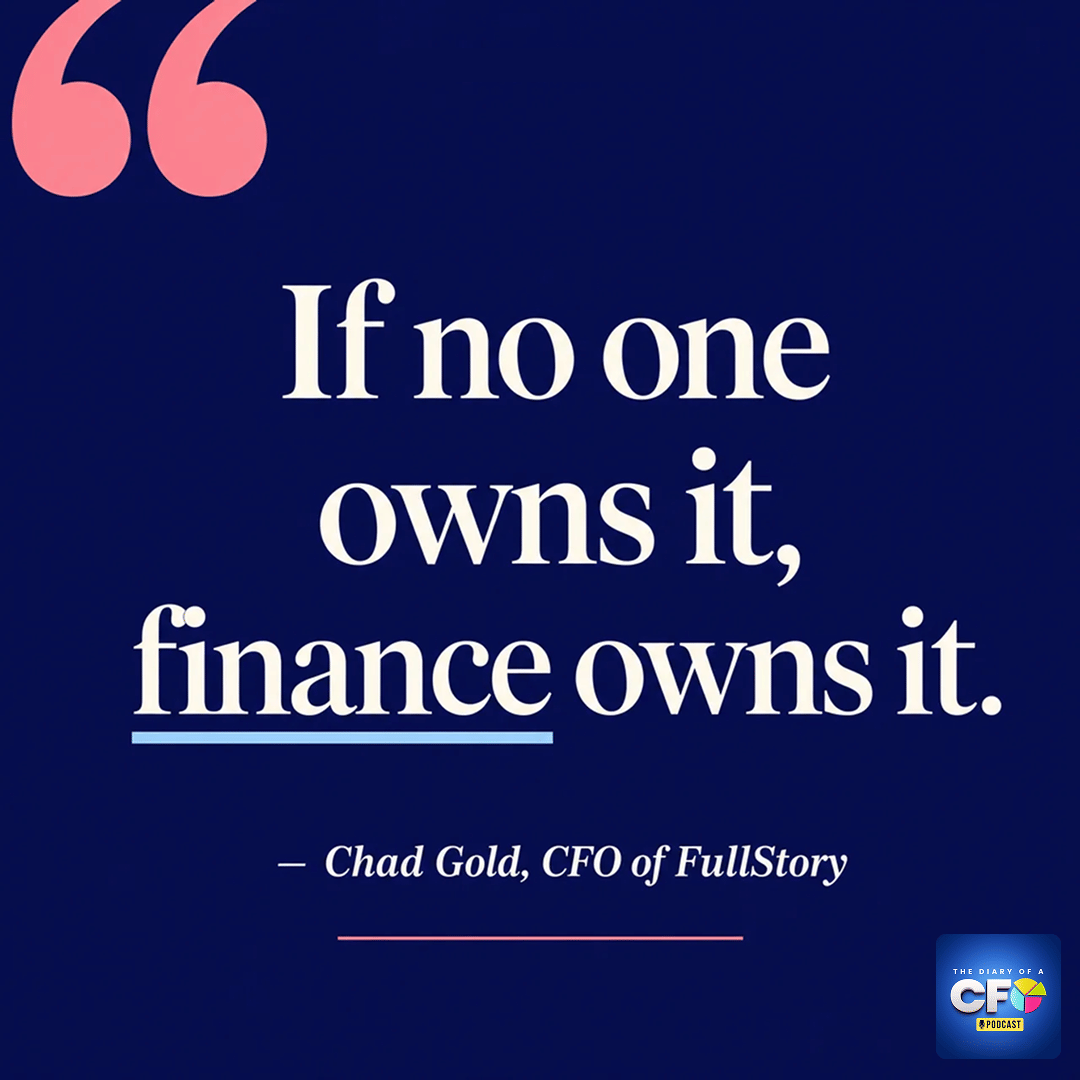
The difference now is that AI is not just another orphaned responsibility landing on the CFO's desk. It is a mandate. Here is Chad's playbook for actually leading it, drawn from our full conversation.
Why the CFO Is Positioned to Lead AI in Finance and Beyond.
Chad sees two jobs for the CFO in any AI transformation, and he says both are where most AI initiatives fail.
First, you create the environment. That means the data infrastructure, the governance, and the right tools so people can actually start using AI safely. Second, you get the talent right. You need people who marry functional expertise with a genuine curiosity about data and systems.
The CFO also sits in a unique seat. You see every function of the business. You can, as Chad put it, invite yourself to any party in the company. If you have earned the right by showing up as a true business partner, teams will pull you in and ask how AI applies to their work.
The question he now asks every team is not "how are you using AI to write better?" It is: what are you doing to transform your business processes with AI? He was not having that conversation a year ago. He has it every day now.
Where to Start With AI in Your Finance Function
If you are a CFO who wants to bring AI into finance today, Chad's advice is refreshingly unglamorous: start with the easiest tasks.
Look at what your team spends time on that is manual and repetitive. Ask everyone to assess their own work and raise their hand where AI could help. And be clear about the intent. The goal is not to cut headcount. The goal is to free up people's time for higher value work.
He is direct about the mistake he sees most often. Scroll LinkedIn and every other post is someone claiming they automated all of their board reporting with AI. Chad's take: that is a great goal, but you probably are not doing that much board reporting, it is one of the more complicated use cases, and if you have not nailed your data first, it will be painful. Nail the basics before you chase the highlight reel.
Real AI Use Cases From FullStory's Finance Team
This is where the conversation got really practical. Chad gave a mandate to his accounting team to cut the month end close, and they delivered a 50% reduction in close time in one year. He has now asked for another 50%. Here is what that looked like in practice.
The SEC Agent. Revenue accounting in a software company means every deal comes with the question "is there a revenue impact here?" and the accounting guidance runs hundreds of pages. FullStory's enterprise systems and data team built an internal agent trained on all of that accounting guidance. Now the team uploads a contract and asks for the implications. Hours of work per contract, gone.
The daily cash agent. Chad has asked for daily cash reporting at every company he has led. His philosophy on why is one of my favorite lines from the whole episode.

At FullStory, that report used to take someone an hour or two a day to build. His controller, on his own initiative, built an agent that pulls the bank data, runs it through their enterprise AI tools in a secure environment, updates the report, and posts the daily cash update to Slack. One to two hours of daily work is now about five minutes.
A purpose built AI close tool. Not everything should be built in house. Chad's team bought an AI close solution because, as he put it, you do not gain a competitive advantage by building that yourself. The CFO's job is to challenge the team on when to buy and when to build, and to demand a baseline measurement first so you know whether the investment actually paid off. Otherwise you have just added another cost without anyone signing up for the benefit.
## The Guardrails: Data Quality, Governance, and the Audit Trail
If there is one section of this conversation every finance leader should sit with, it is this one. Because Chad is genuinely excited about AI, and he is equally blunt about its limits.
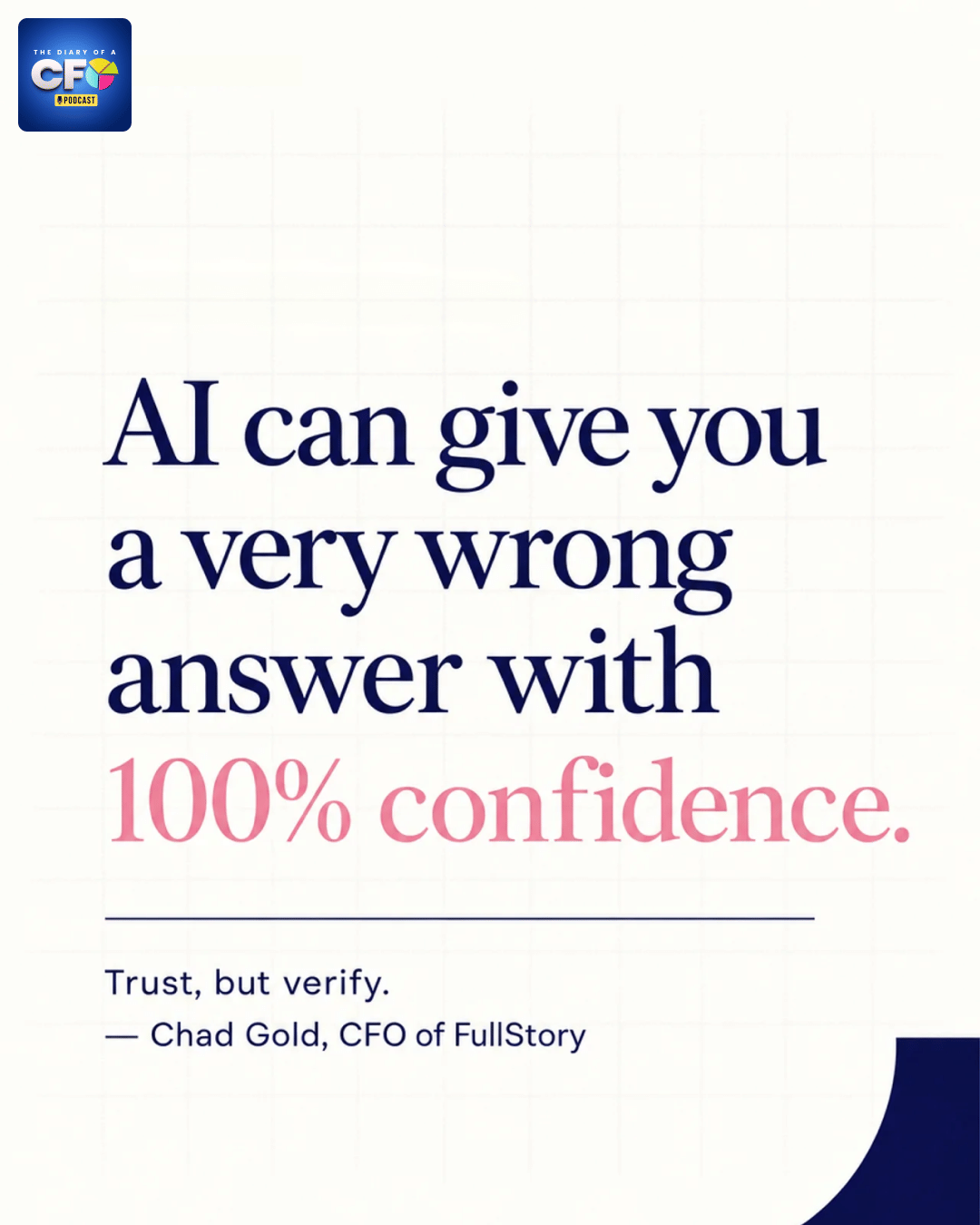
We are in finance. Accuracy is paramount. So Chad's rule is trust but verify, with a human in the loop and an audit trail behind every automation. In practice that means asking AI to walk you through its process step by step, to generate spreadsheets that expose the formulas behind its calculations, and to explain any code it writes in plain language. It will do all of that. You just have to ask.
The second guardrail is data quality. Chad warns against unleashing AI directly on your source systems, your CRM, your Slack, your ERP, and hoping for the best. Instead, invest in a semantic layer that sits between AI and your source systems, where you embed agreed business definitions. If you and your Chief Revenue Officer define bookings or ARR differently, AI will happily hand different people different answers to the same question. The companies learning this the hard way right now are the ones that built the chatbot before they built the data layer.
He shared a cautionary tale from a peer CFO whose company spun up chatbots for every function: legal, HR, go to market. His immediate question was the right one. How do we know those are right, and how do we know the right people are seeing the right information? Governance and access controls are not optional extras. They are the foundation.
The Future Finance Team: From Triangle to Diamond
So what does all of this mean for finance careers? Chad does not believe entry level jobs disappear. He believes the shape of the org changes.
The traditional finance team is a triangle: a CFO at the top, middle managers, and a wide base of analysts and accountants. The new world looks more like a diamond. The CFO still sits at the top, but the middle layer of managers now manages both people and AI agents, with a smaller entry level base beneath them.
His hiring bar has already shifted. Functional expertise still matters, but now he wants to know: tell me how you are using AI in your job today. He compared it to the Microsoft Office classes we all took in college. You could not start a job without knowing Office. AI, he argues, should be viewed exactly the same way. It should be one of the first systems you set up on day one.
The Bottom Line for CFOs
Chad's playbook comes down to a few moves any finance leader can start this quarter:
Claim the mandate. Internal AI transformation belongs to the CFO. Do not wait for someone else to own it.
Start with the easiest, most repetitive tasks. Skip the board reporting fantasy until your data is ready.
Invest in the data layer first. Shared definitions, governance, and access controls before chatbots.
Demand an audit trail. Trust but verify, always, because confident and correct are not the same thing.
Set baselines and measure. Know what a task costs today before you claim AI improved it.
Create a culture of sharing. Chad's teams post every AI win to a shared Slack channel, because seeing one example unlocks ten more.
The technology is moving fast, and nobody has it all figured out, including the companies building it. But the CFOs who create the environment, develop the talent, and keep asking "how are we rethinking how we work?" are the ones who will make the news instead of reporting it.
Frequently Asked Questions
Should the CFO or the CTO own AI in a company?
Chad Gold's view is that both own it, but for different things. The CTO owns AI in the product, meaning what the company brings to market for customers. The CFO owns AI for internal operations, efficiency, and decision velocity. Because the finance leader already sees every function of the business and sets up the data infrastructure and governance, they are uniquely positioned to drive internal AI transformation.
Where should a finance team start with AI?
Start with the easiest, most manual and repetitive tasks, not with your most complex reporting. Ask each person on the team to look at their own work and flag where AI could help, and be clear that the goal is to free up time for higher value work rather than to cut headcount. Chad specifically cautions against trying to automate all of your board reporting first, since it is one of the harder use cases and depends on clean data.
How did FullStory's finance team cut month end close time by 50%?
Chad gave his accounting team a clear mandate to reduce close time, then supported a mix of building and buying. His team built internal agents for specific jobs, such as a daily cash agent that posts updates to Slack and an agent trained on revenue accounting guidance, and they bought a purpose built AI close tool rather than building one from scratch. The key discipline was measuring a baseline first so they could prove the time savings were real.
What are the biggest risks of using AI in finance?
The two Chad stresses most are accuracy and data quality. AI can produce a confidently wrong answer, so every automation needs a human in the loop and an audit trail. And pointing AI directly at messy source systems without a semantic layer of agreed definitions means different people can get different answers to the same question. Governance and access controls sit underneath all of it.
Will AI eliminate entry level finance jobs?
Chad does not think entry level roles disappear, but he does think the shape of the team changes from a triangle to a diamond, with a middle layer that manages both people and AI agents. His hiring bar has already shifted to include a simple question: tell me how you are using AI in your job today. He compares AI fluency to knowing Microsoft Office, something you are expected to have on day one.
Listen to the Full Episode.
Hear my full conversation with Chad Gold on The Diary of a CFO:
YouTube: https://www.youtube.com/watch?v=Ke1lDjrCDV4
Apple Podcasts:https://podcasts.apple.com/us/podcast/the-diary-of-a-cfo/id1768818749
Spotify:https://open.spotify.com/episode/3ELtl1nWojPLCoaYQbSlwz?si=PdA1t4E1QPu91yH-bRz0gA