
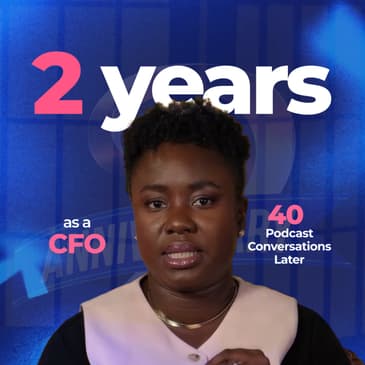
In this solo episode of The Diary of a CFO, I sit down halfway through the year to reflect on what I’ve learned during my first two years in the CFO seat, as well as the lessons I’ve gathered from speaking with more than 40 CFOs on this podcast.
I talk about the difference between strategic thinking and strategic leadership, and why most companies test for the first when the second is what ultimately keeps you in the seat.
I also explore why your relationship with your CEO and board can be the single most important factor in whether you succeed or get pushed out, including a real story from a CFO whose CEO asked her to stop attending board meetings after she shared information he didn’t want disclosed.
We get into why working with a founder CEO is completely different from working with a hired CEO, what that means for navigating the role, and how mid-market CFOs operate at different altitudes in the same day, from talking to funders to reviewing accounting entries.
I also unpack what I mean by “strategic influence” and why it has to permeate everything you do and say as an executive, right down to the words you choose.
And finally, I reflect on why alignment with your boss, your company, your family, and your health has become the one word that defines everything I’ve learned so far.
This is not just for CFOs. If you’re in any senior leadership seat, this episode is for you.
00:00:00 --> 00:00:02 Welcome back to the Diary of a CFO podcast. I'm
00:00:02 --> 00:00:05 your host Wassia Kamon and today it's just me.
00:00:05 --> 00:00:07 We are halfway through the year. The podcast
00:00:07 --> 00:00:09 is almost two years. And I think it's a good
00:00:09 --> 00:00:12 moment to pause and reflect, right? Because there's
00:00:12 --> 00:00:14 so many things going on, so many things really
00:00:14 --> 00:00:16 in leadership that we don't talk about enough.
00:00:16 --> 00:00:19 And I feel like today is a good time to be open
00:00:19 --> 00:00:21 to some of those conversations. So this is not
00:00:21 --> 00:00:24 just for CFOs. If you are in a senior seat of
00:00:24 --> 00:00:26 any kind, this is also for you. I'm going to
00:00:26 --> 00:00:28 talk about really three things. What I've learned
00:00:28 --> 00:00:31 in those first two years being in the seat. Also
00:00:31 --> 00:00:34 what I've learned speaking to now almost 40 CFOs.
00:00:34 --> 00:00:37 over the past two years from my podcast. And
00:00:37 --> 00:00:40 one of the major things I realized, a lot of
00:00:40 --> 00:00:42 people overlook. when they're stepping into executive
00:00:42 --> 00:00:45 leadership. So two years into the role, I realized
00:00:45 --> 00:00:47 that a person who gets promoted to CFO and a
00:00:47 --> 00:00:50 person who survives as a CFO are two different
00:00:50 --> 00:00:52 people. If you've been in the seat of CFO, you
00:00:52 --> 00:00:54 probably know what I'm about to talk about because
00:00:54 --> 00:00:57 I remember what got me into the seat. I was not
00:00:57 --> 00:01:00 a CFO before. My first time CFO, I came from
00:01:00 --> 00:01:04 a VP of Finance and controller. So I was overseeing
00:01:04 --> 00:01:07 FP &A and controller, you know, everything accounting
00:01:07 --> 00:01:10 in that prior company, an executive recruiter.
00:01:10 --> 00:01:12 out to me on LinkedIn, went through the process,
00:01:12 --> 00:01:15 and became a CFO. And I can clearly see why I
00:01:15 --> 00:01:18 was hired, right? looking in hindsight. First,
00:01:18 --> 00:01:20 they were looking at relevant industry experience.
00:01:20 --> 00:01:22 So I was a VP of Finance and Controller in the
00:01:22 --> 00:01:25 CDFI industry, same where I am now. I was familiar
00:01:25 --> 00:01:28 with the reporting complications, reporting cadence
00:01:28 --> 00:01:31 and all things of that side. I had led teams
00:01:31 --> 00:01:33 of similar size across different industries.
00:01:33 --> 00:01:36 I have improved systems. My communication was
00:01:36 --> 00:01:38 on point, whether it was with when I was talking
00:01:38 --> 00:01:41 to the founder or other people that were part
00:01:41 --> 00:01:44 of the interviewing process. I had the right
00:01:44 --> 00:01:46 credentials. I would show strategic thinking,
00:01:46 --> 00:01:48 some of the questions they will ask. And it really
00:01:48 --> 00:01:51 also came down to what we often overlook, which
00:01:51 --> 00:01:54 is how comfortable is a room when you are with
00:01:54 --> 00:01:56 them? Because people like hiring people they
00:01:56 --> 00:01:58 like. So if you're going to an interview and
00:01:58 --> 00:02:00 there is a good vibe, you will be hired. So I
00:02:00 --> 00:02:03 basically checked all those boxes. But now that
00:02:03 --> 00:02:06 I look back, I realize that what has kept me
00:02:06 --> 00:02:09 is not just being a strategic thinker, right?
00:02:09 --> 00:02:12 Strategic thinking, you see the long term, you're
00:02:12 --> 00:02:15 able to analyze the big picture, but being a
00:02:15 --> 00:02:18 strategic leader is really what kept me at this
00:02:18 --> 00:02:20 role. And that's what I realized we often miss.
00:02:20 --> 00:02:23 And it's also easy to miss for a lot of companies
00:02:23 --> 00:02:25 hiring, they will test your strategic thinking,
00:02:25 --> 00:02:27 but how do you know you're a strategic leader?
00:02:27 --> 00:02:29 Because once you come to being a strategic leader,
00:02:29 --> 00:02:31 it's actually understanding what is happening
00:02:31 --> 00:02:34 in the business. What are the implications for
00:02:34 --> 00:02:36 today? What are the risks in the long term? and
00:02:36 --> 00:02:39 acting to influence those results. Now that's
00:02:39 --> 00:02:43 where things get a little complicated. Because
00:02:43 --> 00:02:44 it's knowing when you have to pitch and when
00:02:44 --> 00:02:46 you have to back off on an idea. It's knowing
00:02:46 --> 00:02:49 when you have to argue and when you have to let
00:02:49 --> 00:02:51 go. When you have to advocate for something and
00:02:51 --> 00:02:53 when you have to say no. How are you going to
00:02:53 --> 00:02:56 get executives, your peers that do not report
00:02:56 --> 00:02:59 to you, to take the right action, especially...
00:02:59 --> 00:03:02 How are you going to handle your relationship
00:03:02 --> 00:03:05 with the CEO and the board? And I want to pause
00:03:05 --> 00:03:07 right here because it's something that I think
00:03:07 --> 00:03:12 we often overlook and underestimate. A lot of
00:03:12 --> 00:03:15 CFOs I've interviewed, whether it was on record
00:03:15 --> 00:03:19 or off record, all said that being at this point
00:03:19 --> 00:03:22 of their career, it feels to others like they're
00:03:22 --> 00:03:24 at the top of their game, but it also feels like
00:03:24 --> 00:03:27 you are the tip. of your game. A lot of them
00:03:27 --> 00:03:29 are being forced to resign, not because they're
00:03:29 --> 00:03:30 not great at their role, not because they're
00:03:30 --> 00:03:32 not qualified, like they've checked all the same
00:03:32 --> 00:03:35 boxes for whatever companies hired them. But
00:03:35 --> 00:03:37 it was really because of their relationship with
00:03:37 --> 00:03:40 the CEO and the board. A couple months ago, I
00:03:40 --> 00:03:45 had a CFO reach out to me and she was on the
00:03:45 --> 00:03:46 verge of quitting. She was like, I'm looking
00:03:46 --> 00:03:49 for a new job. And when I asked her why, because,
00:03:49 --> 00:03:51 you know, she was well -paid over probably over
00:03:51 --> 00:03:55 300K and great bonus equity package, it was because
00:03:55 --> 00:03:58 that's At some point, her CEO asked her to stop
00:03:58 --> 00:04:00 coming to the board meeting because she had come
00:04:00 --> 00:04:03 to the board meeting and shared some information
00:04:03 --> 00:04:06 that the CEO didn't. want to be shared, obviously,
00:04:06 --> 00:04:09 because he had painted a different picture to
00:04:09 --> 00:04:11 the board, and the board was okay with that.
00:04:11 --> 00:04:13 And a lot of that happens in those cases because
00:04:13 --> 00:04:17 it was a founder. Now, how you work with a founder
00:04:17 --> 00:04:19 CEO is very different than how you work with
00:04:19 --> 00:04:22 a CEO that was hired. See, how you build a relationship
00:04:22 --> 00:04:25 with a founder CEO is often very difficult because
00:04:25 --> 00:04:27 that's the person that built a company without
00:04:27 --> 00:04:30 you. They went through all this. They had to
00:04:30 --> 00:04:32 learn a little bit about finance. You were not
00:04:32 --> 00:04:34 there. Now you show up, and you're going to tell
00:04:34 --> 00:04:36 them what's wrong. And when they have a board,
00:04:36 --> 00:04:39 it's often a board that's loyal to them first
00:04:39 --> 00:04:42 before being a true governance board that is
00:04:42 --> 00:04:44 loyal to the company and the shareholders. And
00:04:44 --> 00:04:47 so in that situation, you can see how, well,
00:04:48 --> 00:04:50 Neither the CEO, neither the board were on their
00:04:50 --> 00:04:53 side. So for her, it was, OK, I'm going to leave.
00:04:54 --> 00:04:56 And so that is one of the things that we often
00:04:56 --> 00:04:59 overlook when we think about taking an executive
00:04:59 --> 00:05:03 leadership role, is you need that alignment with
00:05:03 --> 00:05:06 your CEO and with your board. Absolutely, because
00:05:06 --> 00:05:09 otherwise, you're very, very. vulnerable. So
00:05:09 --> 00:05:11 even though you checked all the boxes, you have
00:05:11 --> 00:05:12 all the industry experience, you felt the vibe
00:05:12 --> 00:05:16 when you were in the room and you felt like they
00:05:16 --> 00:05:18 said they wanted change and your ideas will be
00:05:18 --> 00:05:21 approved or at least listened to before making
00:05:21 --> 00:05:24 decisions, you really have to make sure all along
00:05:24 --> 00:05:27 the way that you keep that alignment together.
00:05:27 --> 00:05:30 And that is really all the subtle stuff that
00:05:30 --> 00:05:32 happened in the background. So as I said earlier,
00:05:33 --> 00:05:36 that's the part of being an executive that is
00:05:36 --> 00:05:38 really hard to understand, but that's really
00:05:38 --> 00:05:41 what keeps you in the seat and keeps succeeding
00:05:41 --> 00:05:43 in the seat. Like when you have to pitch those
00:05:43 --> 00:05:45 ideas, when you have to back up, when you have
00:05:45 --> 00:05:48 to argue, when you have to let go, when you have
00:05:48 --> 00:05:50 to advocate, when you have to say no, how you
00:05:50 --> 00:05:52 have to deliver bad news, how you have to get
00:05:52 --> 00:05:55 people aligned with you, whether it's your peers,
00:05:55 --> 00:05:57 your CEO, your board, when and how you're going
00:05:57 --> 00:05:59 to introduce change to your team, to the rest
00:05:59 --> 00:06:02 of the organization, when you're going to share
00:06:02 --> 00:06:04 information, when you're going to withhold it.
00:06:04 --> 00:06:08 And even down to the tone and the depth of every
00:06:08 --> 00:06:11 word. Like I remember my CEO one day told me
00:06:11 --> 00:06:13 after a meeting, Waseea, you said you were worried
00:06:13 --> 00:06:15 about so -and -so and you almost never used the
00:06:15 --> 00:06:18 word worry before. Can you tell me more? Right?
00:06:18 --> 00:06:21 Because they read all those things. It's a heavy
00:06:21 --> 00:06:24 title to have. And so this is how closely you
00:06:24 --> 00:06:28 being read once you are in deceit. down to the
00:06:28 --> 00:06:31 word you're using. What are you worried about?
00:06:31 --> 00:06:33 When you say the word worry, what is it? And
00:06:33 --> 00:06:36 once you understand it, you also can understand
00:06:36 --> 00:06:38 how you can be strategic about the kind of words
00:06:38 --> 00:06:41 you use, when you use them. And I call this strategic
00:06:41 --> 00:06:44 influence. It is a term that I redefined in my
00:06:44 --> 00:06:47 Wharton online segment for the FP &A certificate
00:06:47 --> 00:06:49 program. I did a segment for them a couple years
00:06:49 --> 00:06:51 ago on leading through uncertainty. And strategic
00:06:51 --> 00:06:53 influence is really, if you were thinking about
00:06:53 --> 00:06:57 a Venn diagram, is that intersection between
00:06:57 --> 00:07:00 influence and strategy. And it really has to
00:07:00 --> 00:07:04 permeate everything you do and who you are as
00:07:04 --> 00:07:07 an executive. You have to be able to read situations
00:07:07 --> 00:07:11 and read people quickly and strategically. Otherwise
00:07:11 --> 00:07:13 you will end up very frustrated in a role that
00:07:13 --> 00:07:17 you work so, so hard to get. So I'm in the seat
00:07:17 --> 00:07:20 now two years and that's definitely the major
00:07:20 --> 00:07:25 lesson that I learned in this journey is... Yes,
00:07:25 --> 00:07:28 you have the credentials. Yes, you can do the
00:07:28 --> 00:07:31 work. But there are so many nuances that comes
00:07:31 --> 00:07:33 with it. Now, the other thing I also learned
00:07:33 --> 00:07:36 in speaking with other CFOs is regardless of
00:07:36 --> 00:07:39 the size of the organizations, it's not like
00:07:39 --> 00:07:42 you are a small version of a CFO if you work
00:07:42 --> 00:07:44 for a smaller company. It's not like if you're
00:07:44 --> 00:07:46 a large CFO, you have more problems. It's not
00:07:46 --> 00:07:49 like the more money, more problems by the great
00:07:49 --> 00:07:52 philosopher, Jay -Z said. But it's really more
00:07:52 --> 00:07:54 money or less money. There's different problems,
00:07:55 --> 00:07:56 regardless of where we go. That's really what
00:07:56 --> 00:07:59 it is. Because if you are in a mid -market CFO,
00:07:59 --> 00:08:01 you're considering a role in the small to medium
00:08:01 --> 00:08:04 size, which is the space I operate in, you have
00:08:04 --> 00:08:07 to realize that you operate at different altitudes.
00:08:07 --> 00:08:09 In the same day, I can start a day talking to
00:08:09 --> 00:08:12 a funder to give me money. I can be in the leadership
00:08:12 --> 00:08:14 team. And then next thing I know, I'm reviewing
00:08:14 --> 00:08:16 something in accounting. That was wrong. And
00:08:16 --> 00:08:18 so you are doing all these things at different
00:08:18 --> 00:08:21 altitudes going from big picture to small picture
00:08:21 --> 00:08:24 and in between long term, short term, in the
00:08:24 --> 00:08:27 weeds in the same day that, for example, a large
00:08:27 --> 00:08:31 cap CFO at a larger company may have people specifically
00:08:31 --> 00:08:33 for that. Like they probably have a leader for
00:08:33 --> 00:08:35 treasury. They probably have a separate leader
00:08:35 --> 00:08:38 for investor relations, et cetera. You may not
00:08:38 --> 00:08:41 have it. And so again, it goes back to the bigger
00:08:41 --> 00:08:44 lesson here, which is finding the right alignment.
00:08:44 --> 00:08:48 between your background. the things that you
00:08:48 --> 00:08:51 want to do and what the company is looking for.
00:08:51 --> 00:08:54 Who are the people there? How are you going to
00:08:54 --> 00:08:56 work with them? That's really what I've learned
00:08:56 --> 00:08:59 in those past two years speaking with, again,
00:08:59 --> 00:09:03 over 40 CFOs in the process. So if you're in
00:09:03 --> 00:09:07 a CFO seat or in any other senior leadership
00:09:07 --> 00:09:10 role, I think it's a good time to also pause
00:09:10 --> 00:09:12 and ask yourself the honest question. How is
00:09:12 --> 00:09:14 your relationship with your boss? How is a CEO
00:09:14 --> 00:09:18 relationship? Where are your boundaries and what
00:09:18 --> 00:09:21 is the seat asking of you right now? There's
00:09:21 --> 00:09:23 no wrong answer. It's about staying valid and
00:09:23 --> 00:09:27 staying aligned because that alignment is really
00:09:27 --> 00:09:31 key in making sure that you are fulfilled in
00:09:31 --> 00:09:33 the role. And I can even take it a step further
00:09:33 --> 00:09:36 when it comes to alignment, not just alignment
00:09:36 --> 00:09:38 with your boss and all those things that work,
00:09:38 --> 00:09:41 but alignment with your own personal life. If
00:09:41 --> 00:09:44 you watch my very first check -in, when I started
00:09:44 --> 00:09:46 this podcast, I did my first 90 day check and
00:09:46 --> 00:09:48 I'll definitely drop the link in the show notes
00:09:48 --> 00:09:50 where I was talking about how my first 90 days
00:09:50 --> 00:09:54 went. And one of the things that really came
00:09:54 --> 00:09:57 about was how much weight I had gained that first
00:09:57 --> 00:10:00 year because I hadn't built the habit of dealing
00:10:00 --> 00:10:03 with stress and working out. Now I'm down the
00:10:03 --> 00:10:06 same weight now, two years later, but still comes
00:10:06 --> 00:10:10 down to how is your life optimized for the choices
00:10:10 --> 00:10:13 you have to make at your workplace? What is the
00:10:13 --> 00:10:16 environment you need at home? for you to be effective
00:10:16 --> 00:10:20 in your role. So to me, it all comes down to
00:10:20 --> 00:10:23 alignment, alignment, alignment. Yes, it's very
00:10:23 --> 00:10:27 tempted to just look at the money that is offered
00:10:27 --> 00:10:29 for some of those roles, but you have to look
00:10:29 --> 00:10:31 at the alignment. Is your family okay with it?
00:10:31 --> 00:10:33 Is it gonna crumble because of that decision?
00:10:33 --> 00:10:36 Is your health going to crumble because of that
00:10:36 --> 00:10:38 decision? So the big lesson for me this year
00:10:38 --> 00:10:40 has really been about alignment, making sure
00:10:40 --> 00:10:42 you're working with the right boss in the right
00:10:42 --> 00:10:47 company at the right. Can you work in a company
00:10:47 --> 00:10:49 that's growing at that rate? Is it sustainable
00:10:49 --> 00:10:51 long term? Or is it something quick that you
00:10:51 --> 00:10:54 can turn around? So big word of the day is definitely
00:10:54 --> 00:10:57 alignment, again. This is what I wanted to share
00:10:57 --> 00:10:58 with you, because I don't think we talk about
00:10:58 --> 00:11:01 all those nuances a lot. So if you enjoy this
00:11:01 --> 00:11:03 episode, don't forget to share it with someone
00:11:03 --> 00:11:05 that is also in the senior seat who might be
00:11:05 --> 00:11:08 having the same conversations with themselves.
00:11:08 --> 00:11:10 Drop a comment about what you've been thinking
00:11:10 --> 00:11:12 about halfway through the year. I'll definitely
00:11:12 --> 00:11:15 really want to learn more about them as well.
00:11:15 --> 00:11:16 And I'll see you in the next one.