
Ask most executive recruiters what the path to the CFO seat looks like and they will give you a standard playbook: start in audit, move to controllership, step into FP&A, and land in the C-suite.
Donna Cohen took a different route, and it changed everything about how she leads.
Donna is the Chief Financial Officer at CarMax Auto Finance. After years of managing SEC filings, 10-Ks, and 10-Qs, she made a move that raised a few eyebrows: she left core finance to manage frontline operations. When I sat down with her for The Diary of a CFO podcast, she made a point that every aspiring financial leader needs to hear: if you want to be a strategic CFO, you have to know how the business actually runs.
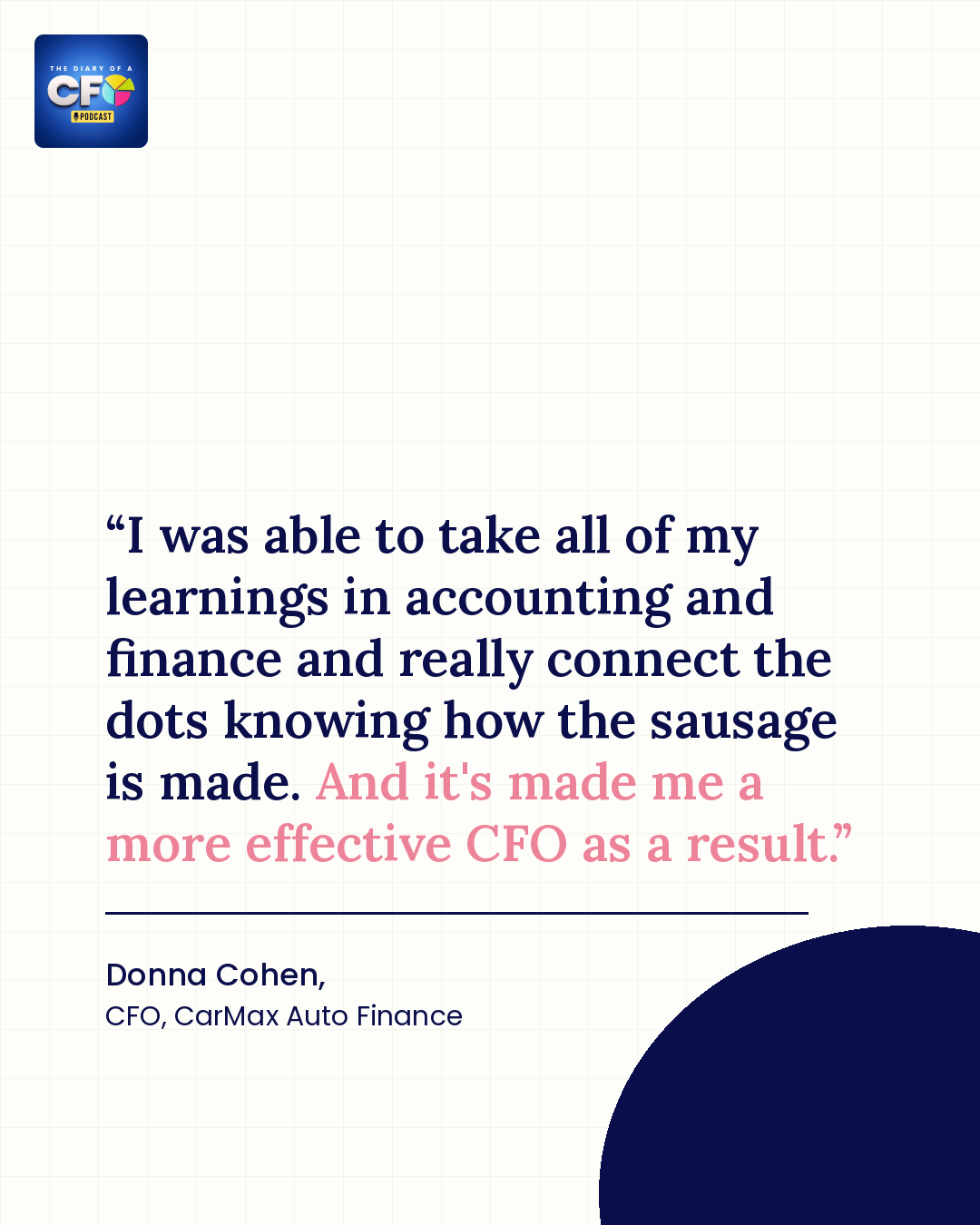
Here is Donna’s playbook for building operational intuition, leading through organizational change, and keeping human judgment at the center of financial leadership.
Why the Best CFOs Get Their Hands Dirty in Operations
When you spend your entire career inside financial models, it is easy to view budget requests purely as numbers on a spreadsheet. Managing operations changes your perspective.
Donna stepped away from predictable month-end closes to handle associate dynamics, supply chain disruptions, and vendor management. That operational friction gave her an intuitive understanding of what execution actually takes.
Now, when a leader asks her for capital or additional headcount, she doesn't just see a cost line item. She understands the operational need behind the request.
"When someone's asking for additional resources... now I can understand why there's a business need, versus if I hadn't had that experience, I might just automatically say, no, you don't need those resources," Donna explained. "It helps me to make better decisions now in terms of how we allocate capital."
Leading Change: The Human Side of Enterprise Transformations
Whether you are executing a corporate restructuring, an M&A integration, or a digital overhaul, the hardest part is almost never the technology or the process. It is human inertia.
Donna’s approach to leading major organizational shifts comes down to three clear steps:
Articulate the 'Why': People resist change when it feels arbitrary. Leaders must connect specific operational shifts back to the enterprise strategy and explain the risk of staying stagnant.
Connect Individual Impact: Help every associate understand why their role is critical to achieving the target outcome.
Mobilize Peer Champions: Find respected leaders across departments who can champion the vision and support their peers through the transition.
When people understand the destination and see their peers leading the way, friction turns into momentum.
AI in Finance: Your New Assistant, Not Your Replacement
There is a lot of anxiety in finance right now about AI taking over jobs. Donna’s take is grounded and practical: treat AI as an administrative assistant, not a replacement for professional judgment.
Instead of trying to overhaul everything at once, start with low-friction entry points:
Communication & Summarization: Use language models to draft operational summaries, digest long reports, and categorize high-volume communications.
Core Accounting Automation: Deploy specialized tools for account reconciliations and matching, freeing accountants to focus on variance analysis and strategic problem-solving.
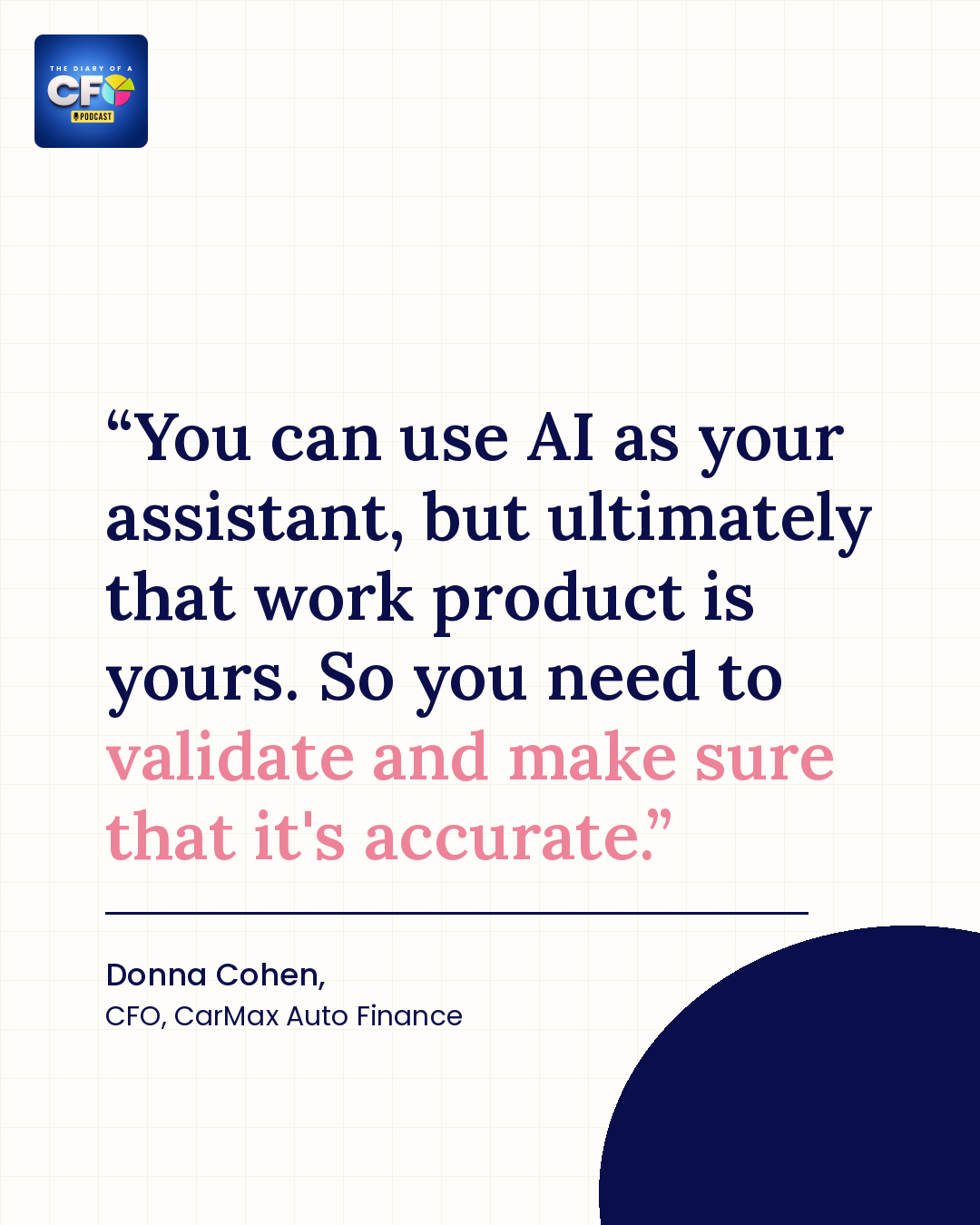
Because generative models can give confident but incorrect answers, human verification remains non-negotiable. Review AI deliverables with the same scrutiny you would apply to work submitted by a junior analyst.
Growth Over Perfection: Reframing Executive Leadership
Early in her career as a first-year accounting associate, Donna was assigned to lead a complex client engagement without workpapers or templates. Naturally, mistakes happened.
Instead of a reprimand, the partner sent her a note acknowledging that perfection was not expected on a brand-new project, while highlighting her strengths and leadership.
That single interaction shaped how she manages teams today. High-performing cultures are built on psychological safety, where people are encouraged to iterate, learn, and grow rather than fear making a mistake.
Sustainable Performance: Setting Boundaries at the Top
Executive leadership is demanding, and without intentional boundaries, burnout is inevitable. Early in her career, balancing high-impact transformations, long hours, and family commitments pushed Donna to a breaking point.
Sustaining high performance over time requires deliberate routines:
Renegotiate Responsibilities: Build a sustainable distribution of tasks with your family and professional support systems.
Protect Personal Time: Block out non-negotiable time for personal wellness, family, and rest.
Build a Strong Peer Network: Cultivate trusted relationships outside your immediate team to gain perspective during challenging cycles.
Long-term success requires recognizing when your tank is low and adjusting commitments before performance suffers.
Turning Introversion Into a Leadership Superpower
In a C-suite filled with dominant personalities, introverted leaders often wonder how to make their voices heard. Donna views introversion not as a handicap, but as a competitive advantage that fosters active listening and deliberate decision-making.
Her playbook for contributing effectively in high-stakes meetings:
Synthesize and Guide Consensus: Listen to the room, then step in to summarize core perspectives, bridge differences, and drive toward a decision.
Leverage Strategic Partners: Coordinate with trusted peers beforehand who can invite you into the conversation at key moments.
Focus on Quality Over Volume: Deliver high-value, well-timed insights rather than competing for airtime.
The Bottom Line for Finance Leaders
Donna’s career offers a clear roadmap for anyone aspiring to the CFO seat:
Step out of your comfort zone. Get operational experience to build true business intuition.
Lead with empathy. Focus on the human side of organizational change and technology adoption.
Use AI responsibly. Leverage tools for speed, but rely on human judgment for accuracy.
Protect your energy. Build sustainable boundaries so you can perform at your best over the long haul.
Play to your strengths. Use active listening and strategic synthesis to influence outcomes.
Frequently Asked Questions
Should finance leaders spend time working in operations?
Yes. Operational experience gives finance leaders firsthand insight into how business activities drive financial metrics. It builds practical empathy for resource requests, improves capital allocation decisions, and turns accountants into strategic business partners.
How should finance teams manage AI adoption safely?
Treat AI as an automated assistant rather than an autonomous decision-maker. Focus on repetitive tasks like communication drafts and initial account reconciliations, but maintain strict human oversight and verification on all final deliverables.
How can leaders manage change fatigue during business transformations?
Focus on transparent communication. Explain the strategic 'why' behind the shift, clarify each associate's individual contribution, and empower peer champions across the business to support their colleagues through the transition.
Can introverted professionals succeed in executive finance roles?
Absolutely. Introverted leaders excel at active listening, observation, and consensus-building. By synthesizing key viewpoints and delivering concise, well-timed observations, introverted executives can guide decision-making effectively without needing to dominate the room.
Listen to the Full Episode
Hear my full conversation with Donna Cohen on The Diary of a CFO:
Apple Podcasts: https://podcasts.apple.com/us/podcast/the-diary-of-a-cfo/id1768818749
Spotify: https://open.spotify.com/show/4NkWm8sQ12vM6a8bYgC11z
Sponsor Link: Learn more about episode sponsor FISPAN at www.fispan.com