
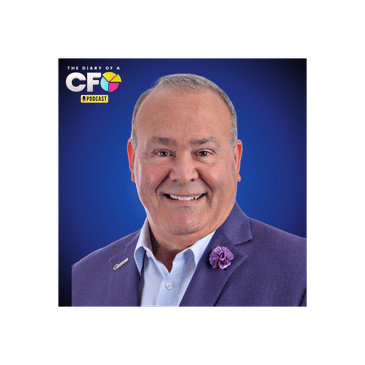


In this episode of The Diary of a CFO, host Wassia Kamon, CPA, CMA, MBA, is joined by Tom Hood, Executive Vice President, Business Engagement & Growth at the Association of International Certified Professional Accountants (AICPA & CIMA), the global organization formed by the merger of the American Institute of CPAs (AICPA) and the Chartered Institute of Management Accountants (CIMA).
Tom is one of the most influential voices in finance leadership, a well-known LinkedIn influencer, and a passionate advocate for the evolution of finance leaders. Together, they unpack the growing pressure on today’s CFOs, the evolving expectations of finance functions, and the skills needed to stay relevant in a world shaped by AI and digital transformation.
CFOs are now expected to drive transformation, lead strategy, and still deliver flawless numbers every month. In this conversation, Wassia and Tom explore how finance leaders can balance performance with transformation, embrace AI as a strategic partner, and build the skillsets that define the next generation of CFOs.
Whether you’re leading a finance function, navigating the evolving role of CFO, or preparing for your first executive seat, this episode offers practical insights on strategy, leadership, and human connection in a tech-driven business environment.
Key Takeaways
The Changing Role of the CFO: The CFO role has moved from just managing finances to being a strategic partner to the CEO, navigating complex challenges like AI adoption and data strategy.
Upskilling and Reskilling: Finance teams need to focus on developing a broader skillset—becoming T-shaped professionals with strong technical knowledge and the ability to collaborate and think strategically.
AI's Role in Finance: While AI can automate transactional tasks, it will never replace the need for human judgment in strategic decision-making. CFOs will need to leverage AI for efficiency while maintaining their leadership role in business direction.
Networking and Career Growth: Tom emphasizes the importance of networking and collaboration in building a successful career. He shares how his connections and continuous learning shaped his journey from corporate roles to his leadership position at AICPA.
Human-Centric Leadership: As technology automates routine tasks, the human touch becomes even more vital in leadership. Empathy and talent development remain key to navigating uncertainty.
Noteworthy Quotes
"We have to perform while we transform." – Tom Hood
"AI is going to augment us, not replace us." – Tom Hood
"The number one pathway to CEO right now is through the CFO." – Tom Hood
"You can’t differentiate between a social network relationship and a real-life relationship." – Tom Hood
Key Timestamps
00:00 – Introduction to Tom Hood's journey and leadership at AICPA
05:24 – The evolution of the CFO role into a strategic partner
08:48 – Key changes in finance leadership since the pandemic
12:00 – The importance of AI in finance and its impact on finance roles
16:24 – How upskilling and reskilling are reshaping finance teams
22:59 – The role of human-centric leadership in navigating uncertainty
25:22 – The future of networking in finance and the importance of continuous learning
31:29 – Tom Hood’s career advice and lessons learned
📬 Get Involved
Have a question or topic suggestion?
Email: Ask@thediaryofacfo.com
🔗 Connect with Guest Tom Hood on:
LinkedIn: https://www.linkedin.com/in/tomhood
Twitter: https://x.com/tomhood?lang=en
Association of International Certified Professional Accountants (AICPA & CIMA): https://www.aicpa-cima.com/
Upskilling & Reskilling Resources - Business Learning Institute (BLI): https://blionline.org
Business Resilience Toolkit: https://www.aicpa-cima.com/advocacy/download/business-resilience-toolkit
F.A.M.E. Finance Assessment Model for Effectiveness https://blionline.org/finance-assessment-model-for-effectiveness
🔗 Connect with Host Wassia Kamon on
LinkedIn: https://www.linkedin.com/in/wassiakamon/
Instagram: https://www.instagram.com/wassiakamon/
👉 If becoming a CFO is in your 5-year plan, get your free CFO Readiness Scorecard here: http://thecfo.scoreapp.com
🔗 Connect with The Diary of a CFO Podcast on
LinkedIn:https://www.linkedin.com/company/the-diary-of-a-cfo-podcast/
YouTube: https://www.youtube.com/@Thediaryofacfopodcast/featured
Website: https://www.thediaryofacfo.com
X (Twitter): https://x.com/thediaryofacfo?
TikTok: https://www.tiktok.com/@csuitestories?
Don't forget to download the free guide on AI prompts every finance leader needs:
00:00:00
Tom Hood: This year seeing the biggest change in the role and CFO moving into
00:00:06
a much more strategic role, and actually the whole finance and accounting teams
00:00:10
moving up in terms of value creation.
00:00:12
Wassia Kamon: What are the new things that are under the umbrella of the CFO?
00:00:16
The CFO
00:00:17
Tom Hood: always had a seat at that executive table, not always looked at as the copa.
00:00:21
In fact, a lot of times it used to be the marketing people that.
00:00:26
Intro: Tom Hood, EVP of Business Engagement and Growth at A-I-C-P-A is a globally
00:00:31
recognized leader in the accounting profession.
00:00:33
Tom has dedicated his career to helping finance professionals adapt to change, embrace
00:00:37
technology, and develop future ready skills.
00:00:39
His visionary approach continues to inspire professionals worldwide to lead
00:00:43
with purpose, innovation, and agility in an ever evolving business landscape.
00:00:48
Tom Hood: So the over hype trend is AI will replace.
00:00:51
Finance and account.
00:00:52
I'm around long enough that I was around when Excel came out and VisiCalc and
00:00:57
Lotus, and when that came out, there was an article in the Wall Street Journal
00:01:01
of all places that said spreadsheets are gonna replace the accounting profession.
00:01:05
The CFO has a good command of all the data and the critical relationships
00:01:10
in their stakeholder system.
00:01:11
And so now they're playing that big role.
00:01:13
And in fact, the number one pathway to CEO right now is through the CFO.
00:01:18
Wassia Kamon: How do you bring all these pieces to a stretch?
00:01:20
Strategic level, especially when you think about AI and how it's gonna automate these things.
00:01:26
Well,
00:01:26
Tom Hood: that's what's creating the urgency.
00:01:28
So right now, the number one issue in our leadership group, as you know, is.
00:01:32
Upskilling and reskilling.
00:01:34
It's the need for new skills, and that's across the whole org.
00:01:37
So what we're finding is
00:01:40
Wassia Kamon: welcome back to the Diary of a CFO podcast.
00:01:43
The finance leaders share the lessons, challenges, and wins that shaped their
00:01:46
careers as well as their organizations.
00:01:49
I'm your host, Wassia Kamon, and today I'm super delighted to have with me Tom Hood.
00:01:53
Welcome to the show, Tom.
00:01:55
Tom Hood: Well see.
00:01:55
As, as always, it's an honor to be with you and, uh, this is gonna be a lot of fun, I can tell.
00:02:00
And by the way, how many of our listeners.
00:02:02
Have no idea that we had an accounting hall of fame.
00:02:05
I should have a green jacket on, I guess.
00:02:06
But yes,
00:02:08
Wassia Kamon: have it in the back, but we do.
00:02:11
Absolutely.
00:02:12
And I just really wanted to start with your career journey, right?
00:02:15
Because you've been in the profession, you were A CFO decades ago, so I'm really
00:02:19
curious to hear what drew you to accounting and finance in the first place, and how
00:02:24
did you find yourself now where you are?
00:02:27
Tom Hood: The thing that drew me to accounting was uh, three letters, the FBI.
00:02:31
Oh, wow.
00:02:33
I'm the son of a Baltimore City policeman, and my mom was a key punch operator, so I'm the first
00:02:40
generation in our entire family to go to college.
00:02:44
I put myself through college at night school.
00:02:47
That was because, you know, all I knew at that time was my dad was a police officer.
00:02:51
I didn't want to be a police officer, but I thought I'd like to be in law enforcement
00:02:56
some way in helping our community and FBI seemed like the right way to go.
00:03:01
Now, once I started getting involved, looking at what was evolved, they
00:03:05
required 2020 vision uncorrected.
00:03:08
I needed glasses or contacts, so.
00:03:11
Unfortunately that didn't pan out.
00:03:13
So now I'm in night school starting at Johns Hopkins University.
00:03:17
Taking accounting and I'm realizing that I'm gonna have to get a job as an accountant.
00:03:21
'cause that's the major I took and I liked it.
00:03:23
So I, here we go.
00:03:25
So that led to, uh, to getting various jobs in corporate.
00:03:30
So I never did any public accounting.
00:03:32
I like to say I was a victim of audits, but I never did an audit.
00:03:38
I'm gonna use that.
00:03:40
But I was encouraged and guided to become a CPA the minute I graduated from.
00:03:46
Ultimately Loyola University is where I went to graduate with my accounting degree.
00:03:50
Wassia Kamon: Wow.
00:03:51
I would've never imagined you being FBI agent, so I'm glad you came to the accounting side.
00:03:57
Me too.
00:03:58
Yes.
00:04:00
And I'm curious to hear, because you, you were CFO for decades and what would you say
00:04:06
helped you break into the role back then?
00:04:08
Because the CFO role has evolved so much.
00:04:11
Tom Hood: Yeah.
00:04:12
Yeah.
00:04:12
So I would say I was very fortunate my early career days, I was in
00:04:17
several major corporate roles.
00:04:19
I started out as like a junior accountant in, in banking and finance.
00:04:24
Then quickly moved into, uh, architecture.
00:04:27
So I was in a, a major global architecture company.
00:04:31
At that point, I was a accounting senior, so to speak.
00:04:35
That's where I started to learn really about the role of the controller and the CFO.
00:04:39
I had really good mentors there and they encouraged me to get my CPA.
00:04:44
And then as soon as I got that CPA, they said, you're gonna write your dues check
00:04:49
to the Maryland CPAs and the AI CPA.
00:04:52
And he literally sat in my office and made me write my own personal check,
00:04:56
uh, to get to join those associations.
00:04:57
And he said, now go out and get involved.
00:05:00
And that set my trajectory.
00:05:03
Well see, it's three things that I think were my secret to success and I would suggest
00:05:09
that they might still be that relevant.
00:05:11
And that's, it's about getting involved in your profession.
00:05:14
In my case, it was the professional associations, A-I-C-P-A and uh, M-A-C-P-A.
00:05:20
And the second part was building your network.
00:05:23
And you're well aware of that.
00:05:25
But if you look at what we're doing with future finance, that's what we're doing.
00:05:29
It's about the collaboration that comes from your network and the people that you meet who you might
00:05:35
not know when they could be helpful or whatever.
00:05:37
But you provide value and you get value.
00:05:40
And that's like, that's one of the biggest keys, and I think we've lost a lot of that.
00:05:45
Over time in the profession as we've gotten, you know, COVID and all these
00:05:49
other pieces that have happened.
00:05:50
But creating networks, which is what we're doing with future finance, has
00:05:54
been a, been a big, big evolution there.
00:05:57
And then the third thing was an insatiable desire to keep learning and.
00:06:02
Obviously, I've got my quote that says, we have to keep our L greater than C squared.
00:06:07
Our rate of learning has to be greater than the rate of change and greater than our competition.
00:06:13
Wow.
00:06:13
Which could be a seatmate.
00:06:15
Or it could be another company.
00:06:16
But I think those three things, right?
00:06:19
Getting involved, raising your hand, doing things in a, in your network through your
00:06:23
associations, building your network, and then collaboration through, uh, constant learning.
00:06:29
Wassia Kamon: Wow.
00:06:29
And this big, this resonates so much with me because maybe I didn't tell you, I didn't get
00:06:34
a chance to tell you 'cause you're always busy at the conferences, but you changed my life.
00:06:39
By those three things.
00:06:40
And let me tell you how, so I'll tell the audience too.
00:06:43
So a couple years ago when I started posting on LinkedIn, I did a post about,
00:06:47
um, the top certification in accounting.
00:06:50
And I missed one of them.
00:06:52
That was very important.
00:06:54
And so one of the other thought leaders on LinkedIn reposted it and it just
00:06:58
happened to be connected with Tom Hood.
00:07:01
And so I was like.
00:07:03
Oops.
00:07:03
But then you were so gracious to send me a message and say, Hey Sia,
00:07:08
I just wanted to tell you about this.
00:07:10
We gotta talk.
00:07:11
And you invited me to the future of finance.
00:07:14
At that future of finance, I met someone who eventually introduced me to someone
00:07:19
else, to someone else, and that's how I got my first ZP role and not my CFO role.
00:07:24
Tom Hood: That's incredible.
00:07:25
Right.
00:07:25
I did not know that full story, but I do remember that that post and that conversation very well.
00:07:30
Yes.
00:07:31
And you were very gracious on the other side to say, I'm open to listen to what you have
00:07:36
to say, and then you helped me get it right.
00:07:38
Right.
00:07:39
Yes, it was, that was fantastic.
00:07:40
Wassia Kamon: Yes.
00:07:40
But it goes back.
00:07:41
I know, right?
00:07:42
Because you, it goes back to what you said, getting involved.
00:07:44
So for me it was initially through content creation, right.
00:07:48
Trying to also.
00:07:49
Get the word out that accountant can be in finance and FP and A and B. That being a CPA didn't mean
00:07:55
being restricted to public accounting, right?
00:07:58
Yes.
00:07:58
But also the networking.
00:08:00
Being willing to go to that conference and also meet people and keep learning
00:08:06
all the conferences and the spaces, the challenging topics that I brought up.
00:08:11
And so, yes, you changed my life.
00:08:15
Tom Hood: That's so cool.
00:08:15
Well, and you changed ours because that, that one meeting was when you um, and a bunch
00:08:21
of the other ladies created the sisterhood as it's now known by really uniting the
00:08:26
ladies in finance, which was incredible.
00:08:28
And that continues to this day.
00:08:30
Oh
00:08:30
Wassia Kamon: yeah.
00:08:30
We are solid going in our third year.
00:08:35
So thank you so much for creating those spaces.
00:08:38
And I wanna go back to, before we derail too much, 'cause I'm too excited to have you on.
00:08:43
I wanted to know, now that you are really in contact with so many Fortune 1000 CFOs, how
00:08:50
would you say the role of the CFO really evolved?
00:08:54
Because sometimes I feel like, is it overhyped?
00:08:57
Did it really evolve, and how did it really change?
00:09:00
Tom Hood: I think what's interesting is actually, I would say this year
00:09:05
we've seen the biggest change.
00:09:09
And, and I think it's because it's been building for, we've been talking about this
00:09:14
probably for a decade or more about the CFO moving into a much more strategic role, and
00:09:19
actually the whole finance and accounting teams moving up in terms of value creation.
00:09:25
I think we're now finally seeing it.
00:09:27
Let me give you a couple quick examples.
00:09:29
Right now we're starting to see the publication of this new role called the COFO.
00:09:34
Cofa, yes.
00:09:35
Workday's using one.
00:09:37
It's the combination of the COO and the CFO.
00:09:42
What we're seeing is that CFO now is the copilot with the CEO of the whole organization's strategy.
00:09:49
So we've been talking a long time about the movement from the rear view mirror
00:09:54
view, closing the books and providing the financial statements to the organization,
00:09:59
to the windshield view where we're actually advising the organization of what to do.
00:10:04
Now you start throwing in all the things that are going on now, ever since COVID,
00:10:09
inflation, geopolitics, tariffs, you name it.
00:10:12
Right?
00:10:13
But these are all forward looking things.
00:10:15
Mm-hmm.
00:10:16
And the CFO now has to step into that role and be comfortable being
00:10:20
that high level strategic advisor.
00:10:23
Wow.
00:10:23
Now I was lucky 'cause when I was way back in those days, I got into
00:10:27
a highway construction company and I was CFO at the age of probably about.
00:10:34
I think I was under 30, and this is about a $500 million construction company.
00:10:40
And we were in a major systems transformation and we went through a very disruptive time and
00:10:45
the CEO relied on me to help them navigate the future, constantly doing projections, going
00:10:52
to the bank, meeting with the Bondi company.
00:10:55
That is what kind of crafted me, but that that was a role that is the future.
00:11:00
And I was occupying that way back then.
00:11:03
Because I had to, it was right.
00:11:05
It was about necessity.
00:11:07
But that is the role that we now see more and more frequently from the biggest corporations
00:11:13
all the way down to the middle market.
00:11:14
And I feel like we're at the arrival phase.
00:11:18
The inflection point has happened, and we're now going into that role.
00:11:22
And in fact, we're pulling the whole finance organization up with
00:11:26
us by upskilling and reskilling.
00:11:29
AI is giving us a turbocharge.
00:11:31
That's how I see that happening.
00:11:33
Wassia Kamon: Okay.
00:11:33
So how would you define then the role?
00:11:35
Because typically when we think CFO, we think finance, uh, we think FPNA, accounting,
00:11:40
treasury, like what are the new things that are under the umbrella of the CFO?
00:11:46
Tom Hood: So I think the biggest new thing is strategy.
00:11:49
Okay.
00:11:50
And long-term planning, and really being the co-pilot with the CEO.
00:11:55
The CFO always had a seat at that executive table.
00:11:59
Not always looked at as the co-pilot.
00:12:01
In fact, a lot of times it used to be the marketing people.
00:12:04
Wassia Kamon: Yeah.
00:12:05
Tom Hood: That were looking at the market.
00:12:06
Right.
00:12:07
And while that's still important, without the understanding of the foundation of the numbers,
00:12:12
you can't really advise those businesses.
00:12:14
And so you're looking at times where businesses are having to cut costs, right.
00:12:18
Pull that lever, but accelerate revenue.
00:12:22
And that accelerating revenue requires that strategic holistic view of the whole organization.
00:12:27
The CFO has a good command of all the data and the critical relationships
00:12:32
in their stakeholder system.
00:12:34
And so now they're playing that big role.
00:12:36
And in fact, the number one pathway to CEO right now is through the CFO.
00:12:42
Wow.
00:12:43
That's kind of cool, right?
00:12:44
I mean, and when I look at the whole transition, well see, I feel like we're doing this.
00:12:49
We're going from a past tense profession to a future tense profession.
00:12:54
That's kind of exciting, right?
00:12:56
As we used to always be about the past, close the books.
00:12:59
Tell us what happened.
00:13:01
Now we're out, we're looking at close the books, get it right, but then tell us what's
00:13:05
going to happen and what happens after that.
00:13:08
And that's the new role that I think we're all starting to take into.
00:13:11
Wassia Kamon: No, that's very exciting.
00:13:12
And, and I'm also curious as a CFO now, how do you bring your whole function with you?
00:13:17
Like when you think about, you know, going into the, the.
00:13:20
The granular level, how do you bring AP ar?
00:13:24
How do you bring treasury?
00:13:25
Like how do you bring all these pieces to a strategic level, especially when you think about
00:13:30
AI and how it's gonna automate these things?
00:13:33
Tom Hood: Well, that's what's creating the urgency.
00:13:35
So right, right now, the number one issue in our leadership group, as you
00:13:39
know, is upskilling and reskilling.
00:13:42
It's the need for new skills, and that's across the whole org.
00:13:46
So what we're finding is.
00:13:48
They suddenly need, we like to call it the T-shaped professional, right?
00:13:51
Those boundary crossing skills that are built on top of the strong
00:13:56
Accounting and finance Foundation.
00:13:58
So that's like collaboration, strategic thinking, storytelling, right?
00:14:04
And, and integration of all that kind of understanding future trends.
00:14:08
So those skills are where we're starting to see finance teams start to acquire.
00:14:13
But even the control, if you look at some of the.
00:14:16
I think EY did a DNA of the controller report, uh, which I love, and it's showing
00:14:20
that the controller is basically stepping into the role that the CFO used to do.
00:14:25
Wow.
00:14:26
Which is taking more of a finance projection, uh, element to it, which is then
00:14:31
elevating AP and AR that they've gotta be.
00:14:35
So think about applying AI for anomaly detection and risk and fraud detection.
00:14:40
So now they're using new tools, which is allowing them to grow, which is kind of exciting.
00:14:46
Um, fp and A has always been a big part of that, but they're getting an expanded
00:14:50
role in this age of uncertainty, which is getting crazier and crazier, right?
00:14:55
Yes.
00:14:56
So that's where that demand is, that the world is getting more uncertain mm-hmm.
00:15:01
And complex.
00:15:02
Which is requiring finance to be able to deal with that from a projection perspective.
00:15:06
Mm-hmm.
00:15:07
Which means you have to elevate the whole team to support that CFO moving into the co-pilot role.
00:15:13
Wassia Kamon: Wow.
00:15:13
And how do you see the timeline of it happening?
00:15:16
Right, because the changes right now, the modeling that we are doing is not just
00:15:21
best, worst case scenario is bad, worst.
00:15:23
Ugly scenario, I feel like.
00:15:25
Um, so how do you bring up, like what is a timeline?
00:15:28
What could be a roadmap for A CFO to get their team at that level?
00:15:33
Tom Hood: So I think it's gonna be up to each CFO, but we have a model called the finance
00:15:37
Assessment Model for Effectiveness, which basically shows a progression of the CFO from, uh,
00:15:43
you know, basically cost control all the way up.
00:15:46
Futurist and value creators.
00:15:49
And so it's up to them to find out where they are on that path.
00:15:51
But our future finance group created that three years ago and this past meeting,
00:15:57
we're gonna update it with an impact of ai.
00:16:00
So I'm gonna send you a link to add that to the show notes so you can give them
00:16:04
this fame model to start looking at the different, so what we're saying, SIA, is
00:16:10
each individual CFO or company has to chart their own path, and some of them might be.
00:16:16
Further behind or further ahead on the journey.
00:16:20
So this model gives them a place to say, where am I and what do I want to move to next?
00:16:26
As opposed to everyone trying to move to the far upper right, because I think it's
00:16:31
gonna all happen at individual paces, even though I would say the economy and the
00:16:36
environment is pushing that to happen faster.
00:16:41
So I would say if you're a smart CFO, you should be looking at how can I elevate?
00:16:46
The role of me and the team to keep up with all this crazy stuff going on in the market.
00:16:51
Obviously AI being the next big catalyst.
00:16:54
So the other part we'll give you is we just released, uh, business Resilience Toolkit.
00:17:00
So it gives you all kinds of resources to think about strategy scenarios, risk
00:17:05
as you navigate all this uncertainty.
00:17:07
So between the FAME model and the Business Resilience Toolkit, you've got two resources you
00:17:13
can give the audience that will give them some.
00:17:15
Good ways of thinking about and mapping their journeys again.
00:17:19
Our hope is that everyone gets on the journey and we all start to
00:17:22
elevate the whole profession together.
00:17:24
Wassia Kamon: Wow.
00:17:24
Thank you so much for sharing.
00:17:26
I take it for granted being within the group, but I, I, I know this will be super helpful
00:17:31
to so many leaders out there, especially when you think about how finance was viewed
00:17:36
and how we quickly have to pick up things.
00:17:38
So thank you for sharing that.
00:17:40
Definitely looking for that link.
00:17:41
And then my next question is, at some point, you know, in the accounting profession.
00:17:47
Within the CFO role, there was a time when being a CPA was a gold standard for finance leaders today.
00:17:53
Some people say that it could actually hold them back.
00:17:56
Where do you stand on this?
00:17:58
Tom Hood: So I think it can only hold you back if you let it.
00:18:01
I, I would say that yes, there's no question that we've seen a migration.
00:18:05
There's been more like MBAs and other.
00:18:09
Quote, credentials or, or, um, or degrees that have been more sought after?
00:18:14
I actually think it's the CPA.
00:18:16
In fact, it's the reason we merge with cma, 'cause the merger of cma, chartered
00:18:22
Institute of Management Accountants.
00:18:24
And the CGMA qualification brought the discipline of management accounting
00:18:28
into the CPA, which is missing.
00:18:31
So when you start to look at the CGMA curriculum, at the top strategy level where CPAs would
00:18:36
enter to get that credential, it's all the stuff that they need to be that evolving.
00:18:42
CFO.
00:18:43
It won't, it will add to the CPA.
00:18:45
So I think what the CPA gives that no one other credential gives them is the ethics and
00:18:51
and trust that comes with that designation.
00:18:55
That's essential for that controllership function to this day in public companies.
00:19:00
And for A CFO, it gives you instant credibility with your investors and your
00:19:04
board that you've got ethics and integrity.
00:19:07
Now you just need to layer on the, the heavy strategy side of being a finance leader.
00:19:12
And then that will give you the skills that you and the credential that you need.
00:19:15
So I say the gold standard still CPA, but the.
00:19:19
Platinum standard is C-P-A-C-G-M-A.
00:19:21
Wassia Kamon: Oh, okay.
00:19:22
So tell us more about the CGMA because again, back to the original Post I, by the time I
00:19:29
learned about the CGMA, I was like, snap.
00:19:31
I already had the CPA and the CMA and I was like, I would've just gotten the CGMA just by itself.
00:19:38
So please tell the audience about what is A-C-G-M-A, what are the
00:19:42
parts and how can someone go for it?
00:19:44
Tom Hood: Okay, so the CGMA stands for the Chartered Global Management Accountant.
00:19:49
It's actually in, I think we have it in about 120 countries.
00:19:55
That's the reason the A-I-C-P-A sought to merge with them.
00:19:58
'cause we lacked the focus on management accounting inside the A-I-C-P-A.
00:20:04
And so sema, that's all they did.
00:20:06
So then it, it also opened up a global market.
00:20:09
Now we've got this big global market of CPAs and CMAs, and I'll give an example.
00:20:14
I was in India like two weeks ago meeting with our major CPA firms that have offices
00:20:21
in India, which there are a ton of them.
00:20:23
And they were all saying, wow, this CGMA opens up another whole doorway for us.
00:20:28
But what it is effectively, it, it basically has three levels.
00:20:32
So you could go into it starting right outta college.
00:20:35
In fact, we have a pathway, the apprenticeship that allows you to go in,
00:20:39
even from almost the high school level.
00:20:41
Wow.
00:20:42
Uh, and begin to earn credits while you are.
00:20:45
Earn money while you're earning credits, if you will then apply to your college credits.
00:20:50
But then you take three levels, right?
00:20:52
One of them is the operational level, the next level is the management level,
00:20:57
and the top level is the strategic level.
00:21:00
Okay.
00:21:01
It's that top level that CPAs need if they want to move into that evolving CFO role faster.
00:21:09
Wassia Kamon: Okay.
00:21:09
Tom Hood: But it prepares you, even without the CPA, it would prepare you for a CFO role globally.
00:21:15
We think the CPA adds that Ethics and trust foundation, which makes it platinum.
00:21:21
Wassia Kamon: Thank you.
00:21:22
Now, can you tell us a bit more what is in that curriculum of the strategic level?
00:21:26
Like what are some of the topics covered?
00:21:28
Tom Hood: So things like digital strategy.
00:21:30
Wow.
00:21:31
Um, risk management, uh, all kinds of strategic, uh, planning notions and, uh,
00:21:38
and basically understanding the holistic business enterprise view and how to lead that.
00:21:45
So that's where, and, and what's interesting about the CGMA 'cause,
00:21:48
the CMA is a great credential also.
00:21:51
CGMA is all case study work.
00:21:54
So you're actually in scenarios while you're building to the exam.
00:21:59
So you're, and these scenarios are like real world updated scenarios that you
00:22:04
will encounter in, in the real, real world lives of CFOs and controllers.
00:22:09
So I think that's what makes it a bit unique.
00:22:11
It's also very hard and intense, but when people get through it, for instance,
00:22:17
one of our members happens to be.
00:22:19
When we first, he was on our future finance group.
00:22:21
He was the CFO of a little retailer in Bentonville, Arkansas.
00:22:25
Called Walmart.
00:22:26
Yeah.
00:22:27
And he's a SEMA member from England that came over CFO of Walmart.
00:22:31
Next thing you know, after three months, he ended up becoming the COO of Sam's Club, and then a
00:22:37
couple months later, he's the CEO of Sam's Club.
00:22:41
So, just to give you an example of where that credential could take you.
00:22:45
He's a living example, running, you know, one of the largest corporations in the world, as
00:22:50
with that designation and that background.
00:22:52
And he would say that was an essential part of him being able to get to that position.
00:22:57
It's, it would be the equivalent of an MBA.
00:23:00
But with all the financial acumen built into it, and that's the differentiator.
00:23:05
Wassia Kamon: No, and I totally get it.
00:23:07
Why you would say it's a platinum level?
00:23:09
Because you know, in my role now I realize like risk management is huge.
00:23:15
When you think about the uncertainty and what's going on, like you
00:23:19
really need to have that toolkit.
00:23:21
I like the idea of the case studies, not just multiple choices.
00:23:24
Like you really have to think, you know where to go because nothing is
00:23:28
straightforward when you come outta school.
00:23:31
For sure.
00:23:31
Correct.
00:23:32
So I'm curious, in your recent conversations without Fortune, uh, 1000 CFOs and now CEOs,
00:23:38
what are they losing sleep over right now?
00:23:40
Tom Hood: You know the top issues.
00:23:41
We obviously track these top five issues constantly with our group by pulling them.
00:23:46
So need for new skills is really challenging them.
00:23:49
But let me put it in context that rose to number one in the last six or
00:23:54
seven months, gen AI was number two.
00:23:59
Number three is accelerated digital transformation, and number
00:24:02
four was innovation and growth.
00:24:05
So let's put up all that in context, right?
00:24:08
What the CFOs are dealing with is they've gotta transform their finance function so they can
00:24:14
support innovation and growth in the business, which is then requiring the need for new skills.
00:24:21
Right.
00:24:21
And then AI is just a big turbocharge.
00:24:24
Yeah.
00:24:24
On all those trends.
00:24:26
So what's keeping them up at night is how do I deal with this whole
00:24:31
playbook of things that I have to do?
00:24:34
And then we saw that come out in the Gartner CFO conference.
00:24:38
Where they talked about what are the top five things CFOs are spending their time
00:24:42
on, and they tie right to those trends.
00:24:46
Interestingly enough, um, it's funny we just covered this in the town hall,
00:24:51
but here's what they're talking about.
00:24:52
Metrics, analytics and reporting.
00:24:55
Think fp and a future oriented stuff, right?
00:24:59
Planning, budgeting, and forecasting, future oriented stuff.
00:25:04
Data strategy and management.
00:25:06
If they're gonna use AI in the enterprise, they gotta get a good handle on their
00:25:09
data and their financial data, especially.
00:25:13
Then AI adoption in finance was number four, and finally the fifth
00:25:18
one was enterprise growth strategy.
00:25:21
So you could see this was as of May at the Gartner CFO conference supporting
00:25:26
exactly what our group came up with.
00:25:28
Which is why I love our group.
00:25:30
The wisdom of the crowd comes through every time, spot on, but that's
00:25:34
what's keeping them up at night.
00:25:35
It's not one thing.
00:25:37
It's the bucket of five things.
00:25:39
How do I transform fast enough to support innovation and growth in my business?
00:25:44
Again, none of that's about financial reporting history.
00:25:47
It's all about looking out the windshield.
00:25:49
Wassia Kamon: Yeah, and I noticed a common thing throughout is technology, like a lot of what you
00:25:54
were saying, uh, whether it was from the Gartner group or what we do at the future of finance.
00:25:59
All around technology.
00:26:01
Upskilling, reskilling.
00:26:03
So I'm curious, how do you find the people to help you upskill?
00:26:07
Your people, right?
00:26:08
Because we all learning AI together.
00:26:10
Like how do you Yes, because the world doesn't stop because we are learning a new thing.
00:26:14
Right?
00:26:14
You still have to do reporting.
00:26:16
You better send your, if you have, if you SEC, the SEC is waiting for you, IRS is waiting for you.
00:26:22
So things still have to happen while we trying.
00:26:26
To think about the future.
00:26:28
So curious to hear what you're hearing from them about that balance.
00:26:32
Tom Hood: So it's interesting, there was a, a phrase or a statement that
00:26:35
came out of Microsoft a while back.
00:26:39
'cause they were going on a transformation journey for their modern finance.
00:26:42
Right.
00:26:42
And they said, I don't know exactly who specifically said it, but the, but the concept
00:26:47
is we have to perform while we transform.
00:26:52
Because every one of these issues about transformation, everyone would love.
00:26:55
I mean, we're doing transformation right now.
00:26:57
It would be great if we could shut everything down.
00:27:00
Yes, transform, get everything right in about six months or a year, and then open back up again.
00:27:05
Yeah.
00:27:05
Right.
00:27:06
That doesn't work that way.
00:27:08
So as we know, so we have to figure out how we perform and transform,
00:27:12
but then go along with this, right?
00:27:14
The upskilling piece, we've been doing all the research on what those skills are at the
00:27:19
A-I-C-P-A and sema, and we have a whole portfolio of the T-shaped professional in addition to
00:27:25
technical training that we've done forever.
00:27:27
But those success skills, we call 'em power skills.
00:27:30
Basically the supercharge, the finance team, we're doing those curriculums for
00:27:35
many of these major companies and beyond.
00:27:37
We're offering it through some state societies and other ways.
00:27:40
So if anyone wants some ideas on that.
00:27:42
Just have them hit me up and we'll put 'em in touch with our sales team, or
00:27:46
we could give you a link so they could see where some of those resources are.
00:27:49
Wassia Kamon: Oh, thank you so much for sharing.
00:27:51
'cause I, I, I can understand why we are all losing sleep over it because in finance
00:27:55
and accounting, like the, the reporting timelines and milestones don't change.
00:27:59
Like that's something that has been.
00:28:01
Standard forever.
00:28:03
Tom Hood: Right.
00:28:03
You got it.
00:28:03
And that's, that's table stakes.
00:28:05
We gotta get that right?
00:28:06
Yes,
00:28:06
Wassia Kamon: yes.
00:28:07
And then we have to think about other things.
00:28:09
So for you all, would you say is one trend in finance leadership that's
00:28:13
overhyped or one that's underrated?
00:28:17
Tom Hood: Okay.
00:28:18
I love that question by the way.
00:28:19
You really made me think.
00:28:21
So this is where I'm, this is what I keep hearing in the market and it, it annoys me a bit.
00:28:26
Okay.
00:28:26
So the over hype trend is AI will replace finance and accounting.
00:28:32
Right now I'm around long enough that I was around when Excel came out and VisiCalc.
00:28:39
And Lotus.
00:28:40
And when that came out, there was an article in the Wall Street Journal of all places.
00:28:44
Oh, that's that said spreadsheets are gonna replace the accounting profession.
00:28:48
Wow.
00:28:49
Now I was like, are you kidding me?
00:28:51
'cause it, it was making everybody more productive.
00:28:54
We were now doing more scenarios than we ever could before.
00:28:57
So next thing you know, after about three years, they did an analysis of the Bureau of
00:29:01
Labor Statistics and the actual finance and accounting jobs increased after the spreadsheets.
00:29:07
The only job that decreased was bookkeeping that went down.
00:29:12
I think AI is gonna be the same idea because the automation will not replace
00:29:19
the strategic decision making roles.
00:29:22
And yes, we want to, we want to automate all the not mind numbing, soul sucking work that we have
00:29:28
to do with those transactions and get to what we really know how to do, which is understand
00:29:32
the language of business, which is accounting.
00:29:35
Then use that for the good of the organization.
00:29:37
So that's my take on that Overhype thing.
00:29:40
It won't replace us.
00:29:41
It will augment us.
00:29:43
So then the underrated trend is the need for human centric leadership and talent development.
00:29:50
So the more we see automation and ai, the more we need human in the loop, right?
00:29:57
And that's the whole point of that idea.
00:29:59
So I think no matter what gets.
00:30:01
Automated.
00:30:02
People always wanna look a human in the eye when you're talking about
00:30:06
what's the fate of this company, right?
00:30:08
You're not gonna want your AI saying you're gonna go outta business in six months.
00:30:12
You're gonna want your CFO saying, if we don't do this, we might go outta
00:30:16
business, so here's what we're gonna do.
00:30:18
That's a point that human judgment and interpretation.
00:30:22
And the empathy that goes along with that, and that includes the talent development
00:30:26
and all those other pieces as we move into that chief value officer role.
00:30:31
Wassia Kamon: Okay.
00:30:32
Now, I love what you just said about we'll still need that human touch, but when I'm
00:30:37
thinking about the traditional accounting and finance person, we don't necessarily.
00:30:42
Develop those skills in our curriculum.
00:30:44
Right.
00:30:44
So I gave a talk earlier this year about being promoted.
00:30:48
Now what, so you promoted for those technical skills at the very beginning of
00:30:53
your career, and then at some point you're supposed to just boop, shift into leadership,
00:30:59
into EQ and empathy and all these things.
00:31:03
I'm curious to hear what was your personal experience?
00:31:06
When you had to make that shit 'cause you had to at some point, and what
00:31:10
do you typically recommend someone?
00:31:13
Tom Hood: So again, what I say, and this is where early on two things, my network was essential.
00:31:19
I could call people and say, how are you dealing with this?
00:31:22
Or what are you doing?
00:31:23
A lot of the programs that were being offered at the MACP and A-I-C-P-A
00:31:28
had leadership components to them.
00:31:30
So I was, became an avid reader of leadership and strategy.
00:31:35
Tom Peters, Peter Drucker, some of those folks, and so pretty soon
00:31:41
I learned, wow, through networks.
00:31:44
Like for me it was Twitter in the early days and LinkedIn now, but Twitter
00:31:49
and LinkedIn gave me a bigger network.
00:31:51
I could connect them more people.
00:31:53
Watch what they're saying and learn from them.
00:31:55
And so by paying attention to all that, you know, you get a nice learning lesson by like
00:32:01
looking at your podcast and listen to people that are in the market doing different things
00:32:05
and all you things you're doing with interviewing these thought leaders is giving everyone a great
00:32:09
education that if they pay attention they can use it and they can actually leverage that.
00:32:15
And then I supplemented that with formal school.
00:32:17
So early on I saw technology as a big thing.
00:32:20
So I went back to University of Baltimore for a IT degree and uh, I didn't get the
00:32:26
whole degree, but I got the technology side of it so I could understand the systems
00:32:30
that I was dealing with at the time.
00:32:32
And then later on I went to Johns Hopkins to get a master's in finance with a real estate
00:32:37
specialty because in highway construction we were dealing with real estate developers.
00:32:42
It was a big downturn and I had to understand the economics and the way
00:32:46
to leverage our way through that.
00:32:48
So it's about.
00:32:49
Thinking about what's going on in your world and where can you start
00:32:52
to learn ahead of all that, right?
00:32:54
So you've gotta start thinking about anticipating where the industry's going and
00:32:59
where you might need to go, and then start to learn about that, whether it's informal
00:33:04
or formal, or classes and curriculum.
00:33:07
But whatever it is, get going on that.
00:33:09
Wassia Kamon: And I, I love that it goes back to the formula you said earlier.
00:33:14
About learning help
00:33:15
Tom Hood: greater than C Square.
00:33:16
Wassia Kamon: Yes.
00:33:17
Yes.
00:33:18
Thank you so much for sharing that.
00:33:20
Um, now I'm curious, you spend your career helping others grow.
00:33:23
What's the piece of advice that you find yourself giving over and
00:33:27
over again that's still holds true?
00:33:30
Tom Hood: I think it's the basic theme we've been talking about with
00:33:33
see through this whole piece, right?
00:33:35
It's, it's active in your profession.
00:33:38
In our case, I would say the associations A-I-C-P-A or uh, your local state, CPA society
00:33:44
and build your network in the profession and outside the profession via LinkedIn
00:33:49
or Twitter or other communities, right?
00:33:52
Find your home.
00:33:53
With a group, you know, find your tribe, if you will.
00:33:56
That's our future of finance leadership group that you're part of.
00:33:59
And then really leverage that because that's where a lot of great stuff from.
00:34:02
But you've gotta be good at collaboration and you gotta be good at continuing
00:34:06
to build your learning and knowledge.
00:34:07
So I think the network collaboration and building your continuously, building
00:34:13
your knowledge base are the key things.
00:34:15
Wassia Kamon: I understand and I see how learning and adapting is so important
00:34:21
when you think about growing your career.
00:34:22
Now, when you talk about networking, networking can feel awkward.
00:34:26
'cause a lot of people on my finance team are introverts.
00:34:29
So they always ask me, how do you build those network without feel, you know, getting
00:34:34
to these events without feeling awkward?
00:34:36
Like, do you have a go-to move?
00:34:38
Like, how do you get around and really get to build relationships?
00:34:44
Um.
00:34:45
Are really effective both ways.
00:34:48
Tom Hood: So I'm a big introvert myself, so I can identify with that.
00:34:52
Yeah, I'm a huge introvert.
00:34:53
Nobody believes me.
00:34:53
I've had to, I've had to overcome it when I have to get on stage.
00:34:57
But I would say that's the beauty actually of social media.
00:35:03
So way early on, I learned, actually this came from Tom Peters of all people who said start
00:35:08
blogging, which like, that's how I met you, right?
00:35:11
You started, you were blogging and I'm like.
00:35:14
Paying attention.
00:35:14
All of a sudden you go, when someone says something, cool.
00:35:17
Go there and put your point of view, add a comment, but not just a like and a, oh great cia.
00:35:22
Like, here's what I like about what you said, or Here's what I would add.
00:35:26
Start putting your point of view out there and connect to those people.
00:35:31
And believe it or not, pretty soon you'll have that network building.
00:35:35
And the other part I like to say is I call it.
00:35:37
Power friending.
00:35:38
Remember the old friending thing on Facebook?
00:35:41
So anytime you're in a social network, when I connect to wia, I'm gonna look at
00:35:45
your network and say, who else do I know in CIA's network that I might also know?
00:35:50
Or who do I want to know in Y's network that I should go and say, click?
00:35:55
Would you connect to me?
00:35:57
Hey, we, I see we both are connected to sia.
00:35:59
She's a good person.
00:36:01
I'd love to get you in my network too.
00:36:03
And when they connect to you, what's interesting about that is.
00:36:07
People can't differentiate a relationship on social media when they connect to you from
00:36:13
a real human relationship in the real world.
00:36:17
Let me say that again.
00:36:18
They can't differentiate the difference between a social network
00:36:21
relationship and a real relationship.
00:36:24
Here's how, how that works.
00:36:25
Every time I show up in a meeting and someone there is in my network, they
00:36:29
come up to me and say, I know you.
00:36:32
They feel like they know me 'cause they've been following my stuff and we've been connected
00:36:36
Uhhuh and suddenly there's this familiarity.
00:36:39
Sure.
00:36:39
That jumpstarts that relationship.
00:36:41
So what I do, anytime I'm gonna go to a conference, connect to all the
00:36:45
speakers through LinkedIn if I can and you know, see if I can connect.
00:36:49
I also look at anyone I know that's there.
00:36:51
The leaders of the conference, any of the people on the committee.
00:36:55
Connect to them so that when I get there, I can actually feel like I know people
00:36:59
and they will feel like they know me.
00:37:01
That eases the way for us introverts to get into the conversations,
00:37:05
Wassia Kamon: oh, I love this strategy.
00:37:07
Definitely going to steal that.
00:37:09
But then I'm curious once you get into the conference, okay,
00:37:12
because some conferences are huge.
00:37:16
And my husband is an introvert and he is like, I don't even want to go to the
00:37:19
conference because it drains me out.
00:37:21
Like, how do you manage your energy?
00:37:23
And like, do you have like goals?
00:37:25
I'm only gonna talk to five people or replenish at this time.
00:37:27
What's your go-to strategy?
00:37:29
Tom Hood: I was never that disciplined.
00:37:31
I probably should have been, but for me it was really about being curious.
00:37:37
I'm curious about what other people are bringing and what the conference
00:37:40
people are bringing, and I wanna learn.
00:37:43
So if it's in that spirit and you connect to someone and say, well, see, I wanna know
00:37:47
about your journey and what you're up to, everyone will talk about that and suddenly
00:37:52
you'll find those common threads that you can then pull and, and create a bigger
00:37:57
relationship and a bigger learning as you go on.
00:37:59
So for me, it's always, what can I be learning from these other people?
00:38:04
And when you're in a conference.
00:38:07
You start to hear questions and everything, that's where you start to see the magic happening, right?
00:38:11
And you connect to some of those people that are provocative with questions
00:38:15
and curious, and the speakers as well.
00:38:18
And so that kind of thing I think is where I would go.
00:38:21
Wassia Kamon: Okay.
00:38:21
Thank you so much for sharing.
00:38:22
My last question before I let you go, what is your favorite thing to do outside of work?
00:38:28
Tom Hood: I was born and raised in Baltimore City, as was my wife, but she's a a
00:38:33
kindergarten teacher that evolved into running a school farm actually at my old school
00:38:39
and my kid's school at where she teaches.
00:38:41
So the school farm produces, it's on 10 acres.
00:38:44
It produces thousands of pounds of food that goes to the school kitchen for their lunches.
00:38:50
Oh, nice.
00:38:51
And it goes to the Maryland Food Bank to sustain people who can't afford good, fresh food that.
00:38:57
This has become a passion project.
00:38:59
So on the weekends you'll find me out there guarding the chickens when they're out in the
00:39:03
pasture and helping harvest, and, uh, in fact, I'll be doing that this weekend with her.
00:39:08
So, yeah, it's really that it feels good to be out in nature.
00:39:11
It gra grounds you, right?
00:39:13
When I'm out there chasing a chicken or a Turkey and then helping to
00:39:16
harvest and see the, from the seed.
00:39:19
To the final production of the food.
00:39:22
It's just, it's pretty wild.
00:39:23
So that's my, um, kind of favorite thing outside of work.
00:39:26
Wassia Kamon: Oh, that is so good.
00:39:27
And I love the mission too.
00:39:29
Fresh food.
00:39:29
Wow.
00:39:30
There is somebody at my workplace that have chickens, and every now and then she'll bring a
00:39:35
dozen of, you know, she'll, she'll give people.
00:39:37
And last time she gave me like free, when I opened the carton, the kids were like.
00:39:41
These eggs don't all look the same
00:39:46
and Yeah, it's
00:39:46
Tom Hood: very true.
00:39:47
Wassia Kamon: Yeah.
00:39:47
And it's hard for me to go back to regular chicken eggs.
00:39:50
I'm like, you spoiled me now.
00:39:51
I'll be chasing you for this farm eggs.
00:39:55
Tom Hood: Yeah.
00:39:55
And they taste a lot better on top of it, but it's the same thing with the fruits and vegetables.
00:39:59
Right?
00:39:59
They're not all polished and perfect.
00:40:01
Yes.
00:40:02
That you did in the supermarket.
00:40:03
Right.
00:40:03
They're, but they're.
00:40:05
Taste is tons better and yeah, it's pretty cool.
00:40:08
Wassia Kamon: Good for you.
00:40:08
Good for you.
00:40:09
Well, thank you so much for being on the show, Dom.
00:40:12
Thank you so much for the work you do at the A-I-C-P-A and supporting CFOs
00:40:16
and finance team throughout the world.
00:40:18
Thank you.
00:40:19
Tom Hood: Well, thank you for the work you're doing with this podcast and you're a thought
00:40:23
leader in our profession and we appreciate that and we love having you involved with our
00:40:27
Future Finance Leadership group, so keep it up and thank you for having me on the show.
00:40:33
Of course.
00:40:33
Thank you.
00:40:35
Wassia Kamon: And that's it for today's episode of The Diary of A CFO.
00:40:39
Thank you so much for tuning in.
00:40:40
If you enjoy the show, don't forget to like, review, subscribe, and share with others.
00:40:46
Our website is the diary of a cfo.com.
00:40:49
That's where you can find all the episodes, access all the guest profile, see their
00:40:54
bios and their social media links.
00:40:57
It is also the place where you can apply to be a guest on the podcast and have
00:41:01
information about how you can sponsor the show.
00:41:04
As always, if there is any topic you would like me to cover in the future, just
00:41:09
email me at ask at the diary of a cfo.com.
00:41:13
See you soon.
00:41:14
Wondering if you're ready for the CFO role?
00:41:17
Find out with a free CFO readiness scorecard@cfo.scoreapp.com.