

3 Simple Ways You Can Do More Strategic Work in Finance, Despite a Packed Schedule
Practical methods to add value without adding hours

If you're like most finance professionals, your days are packed with urgent tasks that leave little room for the kind of strategic thinking that actually moves the needle. You know you should be analyzing trends, spotting opportunities, and connecting dots, but who has time for that when invoices need processing and reports are due?
Here's the good news: strategic work doesn't require clearing your calendar or working longer hours. It just requires working a little differently.
Start with the 5% Method: Your Strategic Thinking Safety Net
Think you need hours of uninterrupted time to be strategic? Think again. You only need 5% of your week: that's 2 hours out of 40, or about 24 minutes a day.
Here's how to make it work:
Block it out: Schedule 20-30 minutes, 2-3 times per week
Protect it fiercely: Label it "Strategic Analysis" so people know not to interrupt
Focus on patterns: Use this time exclusively for asking "why?" and looking for trends
Go specific: Pick one dataset or process per session. Don't try to boil the ocean
This method works best when you control at least part of your schedule and prefer regular, bite-sized thinking sessions over marathon analysis sessions.
Real-world example: Sarah, an AP specialist, blocks Tuesday and Thursday mornings from 8:30-9:00 AM to review vendor payment data before her day gets crazy. In just 30 minutes twice a week, she's identified three vendor consolidation opportunities that could save her company $50K annually.
Another success story: Mike, an FP&A analyst, spends 30 minutes every Monday, Wednesday, and Friday morning reviewing one business unit's performance against leading indicators. This rolling analysis has become the backbone of his monthly executive updates—and earned him recognition as someone who "really understands the business."
Transform Your Regular Work into Strategic Gold
Why add new tasks when you can make your existing work more strategic? This approach is perfect when your calendar is already bursting and finding new time blocks feels impossible.
Quick wins you can implement today:
Monthly close: Add 15 minutes to spot one surprising trend
Regular reports: Include a brief "What This Means for the Business" section
Team meetings: Start with a 5-minute "Patterns We're Noticing" discussion
Error corrections: Track root causes to identify bigger systemic issues
Example in action: A payroll manager started adding a simple "Overtime Trends" visual to her regular reports. It takes just 10 extra minutes but now provides strategic workforce insights that help department heads make better staffing decisions. Her boss calls it "the most useful addition to our reporting in years."
Master the "One Layer Deeper" Technique
This is where the magic happens. Instead of just answering the question asked, dig one level deeper to uncover the real insights.
Instead of asking... | Ask this... |
|---|---|
"Did we meet budget?" => | "Which budget assumptions proved most accurate, and what does that tell us about our forecasting?" |
"What's our DSO this month?" => | "Which customer segments show the biggest changes in payment behavior, and why?" |
"Are expenses within plan?" => | "Which expense categories show different patterns than historical trends?" |
When to use this: Perfect for meetings when reports are being reviewed or when you're preparing responses to basic financial questions. Instead of just answering what's asked, provide the strategic context that makes you indispensable.
Real impact: An AR specialist noticed increasing DSO but went one layer deeper. She discovered the increase was concentrated in one product line, which led to uncovering a quality issue that was affecting customer satisfaction. Her "deeper" question saved the company from a potential product recall.
Another example: When asked about marketing expense variance, instead of just reporting "5% over budget," an FP&A analyst revealed that digital spending was 20% over while traditional channels were 15% under—exposing a major strategy shift that wasn't reflected in the original plan. This insight led to a complete budget reallocation that improved ROI by 15%.
Bonus Tip: Leverage AI
You probably heard something around "AI will not replace you, but the people who know how to use it will."
Here is quick guide, I put together to help finance leaders and their teams started on prompt engineering to boost their strategic capacity.
Here is an example:
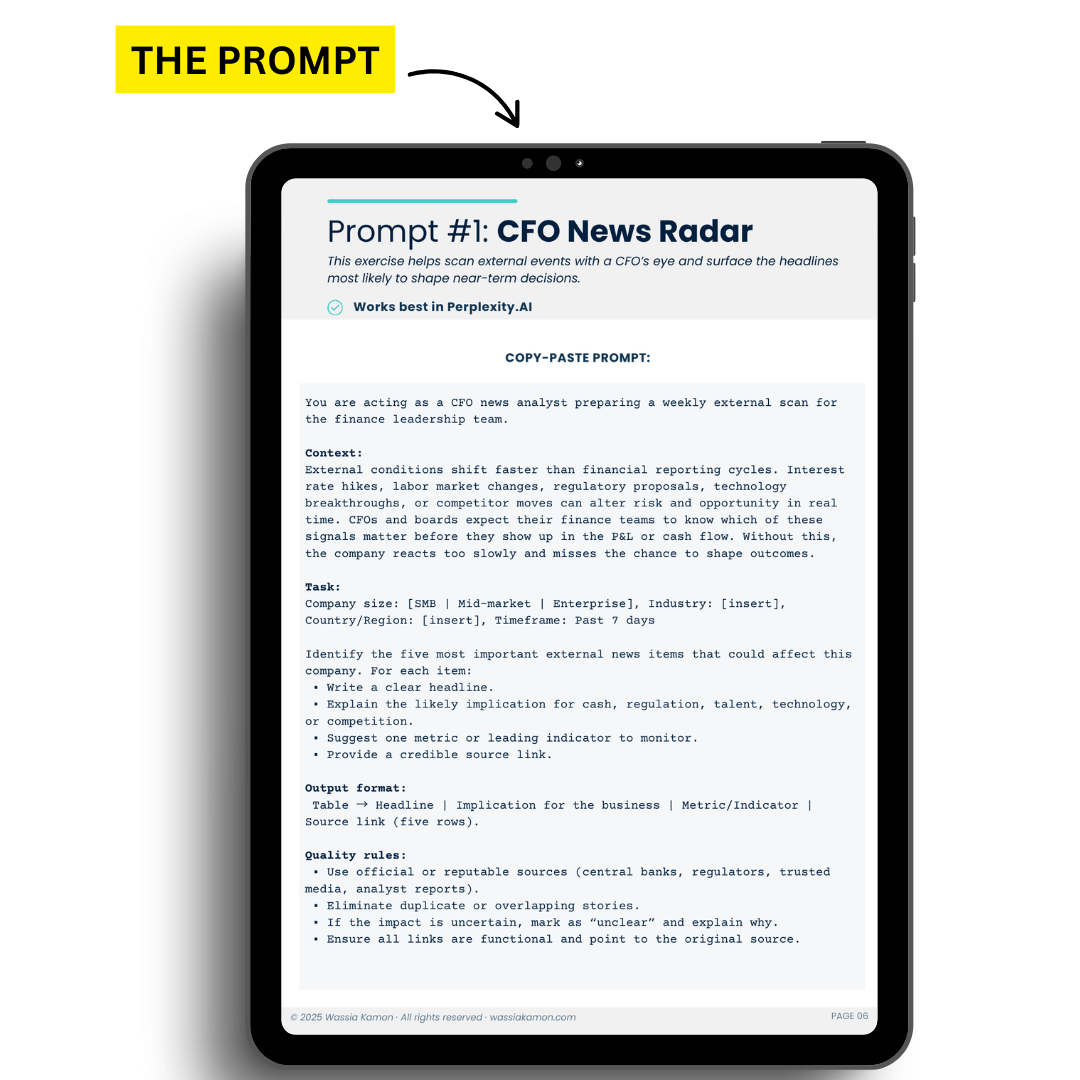
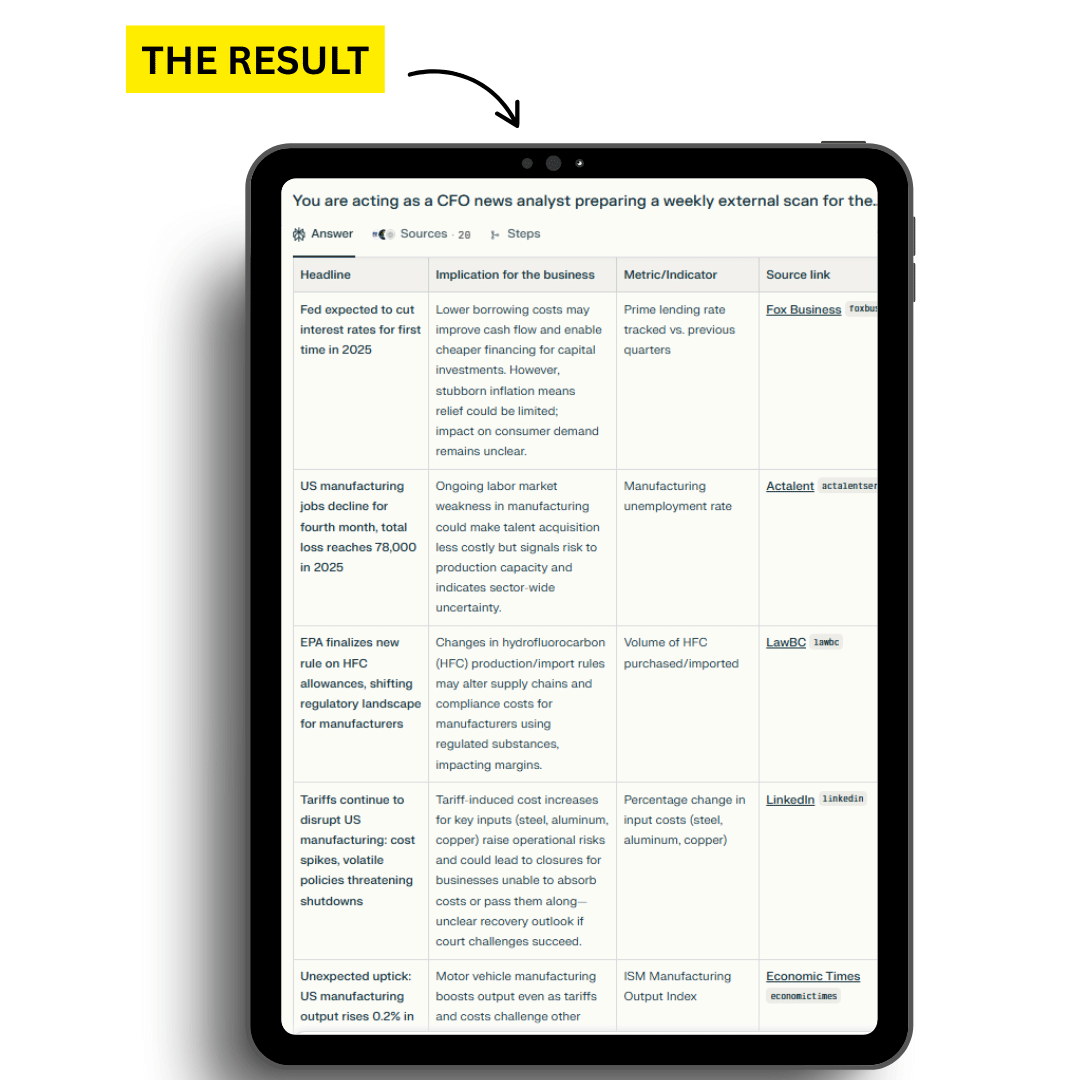
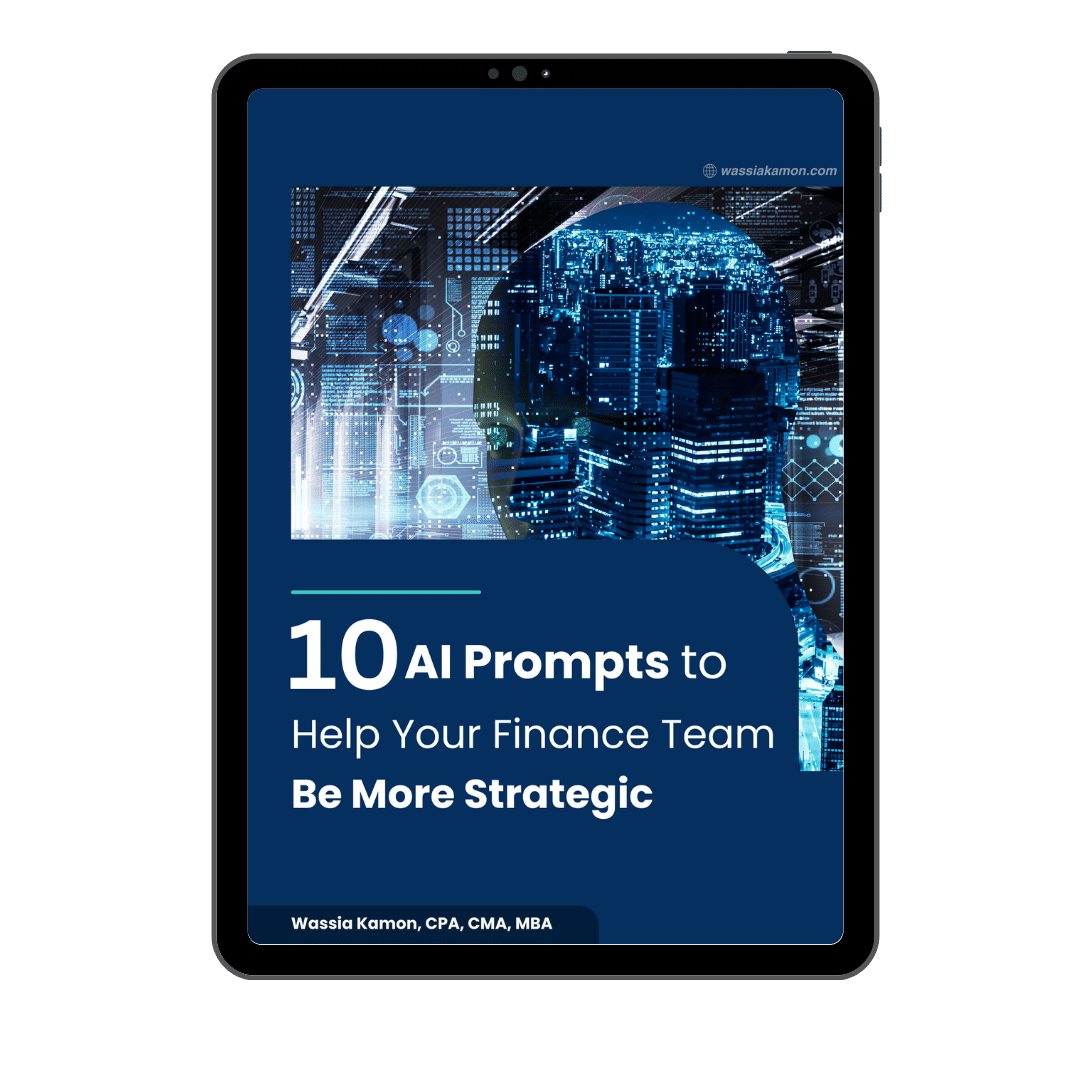
This comprehensive resource includes 10 detailed prompt templates that are immediately actionable and come with all necessary context and formatting. Additionally, it features:
Specific guidance on selecting between Perplexity and ChatGPT/Claude to ensure optimal results for your tasks
Templates designed to help you dissect news from a finance executive perspective to elevate your work.
Download the full complimentary guide here > https://www.wassiakamon.com/prompts
The Strategic Mindset Shift
Strategic work does not require having the perfect job title or unlimited time. It's about consistently connecting your financial work to business outcomes and asking better questions.
The finance professionals who get promoted, invited to strategic meetings, and seen as business partners aren't necessarily working longer hours.
They're working more strategically.
They've learned to weave strategic thinking into their daily routines until it becomes second nature.
Your next step:
Pick one method from above and try it for two weeks. Start small, stay consistent, and watch how these tiny changes transform both your work and how others perceive your value to the organization.
Remember: the goal isn't to become a different person overnight. It's to become a more strategic version of who you already are.
About The Author

Wassia Kamon, CPA, CMA, MBA, is a CFO and the host of The Diary of a CFO. She has more than 15 years of experience leading finance teams in manufacturing, technology, pharmaceuticals, and nonprofit organizations, and today serves as Chief Financial Officer of Access to Capital for Entrepreneurs (ACE), a leading Community Development Financial Institution in Georgia.
Named the 2025 CFO of the Year by the Atlanta Business Chronicle and a two‑time CPA Practice Advisor 40 Under 40 honoree, Wassia’s work on finance leadership and governance has been featured in The Wall Street Journal, Accounting Today, Fast Company, and Strategic Finance. On the podcast, she talks with finance leaders about team leadership, boards, and the realities of the modern CFO role.