
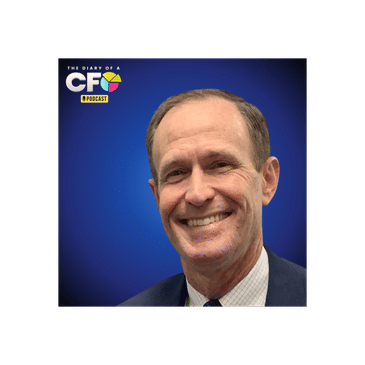


In this episode of The Diary of a CFO, we examine what it actually takes to build a 30-year career at a Fortune 50 company and reach the Group CFO seat. Dave DeFreitas, retired Group CFO of Caterpillar Inc., shares the career moves, leadership frameworks, and operational mindset shifts that shaped one of the most distinctive finance trajectories in corporate America.
What Leadership Skills Does It Take to Reach the Top of a Fortune 50 Finance Organization?
Reaching the Group CFO level at a company like Caterpillar is not just a function of technical excellence. It requires breadth of experience across functions, the ability to lead people at every stage of their development, and a willingness to take roles that build perspective rather than just seniority.
In this episode of The Diary of a CFO, Wassia Kamon speaks with Dave DeFreitas about the 32-year career path that took him through 18 different roles at Caterpillar, from internal audit to managing a product line across three UK manufacturing facilities to Group CFO and acting Chief of Staff to the Corporate CFO. Dave also draws on his experience as a university professor and board member to talk about how finance education and team development need to evolve for the AI era.
This episode is for finance professionals who want to understand what separates a long, high-impact career from a technically competent but stagnant one, for leaders who want practical frameworks for developing teams and leading change, and for anyone navigating the pressure to adopt AI without losing the business judgment that makes technology useful. Listeners will leave with actionable frameworks on situational leadership, value stream mapping, and how to build the right relationship with AI as a finance professional.
Why This Episode Matters
If you are unsure whether a lateral move will help or hurt your career, this episode makes the case for breadth with more clarity than almost any other conversation on the topic.
If you lead teams at different stages of experience, the situational leadership framework in this episode offers a practical model for adjusting your approach to get the best from every person.
If your organization is pushing AI adoption without a clear process foundation, this episode provides a grounded, tools-based approach for figuring out where technology actually belongs.
Key Takeaways
Lateral moves early in a career build the cross-functional fluency that makes senior finance leaders genuinely valuable. Seven different roles in six years at Caterpillar preceded a decade of rapid promotion.
Situational leadership means matching your approach to where each person is in their development, from directive with new hires to full delegation with experienced experts. Using the same style across a team leaves capability on the table.
Leading an improvement is fundamentally different from managing a change. When people can see that a new process removes their own pain points, they want it as much as you do.
AI augments the human. It does not replace the need to understand how the business works, why it works that way, and how to ask a question precisely enough to get a useful answer.
Questions This Episode Answers
What are the career moves that most reliably build a path to the CFO seat at a large company?
How do you lead people who are older, more experienced, or more skeptical than you are?
What is situational leadership and how do you apply it across a finance team?
How do you get resistant teams to embrace process change and new technology?
How should finance professionals prepare themselves and their teams to work effectively with AI?
Why Lateral Moves Build Better CFOs Than Straight-Line Promotions?
The fastest path to the Group CFO seat at Caterpillar ran through seven different roles before the first promotion. That breadth, spanning internal audit, inventory accounting, P&L coordination, budgeting, and cost accounting, built something a direct climb rarely produces: a deep understanding of how a company actually works and why it works that way. When the opportunity came to lead an entire UK product line including engineering, manufacturing, design, and marketing, it was that cross-functional fluency that made the two-level promotion possible, not technical depth in any single area.
The insight this unlocks for senior finance leaders is practical. The person who has only ever done FP&A asks different questions than the one who has spent time in operations. The CFO who has sat across from a customer whose harvest failed because of a product defect thinks differently about warranty spend than one who has only seen it as a cost line. That widened perspective is what allows finance leaders to step back with a struggling team and ask what the right destination looks like before mapping the route.
How Do You Apply Situational Leadership Across a Finance Team?
Different people on the same team need to be led differently, and applying one style to everyone is one of the most common ways leaders underperform. The situational leadership framework maps four zones to four approaches. A new hire needs direction and clear steps. Someone six to nine months in who is losing confidence needs a mix of direction and coaching. A capable employee facing an unfamiliar project needs to be pushed to form their own plan and bring it back for discussion. An experienced expert needs agreed-upon goals, full delegation, and a leader who removes obstacles rather than adds oversight.
The real test comes when the experienced person on your team is older than you, has been doing the job longer than you have been at the company, and makes no secret of their skepticism. The right response is not to prove authority but to agree on what done looks like, get out of the way, and show up when it counts. That consistency, being present at the moments that matter and absent at the moments that do not, is what earns trust across a team where experience and tenure vary widely.
How Do You Lead Finance Teams Through Process Change and AI Adoption?
The most durable approach to process change starts before any technology decision is made. Value stream mapping asks every step in a process to justify itself: what does it cost, what value does it generate, and what would happen if it changed or disappeared? When that analysis surfaces the steps that people actually hate doing, the conversation about automation shifts. Resistance melts when the improvement being proposed directly addresses the pain people have been living with for years.
The same logic applies to AI. The question worth asking is not what tasks AI can automate but where AI can make the human more effective. That requires knowing the business well enough to ask a precise question, and knowing the answer well enough to recognize when the output is wrong. A finance professional who can triangulate an AI output against six related metrics, and who knows that an inventory turns figure of nine is impossible given everything else they know, is far more valuable than one who simply runs queries and reports what comes back. AI handles the noise; the human still has to know what signal looks like.
Resources Mentioned
Guest: Dave DeFreitas, Retired Group CFO, Caterpillar Inc.; Retired Chief Revenue Officer, TADA Cognitive Solutions; Board Member, Bradley University College of Business and Engineering
Frameworks: Situational Leadership, Value Stream Mapping, Activity-Based Costing, Social Styles Assessment
CFO Readiness Assessment: diaryofacfo.com
Subscribe to the Finance Executive Track newsletter for actionable insights to become the obvious choice for top finance roles and thrive once you get there
https://the-finance-executive-track.kit.com/signup
Download the free guide on AI prompts every finance leader needs:
https://www.wassiakamon.com/prompts
If you liked this episode, listen next to:
Learn more about Wassia Kamon and The Diary of a CFO at thediaryofacfo.com.
About The Diary of a CFO
The Diary of a CFO is a podcast about modern finance leadership, hosted by award‑winning CFO Wassia Kamon. The show is for current CFOs, emerging finance leaders, FP&A professionals, and founders who work closely with finance teams.
Each episode explores how CFOs and senior finance executives build high‑performing finance and FP&A teams, partner with CEOs, boards, and capital providers (banks, PE/VC, and impact lenders), and navigate growth, regulation, and transformation without burning out.
TRANSCRIPT
[00:00:00] As you move from accounting outside to operations, what are some things that had to change maybe in your mindset or in your habits? You know, the old saying you had to spend money to make money. Well, it really is true, and, and that was one of the things I had to change my perspective. Going to finance at such a high level, at such a young age, like what did you also have to change to lead effectively?
So you have to be more directive in your approach and less coaching. In nature. So what would you say are some of the things that you know, CFO and finance leaders need to be aware of? First of all, find places where AI can augment the human. Welcome back to the Diary of a CFO podcast. I'm your host. Wassia Kamon.
I'm A CFO with a background in accounting and FPNA and I started this show to talk about what leading finance really looks like and what it takes to become a modern CFO. Each week we explore how today's top finance leaders build high performing teams, partner with CEOs and boards. And lead through growth and [00:01:00] transformation without burning out in the process.
Today I'm super delighted to have with me Dave DeFreitas. Dave is a retired group, chief Financial officer of Caterpillar Inc. And a retired Chief Revenue Officer at Tata Cognitive Solutions. He's a high impact leader with a unique combination of expertise in business leadership and financial management.
Directing senior business leaders and strategizing paths forward. Fun fact, Dave has been my mentor for now close to three years. He was voluntold into that role and he has been a member of our personal board of directors ever since. Super excited to have you here. Welcome to the show, Dave. Thank you.
It's great to be here. Awesome. I just wanna dive in straight because you spent over 30 years at Caterpillar and you ended up as group CFO. When you look back, what are, um, three things you will say really made the difference for you to getting to that level? Yeah, I would say, um, first and foremost it was.
Getting excited about what I do. Mm-hmm. [00:02:00] Um, you know, when you think about finance, you think about accounting. Some people kind of, oh, you really, I've gotta do that for 40 years and Yes. Uh, then retire and, and I'm gonna audit a company. Or in some cases I'm gonna do debits and credits, but it's. Find something to get excited about and embrace it and go do it.
Mm. And and frankly, if you can't find something to get excited about within the profession, then quit and go find something you can get excited about. The other thing that. As I started to go up the ladder, uh, at, at Caterpillar is I would tell some of my peers, if you have people in your group that can't get excited about your goals, your objectives, and what you're trying to accomplish, then get 'em transferred.
And I don't mean to another department within your company, get 'em transferred to your competition. 'cause they'll drain the life right out of 'em. So a nice strategy, but you know, that's kind of the first thing is, is getting excited. The [00:03:00] second thing is, um, it, it, it's know the people around you and become a sponge for what they're doing as well.
Understand how your company works and why it works the way it does, because you'll become much more valuable when you're answering questions. And doing your work. A as you bring those answers and bring that work back to others, because you'll be able to think about the bigger picture of how it all fits in and provide more value to the overall organization.
And probably the last thing, uh, is, you know, don't, uh, fear the lateral move. Mm, because that is a great way that as long as you're continuing to get new experiences, you're continuing to get good performance reviews, it'll be the way that you can learn about how that company works and why it works the way it does, and that's where you can really become more valuable.
Wow. [00:04:00] Thank you so much for sharing. And on the last one when you said, don't be afraid of lateral move, I had the lateral move too in my career. But I'm curious to hear what are some of the lateral moves you had at Caterpillar and how do you think it helped you, you know, become eventually group CFO? So that's a great question.
I had a mentor at at Caterpillar that, that frankly, he could have just kept everybody in their jobs, made them functional experts at what they were doing and could have coasted. But instead, every six months to two years, depending on the job and how long it took for the individual to learn what they needed to learn, he would move everybody.
So that they would get rotational experience, and so in my first six years at Caterpillar, I had seven different jobs before I got my first promotion. Wow. Then after that, the next six years, I went up 10 levels. I got to group CFO and, and so what that did for me, I [00:05:00] mean there were roles like I started in internal auditing, then I moved into, um, legal entity accounting, focused on inventory management.
Later I went into. Uh, profit and loss statement accounting. Uh, when we first moved from cost centers to profit centers, um, I basically coordinated the profit and loss statement for, uh, about a $2 billion entity at that time. Then I went into budgeting and coordinated the budget across that entire entity.
Then I moved into cost accounting. From those positions, uh, I learned so much about everything from manufacturing to engineering, to accounting to, um, the whole operations that later, interestingly enough, when I went to Lester England and was, um, the, uh, CFO for one of Caterpillar's product lines, um, one of the guys that I had worked with and [00:06:00] had seen me in all of those roles.
At the Aurora manufacturing facility for Caterpillar, he was now the managing director of all of the operations. Of Caterpillar uk and when he was looking for somebody to lead that entire group, he said, Dave, I think I want you. Wow. And I love to tell this story 'cause it was a two level promotion. And I said, okay, sure, no problem, I'll do that.
Um, you know, what's it involve? Oh, 650 people, three manufacturing facilities across the United Kingdom. You're gonna have engineering, design control, manufacturing, and marketing responsibilities. And the product's gonna be sole sourced out of Leicester, England. And I said, great, two level promotion, sign me up for it.
And after everybody left the room, I, you know, everybody congratulated me. I closed the door and I turned to my boss and I said, are you nuts? What do I know about engineering and marketing? And he said, Dave, you had the same mentor I did. You know how to lead. You know how to [00:07:00] manage people. You know how to lead people, and you don't have to be an expert in, say, engineering.
You have an engineering manager that knows that stuff, but what they do is sometimes they get lost. They can't see the forest for all the trees. You have the ability because you see, you know how the company works, you know why it works the way it does, to step back with them and say, let's think about this from a bigger picture.
Mm-hmm. And let's think about where we're going. In other words, what does done look like? If we have the same picture of what done looks like mm-hmm. Now we can start to plot, plot the route we're gonna take to get to that destination. And when we start to go astray, Dave, you can bring them back to get 'em back on route.
And that really was those. Jobs that we talked about, and, and, you know, later on I'll, I'll probably delve into one or two of those jobs at the staff level that was most important to that journey. Mm-hmm. But it gave me such a perspective that yes, it, it, it really [00:08:00] allowed me to have success. And those, that was the pinnacle job when I got three years out of accounting for good behavior, managing this entire product line that ultimately made me, uh, it gave me the potential and the ability.
To become a divisional CFO and later a group CFO. Mm-hmm. And, and really it, it put me in a position where some of my bosses at that time. Um, really called me the most unique CFO or divisional and then later group CFO that there was at Caterpillar because of that business experience I had beyond just finance and account.
That's awesome. And I hear a lot of people now, you know, they have like kofu titles, COO and CFO, and there's definitely value in, you know, getting that operations. You know, background and experience. So I'm curious, as you moved from accounting outside to operations, what are some things that had to change maybe in your mindset or in your habits?
Well, um, for starters, uh, [00:09:00] you know, as an accountant, it used to be okay, cut cost. I mean, when I opened my wallet mm-hmm. Okay. There were cobwebs in there because it was like the dollar bills that were in there, they, they'd been in there for decades. I was not gonna pull those out and spend them on anything uhhuh.
But I gotta tell you, your perspective changes when you're sitting across. From a farmer in his farmhouse, in his conservatory in England, and he's serving you lemonade, but while he is serving you lemonade, he's looking at you saying, do you realize your product that I bought from your company failed for me in the field and I was not able to bring in my harvest, my bales of hay, for example, to feed my animals in a timely and effective manner.
He said the failure, when he told me about it, it was actually one of the items that we had under warranty that we were thinking about doing a recall on and proactively fixing as opposed to waiting until they failed. And it caused me to think, [00:10:00] wait a minute. This is no longer about optimizing the expense.
It's about. Satisfying the customer. No. Delighting the customer to the point they want to come back and buy from me and rebuy from me, because ultimately I'm not going to maximize. My sales, my margin, my profitability. I want to optimize it. And when I say optimize it, that ultimately leads to the maximum you're gonna get.
You may spend some dollars. Mm-hmm. But you know the old saying you had to spend money to make money. Yeah. Well it really is true. And, and that was one of the things I had to change my perspective. It wasn't just about the lowest cost number. It was about. Hey, you know what does done look like? The perfectly satisfied customer, that's repeat buying, and he's out there telling all of his friends, his neighbors, his, his even competitors.
My goodness, this is my secret sauce. It's this product. But I'm buying from Dave at Caterpillar and, and [00:11:00] that spending the money in the right places to go do that was a mindset change for me. Oh, that's a, uh, I, I mean, I've got several more, one of which is sometimes, you know, there's just no good substitute for rolling up your sleeves.
And, and jumping in and being a part of the solution. You, you couldn't just come in and delegate and go, guys, we got a problem. You guys are the experts. Go do it. Sometimes you can do that, but you have to know how to lead. I learned how to lead through situational leadership, which means sometimes I need to get in with that group.
Roll up my sleeves, brainstorm with them, and, and help lead them to the solution. Again, they're the experts. Mm-hmm. But sometimes they just need somebody to come in and help them put the pieces together. And that was a lot different for me than it was of just being an accountant and saying, okay, what system am I gonna, am I gonna use to close the books and how can I be most efficient in that?
Mm-hmm. Getting really into, like you said, roll, rolling your [00:12:00] sleeves and working with your team. Um, thank you for sharing that. But there's also something like I, if I remember right, you became a divisional CFOs in your thirties and you were leading teams of hundreds of people. So in that process, not just of going from operations, uh, from accounting to operations, back to finance, but going to finance at such a high level, at such a young age, like what did you also have to change to lead effectively?
Well, and again, it comes back to that situational leadership. When I first came into, um, the divisional CFO role, I was, um, 35 years old and, um, I had six direct reports. Now this organization was about 150 people, and, and so I had staff level reporting to supervisors, reporting to division managers, reporting to then ultimately to me.
Mm-hmm. And four of the six of them were 60 years of age or older. And, um, one of them [00:13:00] actually came in for our first meeting and he had known me and I'd been with the company then about 15 years or so. Mm-hmm. And I had, might have been about, probably went in 13 years. Mm-hmm. So, um, he came into me and he, he did this when he said, I can do this.
Yeah. I can make this work. Hmm. I'm gonna do this. And then he looked up at me and I said, Dave, his name was Dave also. I said, what was that all about? And he said, you know, Dave, I've worked for people younger than me. Um, you know, I have in the past. I'm gonna be working for you now. And in the future I'll probably work for others that are younger than me, but I've just never worked for anybody younger than my son.
And so. Right then I knew, okay, how am I gonna lead somebody like this who knew me the day I walked in the door as a staff level accountant? He's in pricing parts, pricing. He's been [00:14:00] doing that job for 15 years and he'd been at Caterpillar for over 35 years, and now I've gotta lead him with an attitude like that.
Well, guess what? So situational leadership, I said I need to take him to zone four. And zone four says, you know, you work with 'em, you don't abandon them. You agree upon the objectives, but ultimately you get out of his way. He knew more about parts pricing than I ever will. Mm-hmm. Or ever would for that matter back then.
And so I said to him, I said, Dave, what do you need? And he said, I need you to stay outta my way. I know what I'm doing. I can get the job done. I've been doing it for years and just let me do my job. I said, okay, great. But. I'm gonna meet with you on a regular basis. We, we've agreed upon the goals and I wanna make sure if there are any obstacles or anything there that I'm helping you remove them.
And he said, that's great. That's, that's what I need. And he said, but you won't do that. And the reason you won't do that is because you're an accountant. I've worked for accountants before and they get busy [00:15:00] with debits and credits and closing the books and, oh wait, don't forget about your budgets. You know, you gotta roll those up.
Oh, they're so important. And whenever I need my boss, he's never there. And so you won't be either. So I remembered that. Wow. And on the rare occasion where he needed me to be in his corner when somebody was trying to make a decision that was not very good. And he knew it. And I knew it, even if it was up to the CEO of the company, I was there with him to support him.
And you know, five years after he retired, he was playing in a band and a group of people that either worked for him or worked with him. About 20, 25 of us came out to listen to him play, and at a break he came over a big smile on his face and he put his arm around me in front of everybody else. You did this with nobody else.
He just walked over me and he goes, I just wanted to let you know in all my years at Caterpillar, you're the best boss I ever had. Wow. Now, the reason I tell that [00:16:00] story is not because I was a good leader, but because when you embrace a concept called situational leadership, it really works. It makes a difference.
And it's, it just in a very simplified, summarized way. Mm-hmm. You have to understand where the person's at in their journey. Don't judge others entirely by the years and yardstick of your own experience. If you've got a new employee, they're like a dog with a bone. They're like, they're excited, they're enthused, but they don't necessarily know what to do.
So you have to be more directive in your approach and less coaching in nature. Here's what I want you to do. Here are the 10 steps. Once you get that done, come back and see me. When you get to zone two, you've got somebody that maybe has been on the job six, nine months and they're starting to go, woo, is this it?
Is this all I'm gonna be doing for the next 40 years? Um, by the way, I don't know if I'm job failing or not. I, I, I don't think I'm learning anything. Mm-hmm. [00:17:00] That's where you can, you still have to be fairly directive, but you have to step back and do more coaching and say, no, no, you know, you're doing fine.
You really are. Think about. Pause for a moment and think about where you were six to nine months ago. You didn't even know where the bathrooms were. Now you know how this works. You know how that works. You, you, you understand the 10 steps you're supposed to be working on. So it's more a combination. But when they get to zone three, it's one where you get a new project and you bring in the employee and they say, great boss, what do you want me to do?
And that's where you go, no, I want you to tell me what you think we should do. Boss. I don't know how to do that. I can't do that. I sure you can't. You've done six other projects in the last two years that are very similar to this. So go out, think about those projects, how they relate to this, when come back to me with a plan and we'll talk about it together and we'll agree upon it.
Nice. Now, it would've been easy for me in that situation to do the plan and tell 'em exactly what to do. It took more time this way, [00:18:00] but it built confidence in that employee the next time knew exactly what to do, and it builds them into then zone four, which is they know as much or more about it than I do, and I can just let 'em get out of the way and go do it.
That situational leadership, and if you build uh, like that, then you get the best staff possible. Wow. Thank you so much for this great breakdown of what situational leadership is. So you talked about zone one, they're brand new and that's when you need to be more directive. And then as you move to zone two and three, you get more into the coaching, um, and less directive.
But what about zone four? I think that's where your former employees was, was in. So with zone four, that's heavily in delegation. Okay. And so there it's. If you have a project or if there are even just common processes you agree upon, what are the objectives? Again, let's get a clear picture together. The same picture in our mind of what done looks [00:19:00] like.
Mm-hmm. And I'll give you an example. A lot of companies talk about finance transformation. I hate finance transformation, and here's why. 'cause what's it mean? It means if there are a hundred people in an audience, there are a hundred different pictures in their minds of what transformation means. Mm-hmm.
It's okay to say transformation, but you have to follow up with transformation at our company means moving from this X, Y, Z system to this new A, b, C system. And it also means taking a process that used to take two days and applying artificial intelligence to get it down to two minutes or whatever, but it everybody then has the same picture in their mind.
It's like if I said to you, Hey, we're gonna go watch a football game and we're gonna do it, uh, in September, and that's all I tell you. What are the odds we're gonna end up at Soldier Field watching the Chicago Bears play their home opener, uh, at 12 noon getting a hot dog and a beer. It, it's, it won't happen.
Yeah. But if I say, [00:20:00] Hey, we're gonna go see a football game. It's gonna be the Bears, it's gonna be on September 12th, it's gonna be at 12 noon, and we're gonna get a hot dog and a bear together and just have a great afternoon. The odds are pretty good that you and I have the exact same picture in our mind of what done looks like.
Yes. And you may take a train, I may take a plane, whatever may take a car. We may take different routes, but at least we have the same endpoint in mind. So with that zone four, you get everybody on the same wavelength and then you say, Hey, you don't even have to necessarily go over the plan with them of how they're gonna do it.
They've driven that route to that destination. So many times you just say, now that we know we're going to Chicago, hey. Joe, Bob, whoever. Um, go get us there and if, if you have a problem along the way or you have a breakdown, you got a flat tire, call me. I'll be glad to roll up my sleeves and help you fix the flat tire and help you get there.
I'll remove any obstacle you got. I'm just gonna let you drive the [00:21:00] car. Wow, this is, this is so impactful. Thank you so much for sharing. I'm curious to hear, like, how did you first learn about situational leadership? Is it something that you learned the hard way? Was it a training? 'cause I'm always curious because I realize now that you know as a CFO, as any finance leader, once you pass manager, you didn't work with people then with numbers.
99% of what you do is leadership and leading people. So I'm always, I, I really like this kind of frameworks that can help. So, curious to hear how you, how the concept probably evolved for you. Well, uh, early on. At Caterpillar when, this is way back in the late eighties and early nineties, um, when they identified people as potential leaders of other people, they had a series of training courses and you started with something called Social Styles where you really went in and you, um, learned to assess [00:22:00] other people.
Mm-hmm. And for example, I am an amiable driver. Driver is my core or foundational strength or social style, if you will. Mm-hmm. The amiable part of it is kind of a subset that basically means that I'm very task oriented and I am, if you got a list of things to do, I love to check off the boxes, get 'em done and move on.
The amiable is, um, but I tend to have. The ability to, uh, also work with people along the way. There are multiple other styles. Some people are very into what they call woo, or in other words, they're very good with other people. It's all about how they feel and how the other people feel, and they're not very task oriented.
So they're not all about getting the task done as fast and efficiently as possible. So those two social styles, just as an example, clash because I'm over there constantly going, come on, let's go, let's get it done, let's go. Mm-hmm. And if for you, if, if you were more of a woo [00:23:00] type. Person you might be, well, yeah, we'll get there.
Okay. But really, but how are you feeling? Mm-hmm. You know what, and, and let's talk a little bit about the situation. How did you feel when this project came out with this answer and this analysis? Who cares? Let's move on. So when you do that, that's step one. Step two was another training program, and it was called Situational Leadership.
And it was external training packages that Caterpillar purchased at the time and took us through. But it really did allow you to learn the difference between being a manager and being a leader. So many people think they are leaders, but in reality, managers maintain the status quo. Leaders set bold, but achievable goals, they innovate.
Okay? Um, managers use their titles and position authority. Leaders leverage their reputation and people want to follow them because they're inspired by that leader to want to do the thing that has to get done as much or more than the leader does. So it takes on [00:24:00] a life of its own and people just. Go to the de end destination.
Managers do things right. Leaders do the right things. Mm. And managers also share minimal information where leaders share as absolutely as much as they can, and managers coach the team as it exists. And this actually came from the head coach of Bradley University and their, their men's basketball team.
But he says, look, I don't coach. Players that I have, and I don't coach the team that I have, I coach. I assess their potential and then I coach the players for the players that they can be nice at the peak of their potential. And I coach the team at that same way. So I push them, mm-hmm. To accomplish and achieve more than they even thought they could possibly do.
And my last one is managers manage change. Change management. I hate it. Okay. Leaders lead improvements. [00:25:00] Okay. So you can do change leadership or you can do change management and think about this. Mm-hmm. What do people do when you talk about change? They go change. You want me to change? What? No, no, no, no.
See, they're, what I'm doing is fine. I like what I'm doing. I understand it Now. Wasa over here, she's got some problems. Maybe she used to go work on her stuff 'cause she probably needs to change. Just leave me alone and I'm, I'm doing good Uhhuh. But if I were to come forward and say if there were a way.
That you could improve the way you do your work. You probably wanna know about it, wouldn't you? Now all of a sudden the body language is, well, wait a minute. You mean you could help me? Free up some of my time from the mundane things that I don't like to do. Mm-hmm. That don't add much value and give me more time to do the things I do like to do where I can add more value.
Well, tell me more. What do I need to do? Mm-hmm. That's changed leadership and it's just one of a six ingredient recipe I've got on leading change, or sorry, leading [00:26:00] improvements as opposed to managing a change. But the first step is really getting in and talking about. Leading an improvement with the employees.
Wow. And so for you, when you think about the difference between a manager and the leader, love that definition, and then you go to the next step and think about how do you manage change versus leading the change. Leading the improvement, what would you say are some of the steps? Because right now the big change in many organizations is bringing AI.
So what do you think is happening, like if people are just seeing AI as managing a change versus leading improvements? So the short answer to that, as you lead an improvement, take ai. Mm-hmm. Um. So I, and, and, and I can even use an example. I, at one point in time had accounts payable in my organization and I had a group of employees that all of them at the staff level that were, [00:27:00] uh, running the process of accounts payable were in their late fifties, early sixties.
And they were happy with what they were doing in multiple leaders before me, had tried to get them to change their processes, put in new technologies and things of that sort, and they just wouldn't do it. I mean, they, they fought it and the whole, well, not me. I mean, you know, go talk with Mary. She's got a problem, but me, I'm fine.
So I came in a little differently because with change leadership I said, you know, okay, talk to me about your process. So we did value stream mapping and with each step in the process, not only did we cost it using activity-based costing applied to the office processes, but we then said, what's the value of each step?
And by putting a value on it, all of a sudden their pain came out. They talked about, look, we actually have to take an invoice from a supplier and manually type it into one system. And because the one system won't talk to the other system, we have to manually type it. And that's, we hate doing that. It's all of our [00:28:00] time and, and we make mistakes 'cause we're daydreaming about other right.
Time out. So now if I'm gonna put in AI or some kind of a change to their process mm-hmm. While I'm under the hood fixing the engine, I'm gonna make sure I address that. Nice. So now all of a sudden, these employees here, wait a minute, you mean you're gonna take away me having to enter the same invoice in two systems?
And I said, yes, but I'm gonna go one step farther. And we actually did this at the time with, uh, robotic process automation, um, and with bots, and we said. Not only am I gonna make it so you don't have to enter it in two different systems manually, but I'm gonna make it so you don't even have to enter it in the first system.
We're gonna let the bot read the invoice and put it in the system for you. All you have to do is go in and check it and then help process it from that point forward within our, um, uh, value stream mapping processing that we did. And all of a sudden they were on [00:29:00] board, they were ready to go 'cause they hated doing certain things.
And I said, yeah, I'm gonna change your entire process, but when I do, I'm gonna fix that problem. Now I got it. Nice, because now they want to do that improvement as much or more than I did. So that's a key part of, of getting this thing done, um, within any kind of improvement, uh, that, that you wanna make.
Yeah. Value stream, stream processing. I know you, you, you, you explained that to me when the bus at a conference. So why don't you give our listeners like a one-on-one of what it really is and what is the value of value stream processing? Yeah. So some people would say, look, uh, aren't you just talking about process mapping?
Well, not exactly. I mean, it starts with a process map. It says okay to do. This office process. Here's step one, step two, step three, step four, step five, however many steps there are, break them down into what are the manageable [00:30:00] chunks. Think of it like an assembly line, and think about it this way. If you have 10 people in your group, if you've got.
Two people that are doing, uh, step one, four people that are doing step two, uh, one person that's doing step three, et cetera, then, you know, how long does it take for those two people to do step number one? How long does it take for them to do step number two, what is the wage and benefit rate? So you cost it out.
And the next to it, you come along and if, if there is a step that's actually generating a revenue, that you're billing a customer, there's your revenue, are you getting more in revenue than the cost to do that step? Yes or no? That's the first question. If you can't put a dollar amount on the revenue you're bringing in, then use a six Sigma style approach of maybe 1 3, 9 to actually say, look, step number one is hugely valuable.
Because it feeds six other groups, the information they need or whatever. Okay, that's gonna [00:31:00] get a nine. And you go through and once you're done with that, you take it and you evaluate each step in the process and you say, step number one is something that is of high value and low cost. Alright. You know what, not only is it good that we're doing that, but we ought see if we can do more of it.
Mm. Because I'm getting a favorable margin out of it. Step number two or another step in the process is high value. We're really good at it. It's a core competency, but you know what? It's high cost it. It's costing us so much to do it that it's equal to, or maybe more cost than the value. So what can we do within that process?
Apply technology, whatever it may be. To reduce the cost. Mm-hmm. Because you wanna keep it. The next one is, it is low value, but it's, um, low cost. And in that case, you know, it's probably a distraction for your organization. Um, outsource it. There's somebody out there who probably does it [00:32:00] better. I'll give you an example, caterpillar.
Years ago, they used to hire people that actually did the janitorial services and it was noise because if. The toilets weren't clean one day. Then all of a sudden, half of the manufacturing facility where I was working got all in a lather about we gotta go, go talk to the leaders and department heads and figure out how to get more toilet paper in the bathrooms.
They said, this is distracting us from designing, manufacturing and marketing the best products in the world. Have another service like a service master or whoever come in and do that for us. If there's a problem, we call 'em up and go fix it. So it's no longer a distraction, and the last type is it's low value and it's high cost.
Try to find a way to just stop doing that. Do we even need to do that step anymore? If you absolutely have to do it, then find some way to significantly streamline it or do it as little. Uh, or as few a times as possible. And those are the four main quadrants. And once you break it [00:33:00] down, now you can attack each, you, you can find out which step is the critical process.
Mm-hmm. Uh, critical step within your process, and then tackle it. And once you get done, now you can rebalance your assembly line because what you don't wanna do. Is have step one take two hours to do the person or people in step two, maybe it only takes 10 minutes. So when they get done with theirs, they go, huh, I got an hour and 50 minutes to wait for the group in step one to get me what I need to do.
Step two. Mm-hmm. Then take some of the things that step one, the people in step one are doing and shift it and have the people in step two do it. So now each step is balanced at about 30 minutes a piece. So when the people in step two are just finishing things up, the people in step one are just getting done and feeding them their output, which becomes step two's input.
Now you've got a fully streamlined process and you've got the line rebalanced. That's when you should also step back and [00:34:00] say, Hey. Why am I doing what I'm doing, where I'm doing it today? So now you can think about world sourcing, and I'll give you an example at Caterpillar. Um, they would have owner's manuals, um, you know, parts, books, things of that sort, and okay, they're virtual now they're up in, in the cloud.
But the point is, you, you start in English because that's. Caterpillar was an American company. Over time, they started to sell into other countries and they needed to translate into French and German and Spanish, whatever. So they would hire people where their world headquarters was at that time in Peoria, Illinois to do the translations.
Wake up one day and now they're a global company. And you're like, does it, why? Why do we translate all of the, the literature that we have in Peoria, Illinois? There are a billion people in China. There are probably more people in China mm-hmm. That speak Mandarin, that also speak English than there are in Peoria, [00:35:00] Illinois.
Mm-hmm. So maybe we should do the main parts book. In English, in Peoria, and we have a group of people in China and France and Germany, et cetera, that do the translations into the local languages. It seems to be more cost effective and more efficient. So you streamline the process, you rebalance the line, then you look at why are we doing what we're doing it today?
The reason Caterpillar was, is they were a US company that added France and then a few lay years later added Germany, few and, and so all of a sudden it made sense at the time to just add one or two people for a new country. But you would've never organized that way initially if you said, bang, go from just a US company to global company overnight.
Mm-hmm. Wow. Thank you so much for sharing these great frameworks and I think they're so relevant to what we are seeing now with ai. Um, if people were using your process right, whether it is value stream processing or, and trying to understand where to go [00:36:00] next, it would be great. But now what we are seeing is we just want AI.
The push is for ai, whatever AI like is like catch up on the side. So what would you say are some of the things that, you know, CFO and finance leaders needs to be aware of? You know, whether it's mistakes to avoid or how can they prepare their team to implement AI the right way? So, you know, AI is, um, a part of an overall solution.
It's, you know, I, I used to have, uh, a friend who actually started in accounting and, and later branched off into it at Caterpillar and became a CIO for one of the divisions. And when we started talking about AI and we started talking about robotic process automation, because it's just the next stage in the evolution of technology and automation.
I, you know, think about the spreadsheet. Mm-hmm. Okay. The spreadsheet finally replaced the, what my dad had when he was in accounting at Caterpillar, a 22 column manual. [00:37:00] Um, you know, they used to take his pen and fill it in with numbers and use the old crank adding machine. So this is just the next stage.
It's not the solution. What, what I would say is, first of all, find places where AI can augment the human. What I mean by that is by itself, if the human doesn't know the right questions to ask, if they don't know how the business works, why it works the way it does, AI's gonna come back with wrong answers.
So, and everybody knows you can't just apply it across the board, it's. It'll make mistakes. Mm-hmm. But if you apply it in the right spot and in your correct processes, it will make the human more efficient. And, and I'll give you an example of, of a way to do that in a moment. It was done by a group of college students and saved, uh, a company hundreds of thousands of dollars a year.
But first and foremost, as you're talking about applying it, think about this as well. [00:38:00] A beach, what is it? You got a bunch of sand and individually each grain of sand doesn't mean much. Mm-hmm. But when you put all the grains of sand together, they become a beautiful beach. Mm-hmm. That's no different than AI or applying technology.
Once you apply it, you're gonna have to think about how do I link it together so it makes the entire process more efficient so that I can either do more with the same amount of people or do the same amount with the less amount of people. Because if, if all I do is do a bunch of ai, but I'm still employing the exact same amount of people and doing the exact same amount of work, then I haven't cut any costs.
I haven't improved any profit. Mm-hmm. So you either have to pay people less or you know less people or else you gotta get more work, you know, more business, uh, as you apply this stuff. And that's what, finding a way to connect those things together. And I give you an example. So I was working and mentoring, um, uh, a group at Bradley University group of students.
And their convergence [00:39:00] project, their senior capstone project, was to work with a company, um, that was an insurance company. And their actuarial process was extremely expensive. And they said, help us. So this is a group of, um, students where they got an accountant, they got a marketing person, they've got somebody in data and analytics.
Technology. Uh, they've got people that are more on the general management side that helps with like HR, marketing. They're all together. And so there are 10 steps in this actuarial process. Step three. Was one where because it, it was such a unique focus for this company, their actuarial science, um, employees would have to go out and do sometimes a hundred or more hours of research in multiple different, um, sources just to come back and actually write a.
So what this group did is they went in and understood all of that, and using chat GPT, they actually wrote something that would go do the research [00:40:00] into the databases for the actuarial scientist. Now, when they did it, all they did is they went in and they said, Hey, source number one has no relevance to the policy that you're trying to write.
Put it aside and, and if there were a hundred sources, it would go through in what used to take about a hundred hours for the human in about three hours, and it would boil it down to, here are the three or the five, whatever, um, sources of information that are most relevant to this policy. So now the human didn't have to do all the research to go number one, don't need that.
Number six, don't need that. Number 10, don't need that. I need number 2, 47 and 62 are the three. Uh, bits of data and information that I need to deep dive on. The human still did the deep dive. Mm-hmm. But all that work to rule out or to get through the noise and focus on what's important was done by the technology.
And it literally saved them hundreds of [00:41:00] thousands of dollars a year in, in, because of the way it was applied. They didn't apply it across the entire 10 steps. They took one and simply improved it. That's amazing. Thank you for sharing. And also, you are a university professor now, so I'm curious to, to understand how you think the curriculum needs to change, you know, in, in, in light of AI and really what the modern, um, finance organization needs.
Yeah. So I, I think there's a couple things. Um, I think the curriculum needs to become more experiential in learning, and I know that's the big buzzword. Mm-hmm. Some universities do it better than others. Okay. But when I'm talking about experiential learning in the classroom, these students need to understand how to apply all of the concepts they've learned over four or five years.
Mm-hmm. And I, I even had a student say to me, not too long ago. I learned each individual topic, um, over my first four years. Mm-hmm. But it wasn't [00:42:00] until your class when you started to say, Hey, uh, for example, financial statement ratios and evaluating the financial statements of a company. Um, we actually went in and did it.
We took a 10 k. We applied the ratios, did the calculations. Then we said, what do they mean? So you have an inventory turns of 2.41. Is it good or bad? And we really got into how you apply it, how you compare it to competitors, and then are they really competitors? Because one company maybe is more vertically integrated than another one, so that has an impact.
So it really came down to it taught them how to think and so now they understood. When they went out in the working world, not just how to do the math. Mm-hmm. And do the staff level, pull the invoices in an audit and tick and tie. Instead, they understood the questions to ask. So now if AI was gonna do that work, they could ask the right questions of AI to know that they were getting a good answer back.
So that's step one. Mm-hmm. [00:43:00] Understand how to ask the right questions and get some training because of experiential learning. The second one. And it's probably as or more important, is to learn how to triangulate meaning when you get an answer back from ai, you know, one of my mentors used to say, Freis, I don't care what the spreadsheet says.
I know you got all the formulas right, but is it the right answer? How do you know it's well, if you're good enough to know there are six other metrics that are out there and we know when they're aligned like this, it means that inventory turns in. My example should be between two and three. So if something comes back with AI and it tells me nine, I know it's wrong.
Yes. I, maybe I didn't ask the right question, but I have to deep dive 'cause it cannot be right if it comes in between two and three. I can probably move on. AI helped me. It's close enough, and by the way, some people will go, well, Dave, what if you're wrong? What if it was 2.2 and the answer came back [00:44:00] 2.2 and it's really 2.4?
Would it have changed what you were gonna do? Would it have changed your decision? If not, just move forward. It doesn't, ma, you don't have to do anymore. It doesn't matter whether it was 2.2 or 2.4. The point is you were still gonna do the project now if it really was nine, you may not do the project, it would change your decision.
Mm-hmm. So it's, it's understanding the ability to triangulate. But on the other side of it, I would say universities need to sit down. With partner companies, um, part, uh, companies that they partner with, whether it be on advisory councils or things of that sort, and say, how are your job descriptions for entry-level positions going to change?
What are the duties gonna be like when AI is fully deployed and, and technology is fully deployed? And listen to what they're saying as to, well, when we bring somebody in, they're not gonna do this, this, or this anymore. Here's a job description. Here it is right here. I'm gonna send it to you. These are going away.
Here are the new [00:45:00] things they're gonna do. Once they understand that now universities can tailor their curriculum around meeting those new job descriptions. And the reason I say that's important is 'cause I don't think a lot of employers know exactly what, how quickly. Um, that, that it's gonna move those entry level positions and exactly what they'll look like.
Mm-hmm. But they can start to get an idea and if they, um, universities stay close to their partner companies, they'll be able to see that migration and make the adjustments over the course of time. Wow. Thank you so much for sharing. That is so insightful because I remember coming out of college, um, however many years ago, 'cause I'm 39 99.
Right. Um, and I didn't feel prepared even though I graduated summa cum laude and I went into the workforce. I was like. I'm not sure I, I know how to apply. So I think with ai, like you said, we need to be more experiential. Like we need to be more practical in the curriculum to better prepare people. But I'm also curious about [00:46:00] people already in the workforce and AI is here, it's changing our job descriptions.
How. As we are in those jobs, how do you think we need to evolve the way we think? Right? Because you mentioned, um, for, for students, I'm, I'm teaching them how to better think so they can ask better questions. For someone that, you know, studied their accounting career 15 years ago and still have a good 20, 30 years in the profession, what do you think are some of the things they can do, um, to adapt and evolve with ai?
Well, um, I, I think they have to, um, again, it comes down to understanding how a company works and why the way it does. I know I, I beat that to death, but I mean, I'll give you an example. When I first started working with data scientists, um. And I had, uh, some work for them and I thought I was asking the right question.
I said, look, I need you to go in and take the last 10 years and whenever this situation [00:47:00] applied, I need to know what the variable margin was. Mm-hmm. And they said, okay, great. And we got into it. We talked about a bunch of different things, and he goes, oh, excited. And he goes, I just got one question for you.
What's variable margin and how do you calculate it? Okay. This was not an accountant, they were a data scientist. Mm-hmm. So I realized right there, okay, I have to come back and take a little different approach. 'cause I have a non accountant who I can't take for granted. They understand what variable margin is and if he hadn't asked that question, what I would've gotten back, I would've wasted a few days and he would've come back with something.
I would going, this is not verbal margin, I can't use it. Mm-hmm. And so, um, making sure you understand either who you're working with or if it's truly artificial intelligence and you're asking Claude or whatever, um, questions. Don't assume that they know what variable margin is, for example, or make sure you're asking your question in a way that will get you the right answer.
I'll give you a another, uh, short example. Uh, [00:48:00] when I was, um, a part of a team with an engineer, manufacturing a specialist, a purchasing specialist, marketing, and me as the accountant, designing a new line of wheel loader lift arms. I had the engineer tell me, so what's gonna cost less? Um, should I do this with a casting or fabrication?
And if I'd had AI today, I would've say, ah, what's the cost per pound of a, uh, fabrication or a cost per pound of a casting? Wrong question 'cause it would've come back and given me a generic answer. Problem is with fabrication, what I found out was there is a material spec called one E 5 77 and it is a lot stronger than the one E one 70.
The one E one 70 is a lot lower in cost per pound. So today I would've said, look, I know this thing based on what the engineer told me, has to be built with one E 5 77. So. What is the cost of material at the one E 5 77 [00:49:00] spec on a cost per pound basis? And if, if I've got, um, you know, one ton of material that I need or whatever, versus in a casting, oh, by the way, casting is gonna have to infuse a certain type of, um, material into the dye to avoid hot tears.
So now that I know that material, I can be more specific in what I ask for. But if I didn't know that. Then I would've asked a higher level question and I would've run with the answer and been wrong. Mm. So it's that kind of thing where the, you know, the. Accountants of the world, employees of the world have to get beyond the, I'm gonna come into work, I'm gonna plug some numbers in a spreadsheet I'm gonna do.
They really have to understand far beyond their functional discipline as to what are we in business to do and why and how does this thing work? 'cause I gotta know what question to ask ai. If I do, I'm gonna be really efficient. The company's gonna be efficient. If I don't know how to ask the right question, we're either gonna be [00:50:00] bankrupt 'cause we're gonna.
Make the wrong decisions or it's gonna cause me to have to rework it and I'm gonna be at a competitive disadvantage because it takes me way too long to get things done. Wow. Thank you so much Dave. I know we, we are coming at the end here. Um, this is so good. Like you gave like five masterclass in one episode.
So you, you, I hope you're coming back. And so my last question will be, um, wanting to know what is your favorite thing to do outside of work? So first and foremost, it's spend time with, with family. And, uh, but if I, if I set that aside, 'cause it's, uh, a lot of fun with, uh, a wife of 37 years, uh, uh, a son and a daughter who are both in their thirties, uh, very successful as well.
And now three grandsons. Uh, but you set that aside for a minute. Yeah, I, I like to, uh, I like to play golf and, and like to travel. Um, the, uh, the golf game, uh, it's. It varies in my ability to, uh, to play it well. [00:51:00] But, uh, I like to get out and enjoy it. And, uh, I do about 2,500 miles of walking or jogging, running, that type of thing each year.
Nice. And uh, so that all goes together with the golfing. You can kind of enjoy it. And then traveling, um, we've been getting into, uh, riverboat cruises and uh, ocean liner cruises and so that's a lot of fun. Oh God. And it's definitely. You know, uh, don't, uh, nobody's got a contract to be here tomorrow, so it's okay to plan for the future, but just don't forget to live for today.
Make a difference each and every day. Take a step towards your personal and professional goals each and every day. Wow. Thank you so much, Dave, from being on the show. I definitely want to, when I grew up, to be like you in so many ways. Thank you so much. Thank you. And that's it for today's episode of The Diary of a CFO podcast.
I hope you enjoyed it as much as I did. If so, don't forget to leave a review and subscribe. Dave is [00:52:00] such a great mentor. He has helped me so much to have him on my personal board of directors. Actually, one of. Seven people I have on my personal board of directors. And if you're new to the whole concept of having a personal board of directors, I strongly encourage you to look into it.
I actually wrote a guide about how you can get started and I'll leave the link in the description. It has helped many ways. I can't even begin to, uh, to explain, so definitely check it out. As always, if you have any questions, just email me at ask at the diary of a cfo.com and for deeper dive you can always visit our website.
Site the diary of a cfo.com with insightful, insightful articles. I just wrote one about the first 90 days as a CFO, as well as other good gems. So head out there and I'll see you next time.