
"When I cook that egg, I'm always thinking about how and in what way are we going to be selling that egg later," says Chris Voudouris.
As a three-time private equity CFO whose background is rooted in transaction services and PE deal-making rather than standard internal accounting, Chris approaches financial leadership with the ultimate end state in mind: exit readiness.
Starting at KPMG in audit before transitioning to transaction services and restructuring, he went on to private equity at Graham Partners before stepping into his first CFO seat in 2013. Today, Chris brings a unique buyer-and-seller perspective to running a finance organization.
Chris shared how coming up through deal-making changes the way a finance leader approaches value creation, executive alignment, and the ultimate destination of any PE-backed company: a successful exit.
Value Creation Begins with Exit Readiness
When you enter the CFO seat from the ownership side of the table, you view the business through a very specific lens. Traditional corporate finance often focuses heavily on incremental improvements and operational continuity. Private equity demands a constant focus on the end state.
"Coming in, I was always thinking about value creation," Chris explains. "Where are we going to create value, and exit readiness? Is this business prepared to be exited?"
The private equity model is straightforward in concept: buy a business, improve it, and eventually sell it to return capital to investors with a gain. But executing that model requires evaluating every decision against how a future buyer will price the asset.
That forward-looking perspective shapes how a finance team builds its processes. On the sell side, success requires having your operational story, financial history, and future projections perfectly aligned. By establishing early performance indicators that consistently predict future positive outcomes, a finance leader allows potential buyers to price the business based on future earnings potential rather than just present performance.

Evaluating the Investment: The Three Lenses for Finance Leaders
Stepping into a PE-backed CFO role comes with substantial financial upside, often tied to equity incentives and hold-cycle realizations. However, the path is rarely linear. To evaluate whether a private equity opportunity is worth taking, Chris advises leaders to look at three distinct lenses before making the leap:
The Investment Lens: Treat taking the CFO job as making a direct investment in the business. Perform thorough due diligence on the industry, the business model, and the private equity partners involved.
The Business Lens: Assess the operational reality of where you will be spending your daily life. Review the Confidential Information Memorandum (CIM), Quality of Earnings (QofE) reports, and sales diligence documents to identify structural risks and upside potential.
The People Lens: Focus intensely on the human dynamics, particularly the relationship with the CEO.
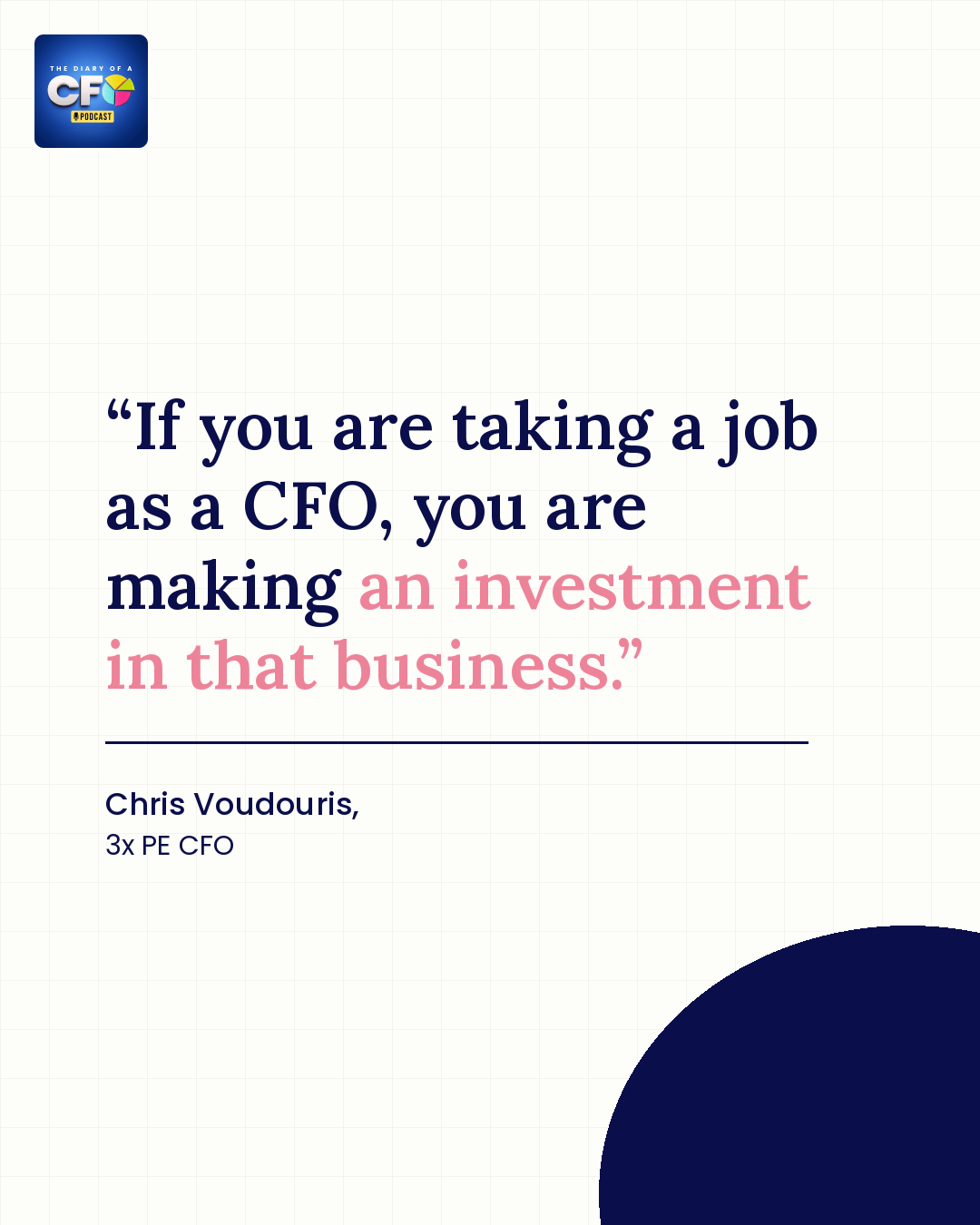
When conducting diligence on an opportunity, Chris recommends requesting key transaction documents, such as the initial investment thesis, sales diligence, and customer concentration reports. But documents alone are insufficient. Performing physical facility tours alongside the Chief Operating Officer and spending dedicated time with the Chief Commercial Officer reveals how the leadership team actually operates and where the commercial growth cycle stands.
The CFO-CEO Relationship: Sharing Bad News Quickly
In a private equity environment, the bond between the Chief Executive Officer and the Chief Financial Officer is critical. "You're in the foxhole with them," says Chris.
Building that level of trust requires two fundamental practices: meeting executives where they are and communicating with radical transparency.
Every CEO processes information differently. Some require real-time updates as events unfold, others prefer high-level strategic summaries, and some want complete autonomy until a decision threshold is reached. An effective CFO adapts their communication style to match the CEO's operational rhythm while structuring business proposals around the "why"—outlining the options, offering a clear recommendation, and explaining the strategic rationale behind it.
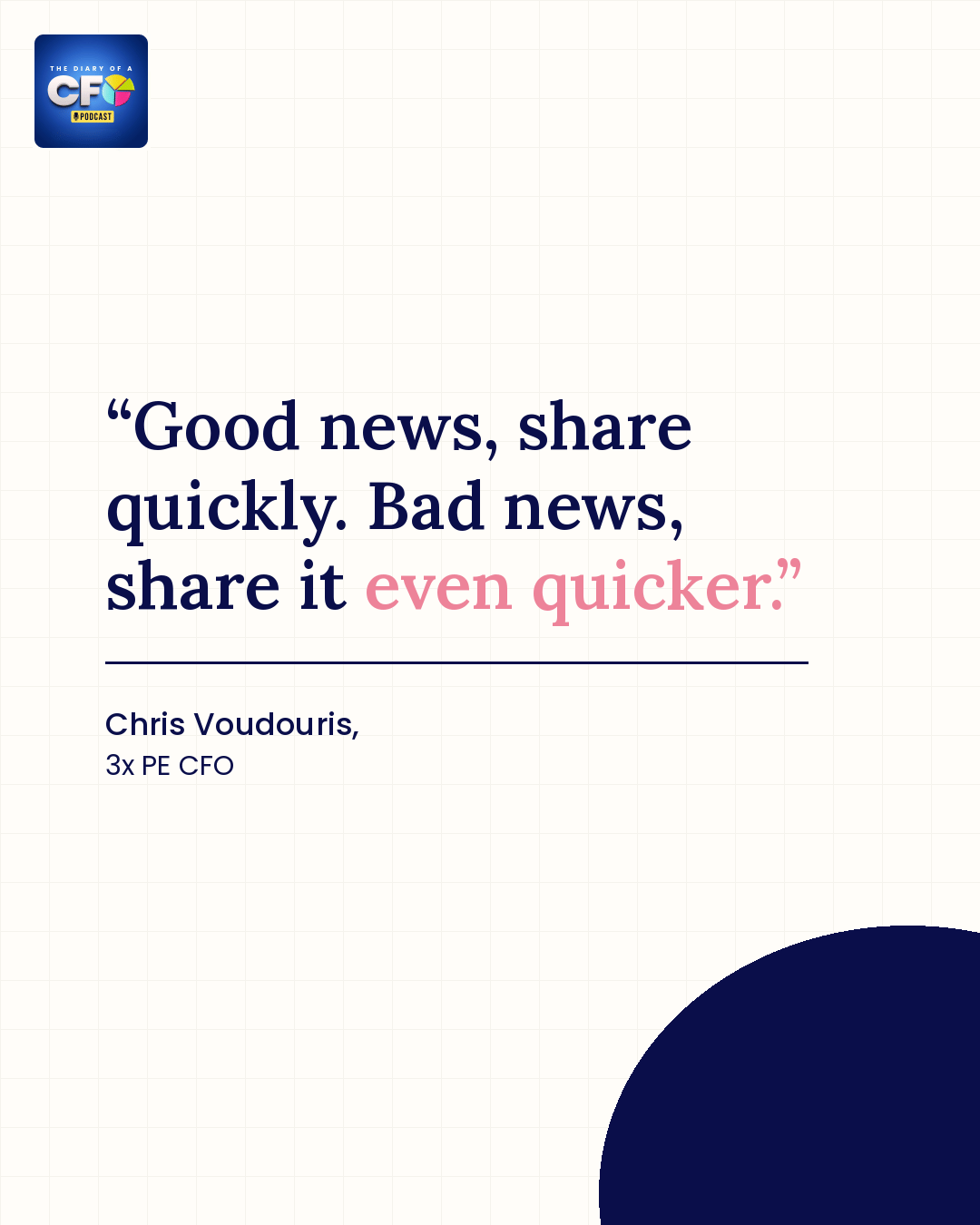
Trust is forged in moments of friction rather than periods of smooth sailing. Early in his executive career, Chris discovered a modeling error in a board-approved annual budget that accounted for roughly 15% of the projected EBITDA growth. Rather than attempting to soft-pedal the error, he went directly to his CEO to deliver the news.
"When you share those tough circumstances, you find out the true nature of your relationships," Chris reflects. By delivering bad news immediately, leaders build credibility that stands up under the pressure of tight deadlines and intense board scrutiny.
The CFO as Chief Interpreter
Beyond financial oversight, high-performing CFOs act as organizational translators. In a high-growth environment, every functional leader, from sales and marketing to operations and safety, speaks a different operational language and advocates for their own priorities.
The debits and credits of accounting serve as the universal language that unites those disparate departments.
"Finance and numbers and the debits and credits that you grew up loving is that common language for everyone," Chris explains. "And as CFO, it's your job to be chief interpreter for the organization."
By framing financial insights into clear analogies and actionable narrative points, the CFO elevates the finance function from a back-office recording department to a central strategic advisor, driving decisions based on objective operational facts.
The bottom line for Finance Leaders
Build for the exit from day one: Align financial reporting, KPIs, and operational systems around how a future buyer will evaluate and value the business.
Diligence the role like an investor: Review the Quality of Earnings report, investment thesis, customer contracts, and facility operations before committing to an executive contract.
Structure equity expectations clearly: Understand how sweat equity vestings, time-based tranches, and performance hurdles (such as MoIC and IRR targets) are defined in your agreement.
Report bad news instantly: Protect the executive partnership by surfacing financial discrepancies, model errors, and operational risks as soon as they are identified.
Act as the chief interpreter: Translate complex financial realities into simple analogies that enable cross-functional leaders to make fact-based decisions.
Succeeding in private equity requires more than just mastering debits and credits. It demands an investor mindset, absolute transparency under pressure, and the ability to turn financial data into a compelling growth narrative. For CFOs who can bridge the gap between daily execution and exit readiness, the rewards extend far beyond the balance sheet.
Frequently Asked Questions
How does a transaction services background benefit a CFO in private equity?
Coming from transaction services and the deal side equips a CFO with an ownership and exit-oriented perspective. Rather than focusing solely on internal accounting routines, a deal-experienced CFO approaches financial management with a constant focus on value creation, risk identification, and exit readiness for future buyers.
What documents should a CFO review before taking a role at a PE-backed company?
A prospective CFO should ask to review the Confidential Information Memorandum (CIM), Quality of Earnings (QofE) report, original investment thesis, and sales/customer diligence reports. Additionally, conducting site tours with the COO and meeting with the Chief Commercial Officer helps assess operational health and sales cycles.
What are the key components of equity compensation for a PE CFO?
Equity compensation (often called sweat equity) typically vests over a hold cycle and is tied to specific performance thresholds. These thresholds usually include time-based vesting tranches as well as performance hurdles based on Multiple on Invested Capital (MoIC) and Internal Rate of Return (IRR).
How should a CFO handle financial errors or unexpected bad news?
A CFO should communicate mistakes and negative operational trends to the CEO immediately. Sharing bad news early builds trust, tests the true strength of executive relationships, and gives the leadership team the necessary runway to solve problems before board-level escalations.
Listen to the Full Episode
Hear the full conversation with Chris Voudouris on The Diary of a CFO: