
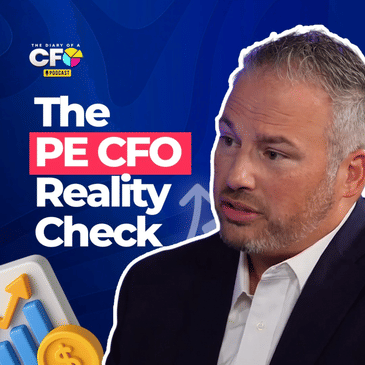
Most finance leaders think about making the jump to a private equity backed company at some point. Very few know what they are actually walking into.
In this episode, I sit down with Chris Voudouris, a 3x PE CFO who has been on every side of the table. He started at KPMG in audit, moved into transaction services analyzing deals on both the buy side and sell side, then made the leap into private equity. He has led finance at multiple PE-backed companies across different industries and moved his family to Atlanta for his first CFO role knowing nobody in the city.
We talk about what nobody tells you before you take a CFO role at a PE-backed company. The three lenses he uses to evaluate any opportunity before saying yes: the investment, the business, and the people. What documents you should be asking for before you accept the role, from the confidential information memorandum to the quality of earnings report.
How he builds trust with his CEO and why he says the foxhole relationship is everything. The budget error that wiped out 15% of projected EBITDA growth he had just presented to the board and what happened when he told his CEO immediately. Why he lives by the rule that relationship always trumps the issue.
How to be the chief interpreter of your organization as a CFO. The difference between stress that motivates and distress that destroys. And his honest advice for anyone in public accounting thinking about crossing over into PE.
Whether you are considering a move into private equity, already in a PE-backed role trying to navigate the pressure, or a first-time CFO figuring out how to evaluate your next opportunity, this conversation is the playbook.
00:00:00 --> 00:00:02 We are live in Atlanta and this is the diary
00:00:02 --> 00:00:05 of a CFO. I'm your host Wassia Kamon and I've
00:00:05 --> 00:00:07 called this city home for over two decades and
00:00:07 --> 00:00:09 it is one of the most important business hubs
00:00:09 --> 00:00:11 in the country. This is a limited series where
00:00:11 --> 00:00:14 I'm sitting down in person with CFOs and senior
00:00:14 --> 00:00:16 finance leaders right here in Atlanta to learn
00:00:16 --> 00:00:19 more about how they build their careers, what's
00:00:19 --> 00:00:21 working, what's been different about doing it
00:00:21 --> 00:00:23 here so we can get a better understanding of
00:00:23 --> 00:00:28 the humans behind the big titles. Today I am
00:00:28 --> 00:00:31 super delighted to have with me Chris Voudoris.
00:00:31 --> 00:00:34 Chris is a three -time PE back CFO. What I want
00:00:34 --> 00:00:36 to get into today is how he got there because
00:00:36 --> 00:00:38 Chris didn't come through corporate finance like
00:00:38 --> 00:00:41 most CFOs. He came up on the deal side, starting
00:00:41 --> 00:00:43 at KPMG, then transaction and restructuring,
00:00:43 --> 00:00:46 then private equity with grand partners before
00:00:46 --> 00:00:49 stepping into his first CFO seat in 2013. Three
00:00:49 --> 00:00:52 CFO seats, multiple private equity exits, a career
00:00:52 --> 00:00:56 built almost entirely inside the PE space. Super
00:00:56 --> 00:00:59 excited to have with me. today, Chris Voudoris.
00:00:59 --> 00:01:01 Chris, welcome to the show. Thank you for having
00:01:01 --> 00:01:04 me, Wassia. Of course. Always curious to hear
00:01:04 --> 00:01:07 your story about how you got into corporate finance
00:01:07 --> 00:01:09 and accounting. Yeah, sure. Well, I went to Villanova
00:01:09 --> 00:01:13 University. When I was at Villanova, I had a
00:01:13 --> 00:01:15 professor and that professor, his name was Noah
00:01:15 --> 00:01:17 Barsky, and he was my accounting professor. And
00:01:17 --> 00:01:19 he said, You know, I know you've been talking
00:01:19 --> 00:01:22 a lot about going to MIS and double majoring
00:01:22 --> 00:01:25 in finance, but forget all that. Come and do
00:01:25 --> 00:01:27 accounting. Come to the dark side is what he
00:01:27 --> 00:01:30 called it. And he said, if you do that, you can
00:01:30 --> 00:01:32 do anything you want. So I heeded his advice.
00:01:32 --> 00:01:35 I met some great people, KPMG folks. And that's
00:01:35 --> 00:01:38 what brought me on that pathway of corporate
00:01:38 --> 00:01:41 finance and accounting. Okay. And so once, once
00:01:41 --> 00:01:44 you joined KPMG, were you in audit, tax consulting,
00:01:44 --> 00:01:46 which one? Yeah, so I was fortunate enough to
00:01:46 --> 00:01:49 have an externship followed the next summer by
00:01:49 --> 00:01:51 an internship. OK, and that was all in the audit
00:01:51 --> 00:01:56 space and had some really good groups and I did
00:01:56 --> 00:01:58 audit for a couple of years. I liked it, but
00:01:58 --> 00:02:00 I didn't absolutely love it because I felt like
00:02:00 --> 00:02:03 I wanted to. be more into business insights.
00:02:03 --> 00:02:06 And that led me into the transaction services
00:02:06 --> 00:02:10 group, which is an M &A practice at KPMG in the
00:02:10 --> 00:02:14 advisory side. And I joined that in 2006, 2007.
00:02:14 --> 00:02:17 And that's what put me there. Okay. And so from
00:02:17 --> 00:02:21 being in at KPMG, what drew you towards like
00:02:21 --> 00:02:23 private equity? Because once you left Big Four,
00:02:23 --> 00:02:26 you went into private equity. Yeah. Yeah, so
00:02:26 --> 00:02:28 KPMG was great for me. In transaction services,
00:02:28 --> 00:02:31 I would assess and analyze strategic as well
00:02:31 --> 00:02:34 as financial buyers targets that they wanted
00:02:34 --> 00:02:36 to acquire. And these businesses, you saw some
00:02:36 --> 00:02:38 really good ones. You saw some not so good ones.
00:02:38 --> 00:02:41 You saw some mom and pops. I remember some businesses
00:02:41 --> 00:02:45 where. mom and pop exterminators. Another was
00:02:45 --> 00:02:48 GE Plastics was sold to Sabeck for $11 billion.
00:02:49 --> 00:02:52 So span the gambit of different sizes and different
00:02:52 --> 00:02:55 vendors who we were servicing. But as I kept
00:02:55 --> 00:02:58 doing that, I saw a lot of different businesses
00:02:58 --> 00:03:00 and I saw good ways of doing things and bad ways
00:03:00 --> 00:03:03 of doing things. But I wanted to do things. I
00:03:03 --> 00:03:05 wanted to be a part of the journey of these businesses
00:03:05 --> 00:03:09 themselves. And that's what led me to explore
00:03:09 --> 00:03:12 what else is out there. And I found Graham Partners,
00:03:12 --> 00:03:16 a private equity firm in Philadelphia. And that's
00:03:16 --> 00:03:18 what really led me to go out to private equity.
00:03:19 --> 00:03:21 Okay. And what brought you to Atlanta? A mix
00:03:21 --> 00:03:24 between opportunity and the regional interest.
00:03:25 --> 00:03:27 So I had a one year old son at this time living
00:03:27 --> 00:03:30 in Philadelphia with my wife, Melissa. And there
00:03:30 --> 00:03:34 was a business called Universal Pure. that we
00:03:34 --> 00:03:37 owned and it was operating out of Lincoln, Nebraska.
00:03:37 --> 00:03:39 And we were opening a green field operation here
00:03:39 --> 00:03:43 in the suburbs of Atlanta, Albuquerque, and when
00:03:43 --> 00:03:46 that business was going, we really needed a CFO.
00:03:46 --> 00:03:50 And I ultimately raised my hand. went through
00:03:50 --> 00:03:52 an interview process. And next thing you know,
00:03:52 --> 00:03:54 I was moving my family down to Atlanta. I knew
00:03:54 --> 00:03:57 nobody down here scared to death. Right. And
00:03:57 --> 00:04:00 my wife and I were excited though. And now we're
00:04:00 --> 00:04:04 never going to leave. Oh, good. Good. But curious
00:04:04 --> 00:04:07 to hear though. I'm glad you raised your hand,
00:04:07 --> 00:04:10 but That was your first year for all coming directly
00:04:10 --> 00:04:15 from like the deal side and most CFOs usually
00:04:15 --> 00:04:16 come from corporate accounting. They've done
00:04:16 --> 00:04:19 clothes or some type of FPNA. They've done like
00:04:19 --> 00:04:21 the budget and forecasting. You came straight
00:04:21 --> 00:04:24 from there. How do you feel that that Do you
00:04:24 --> 00:04:28 feel like actually strengthen your PE background
00:04:28 --> 00:04:30 help there or? Yeah, it's a good question. You
00:04:30 --> 00:04:32 know, I looked at it from the outside, right?
00:04:32 --> 00:04:35 From the service provider at KPMG. I looked at
00:04:35 --> 00:04:37 it from the ownership side, Graham Partners and
00:04:37 --> 00:04:40 being the private equity owner. So coming in,
00:04:40 --> 00:04:43 I was always thinking about value creation. Where
00:04:43 --> 00:04:45 are we going to create value and exit readiness,
00:04:45 --> 00:04:48 right? Is this business prepared to be exited?
00:04:48 --> 00:04:50 Because that's the private equity model. you
00:04:50 --> 00:04:52 buy a business, you're going to improve upon
00:04:52 --> 00:04:53 it, and then eventually you're going to move
00:04:53 --> 00:04:56 on and sell and return the capital back to the
00:04:56 --> 00:05:00 investors with a gain. And because I always took
00:05:00 --> 00:05:02 that view, I would say there's many different
00:05:02 --> 00:05:06 ways to cook an egg, right? There's many delicious
00:05:06 --> 00:05:10 ways to cook an egg, but ultimately somebody
00:05:10 --> 00:05:12 from corporate finance can cook an egg probably
00:05:12 --> 00:05:14 just as well as I can. I will tell you, when
00:05:14 --> 00:05:16 I cook that egg though, I'm always thinking about
00:05:16 --> 00:05:19 how and in what way are we going to be selling
00:05:19 --> 00:05:21 that egg later as well, in addition to making
00:05:21 --> 00:05:24 a delicious egg. I'd say that's kind of the unique
00:05:24 --> 00:05:27 difference and the angle that I came from, than
00:05:27 --> 00:05:28 somebody growing up from within. Did you have
00:05:28 --> 00:05:30 like a culture shock though, like coming inside?
00:05:31 --> 00:05:33 Because I have a lot of friends who went from,
00:05:33 --> 00:05:35 you know, being an auditor to coming inside going,
00:05:36 --> 00:05:38 what the heck, because they were advising and
00:05:38 --> 00:05:40 now they're doing the work. So curious to hear
00:05:40 --> 00:05:43 what your transition was like. I wouldn't say
00:05:43 --> 00:05:45 it was a shock and that's because when I was
00:05:45 --> 00:05:49 in transaction services My job was to explore
00:05:49 --> 00:05:52 these businesses to get the data get the information
00:05:52 --> 00:05:55 cut and analyze it and then say, okay What stories
00:05:55 --> 00:05:58 is it telling and then ask those stories? And
00:05:58 --> 00:06:00 if those trends made sense to the people that
00:06:00 --> 00:06:02 worked within those businesses So I spent a lot
00:06:02 --> 00:06:05 of time with those people asking them for insights
00:06:05 --> 00:06:07 and what's driving certain trends that I was
00:06:07 --> 00:06:10 seeing or circumstances and therefore I interacted
00:06:10 --> 00:06:13 with them often. I'd say that in addition to
00:06:13 --> 00:06:15 wanting to be part of that day to day, I wanted
00:06:15 --> 00:06:18 those relationships. I wanted to have those deeper
00:06:18 --> 00:06:19 relationships with the people that are part of
00:06:19 --> 00:06:22 creating the value in the business. Nice. So
00:06:22 --> 00:06:26 now you've been a CFO at different P companies
00:06:26 --> 00:06:28 now. So I'm curious to hear what you do usually
00:06:28 --> 00:06:32 in your first 90 days, like when you join a new
00:06:32 --> 00:06:35 venture. Cause I'm curious to hear. your perspective
00:06:35 --> 00:06:37 on it, because everybody has their own playbook
00:06:37 --> 00:06:39 on what they do within the first 90 days. Curious
00:06:39 --> 00:06:42 to hear yours going into a new PE. Yeah, sure.
00:06:43 --> 00:06:46 Sure. Well, I've done it a couple of times and
00:06:46 --> 00:06:49 each time I try and go in with the same approach,
00:06:49 --> 00:06:51 but also tweaking it a little bit. The first
00:06:51 --> 00:06:54 thing is just being open and welcoming. And you
00:06:54 --> 00:06:56 need to really just hear people's stories and
00:06:56 --> 00:06:58 what's going on. They've been there and you want
00:06:58 --> 00:07:00 to learn from them what they think is going on
00:07:00 --> 00:07:02 in the business before you go and jump to conclusions
00:07:02 --> 00:07:05 about what you think needs to be done. So I would
00:07:05 --> 00:07:08 say that going in with an open mindset is extremely
00:07:08 --> 00:07:11 important. And you also need to be vulnerable.
00:07:11 --> 00:07:14 You need vulnerable and confident all at the
00:07:14 --> 00:07:16 same time because Think about it. When you're
00:07:16 --> 00:07:18 making friends in the world, not just work, but
00:07:18 --> 00:07:21 just friendships, those people that open up to
00:07:21 --> 00:07:23 you and they expose themselves from a vulnerability
00:07:23 --> 00:07:26 perspective, it's healthy. It's good. And you
00:07:26 --> 00:07:29 need to find common ground. And the only way
00:07:29 --> 00:07:31 to do that is share who you are. And then I spent
00:07:31 --> 00:07:34 a lot of time on learning who they are. And that
00:07:34 --> 00:07:39 can go at different levels. I'm reminded of my
00:07:39 --> 00:07:41 last director of FP &A. When we started connecting
00:07:41 --> 00:07:45 and we were talking, we both had children. And
00:07:45 --> 00:07:47 his big thing was to go to Costco with his son.
00:07:47 --> 00:07:52 And I'm like, I love going to Costco. And we
00:07:52 --> 00:07:54 talk about it. And he's like, yeah, we go around.
00:07:54 --> 00:07:56 And next thing you know, on one of those social
00:07:56 --> 00:08:00 media type platforms, maybe it was Etsy, something
00:08:00 --> 00:08:02 pops up. And it's buying this little tray that
00:08:02 --> 00:08:05 goes into the Costco cart that you can put your
00:08:05 --> 00:08:07 hot dog and soda on while you're wheeling around.
00:08:07 --> 00:08:11 I bought that for him, right? So you need to
00:08:11 --> 00:08:14 have connection with your team. There's going
00:08:14 --> 00:08:16 to be tough times in business. And if you don't
00:08:16 --> 00:08:20 have that relationship, then it becomes tumultuous
00:08:20 --> 00:08:22 at times. And if you don't have that, you need,
00:08:22 --> 00:08:24 you're going to struggle a little bit. Okay.
00:08:24 --> 00:08:27 Now, speaking of relationships, so how you connect
00:08:27 --> 00:08:30 and relate to people when you're on the buy side
00:08:30 --> 00:08:33 versus the sell side, right? Cause you've analyzed
00:08:33 --> 00:08:36 deals like both ways. Yeah, that's correct. So
00:08:36 --> 00:08:38 what have you learned? Like what's different
00:08:38 --> 00:08:41 about maybe the culture or the people on one
00:08:41 --> 00:08:44 side versus the next? Yeah, I've done both buy
00:08:44 --> 00:08:46 side and sell side due diligence. So I've looked
00:08:46 --> 00:08:49 at it from the third party perspective from the
00:08:49 --> 00:08:51 buy side. You know, you really want the business
00:08:51 --> 00:08:54 to open up about not just their greatest successes
00:08:54 --> 00:08:56 and where things are going, but also where the
00:08:56 --> 00:08:59 biggest risks are. Because sometimes those biggest
00:08:59 --> 00:09:01 risks create the biggest opportunities as well.
00:09:01 --> 00:09:04 Ultimately get aligned on. I'm trying to create
00:09:04 --> 00:09:06 value here, and if we can create value together,
00:09:06 --> 00:09:09 we're both going to be successful. On the sell
00:09:09 --> 00:09:11 side, it's really important to have your ducks
00:09:11 --> 00:09:13 in a row, have your stories, your past, and then
00:09:13 --> 00:09:15 also where you're going. Why do you think you're
00:09:15 --> 00:09:17 going to get there? And if you're going to get
00:09:17 --> 00:09:20 there because you've accomplished it before or
00:09:20 --> 00:09:23 because you've seen performance that aligns with
00:09:23 --> 00:09:25 early indicators and those early indicators are
00:09:25 --> 00:09:28 starting to flag again, and you can prove that
00:09:28 --> 00:09:30 those early indicators were a leading indicator
00:09:30 --> 00:09:33 of what happened in the past positively. Now
00:09:33 --> 00:09:35 they can look and buy something based off of
00:09:35 --> 00:09:37 the future value, not just the present value.
00:09:38 --> 00:09:41 Okay. So selling, you really want to create as
00:09:41 --> 00:09:43 much value as you can at that time. Okay. So
00:09:43 --> 00:09:47 I hear a lot about being in PE is a lot of stress,
00:09:47 --> 00:09:50 is a lot of long hours. So curious to hear like
00:09:50 --> 00:09:53 your perspective on it. What should people really
00:09:53 --> 00:09:55 be talking about? Is it true? Like, how did you
00:09:55 --> 00:09:58 survive? Sure, sure. So I think stress can actually
00:09:58 --> 00:10:01 be a motivational tool to some extent, and there's
00:10:01 --> 00:10:04 healthy levels of it and it creates drive. Distress,
00:10:04 --> 00:10:06 however, you don't want that. You don't want
00:10:06 --> 00:10:08 situations where you cannot win no matter how
00:10:08 --> 00:10:10 hard you try, you're not being listened to or
00:10:10 --> 00:10:13 otherwise. So I think it's important that it's
00:10:13 --> 00:10:16 the right type of stress. And oftentimes, stress
00:10:16 --> 00:10:19 is a reflection of the people that you're working
00:10:19 --> 00:10:21 with. And if you're put in a situation where
00:10:21 --> 00:10:24 you guys can't win, then that stress isn't very
00:10:24 --> 00:10:26 healthy. Otherwise, I think stress is very healthy.
00:10:26 --> 00:10:29 You need to challenge yourself. come back and
00:10:29 --> 00:10:32 then go back to more stressful opportunistic
00:10:32 --> 00:10:35 situations. So being in PE, you know, we also
00:10:35 --> 00:10:37 hear, I also hear, you know, the payout could
00:10:37 --> 00:10:40 be great, but you know, the road to get there,
00:10:40 --> 00:10:42 you're not too sure. How do you navigate that?
00:10:42 --> 00:10:45 How would a finance leader think about like the
00:10:45 --> 00:10:48 debits and credits of being successful in that
00:10:48 --> 00:10:51 environment? Yeah. So you're right. It's, it
00:10:51 --> 00:10:54 is not linear. As I think about any opportunity
00:10:54 --> 00:10:56 as a CFO, You kind of have to look at it with
00:10:56 --> 00:10:58 kind of three lenses. And those three lenses
00:10:58 --> 00:11:01 are, I'd say, the investment side of it, right?
00:11:01 --> 00:11:04 If you are taking a job as a CFO, you are making
00:11:04 --> 00:11:07 an investment in that business. And that's the
00:11:07 --> 00:11:09 long -term incentive equity that you're talking
00:11:09 --> 00:11:11 about and that benefit. You need to make sure
00:11:11 --> 00:11:14 that you diligence the industry, the business
00:11:14 --> 00:11:16 that you're looking to go into, and the partners
00:11:16 --> 00:11:18 that you're looking to do it along with. And
00:11:18 --> 00:11:21 then you need to assess the business itself,
00:11:21 --> 00:11:23 right? this is my job, this is where I'm gonna
00:11:23 --> 00:11:24 be spending my time, you're gonna be spending
00:11:24 --> 00:11:27 more time with those people than you do at home.
00:11:27 --> 00:11:29 And you need to assess that just like anybody
00:11:29 --> 00:11:32 else do so. And then I'd say the last thing that
00:11:32 --> 00:11:35 you're assessing are the people, the who. And
00:11:35 --> 00:11:38 for me, the most critical thing is that relationship
00:11:38 --> 00:11:41 with your CEO. I've had some CEOs that are just
00:11:41 --> 00:11:44 spectacular, really motivational, also very understanding,
00:11:45 --> 00:11:47 friends, and I would say that they're friends,
00:11:47 --> 00:11:49 but you're in the foxhole with them. Right. And
00:11:49 --> 00:11:51 you need to build those relationships I talked
00:11:51 --> 00:11:54 about before. Yes. Those are the kind of the
00:11:54 --> 00:11:55 ways that I would assess it. Okay. But yeah,
00:11:56 --> 00:11:57 there's definitely, I wouldn't call it a pot
00:11:57 --> 00:11:59 of gold, but there's something at the end of
00:11:59 --> 00:12:02 that rainbow that is beneficial and rewarding
00:12:02 --> 00:12:05 for your time and commitment. So what are some
00:12:05 --> 00:12:07 tips there? Like what should you be looking for?
00:12:07 --> 00:12:10 Cause now, you know, in talking with most CFOs,
00:12:10 --> 00:12:12 we're talking about how your offer letter, like
00:12:12 --> 00:12:14 what are some of the things in the contract that
00:12:14 --> 00:12:16 you should be looking for security here? Like
00:12:16 --> 00:12:19 what are the the things that you usually want
00:12:19 --> 00:12:22 to have in your offer letter or your contract
00:12:22 --> 00:12:25 any any special clauses as you walk into a role
00:12:25 --> 00:12:26 in the piece. You know it's funny I haven't thought
00:12:26 --> 00:12:29 about it because it's just so normal for me right
00:12:29 --> 00:12:31 but you're typically going to find your base
00:12:31 --> 00:12:34 compensation your bonus target percentage but
00:12:34 --> 00:12:36 then you're going to have some type of equity
00:12:36 --> 00:12:38 incentive which is often referred to as sweat
00:12:38 --> 00:12:41 equity and that is equity that you earn over
00:12:41 --> 00:12:44 the period of the hold cycle of the private equity
00:12:44 --> 00:12:47 investor. There's typically some tranches to
00:12:47 --> 00:12:52 that, meaning that the equity matures or vests
00:12:52 --> 00:12:54 over a couple of different thresholds. The first
00:12:54 --> 00:12:56 is time -based, typically. So as long as you
00:12:56 --> 00:12:59 are there for a period of time, or at least there
00:12:59 --> 00:13:01 when you do sell and create realized value for
00:13:01 --> 00:13:04 your investors, that box is checked. There's
00:13:04 --> 00:13:06 typically also some hurdles that need to be accomplished,
00:13:06 --> 00:13:09 whether they be MoEC, multiple of them invested
00:13:09 --> 00:13:11 capital, two or two and a half times, sometimes
00:13:11 --> 00:13:15 even three times required. And then IRR. So what
00:13:15 --> 00:13:18 rate of return is the investor receiving? They're
00:13:18 --> 00:13:20 all different. And they can come up with many
00:13:20 --> 00:13:24 more creative ways of measuring that. But that's
00:13:24 --> 00:13:27 the equity side. Typically, otherwise, you'll
00:13:27 --> 00:13:29 have separation agreement clauses. So you'll
00:13:29 --> 00:13:32 have an expectation that if you guys decide to
00:13:32 --> 00:13:35 part ways, there'll be some kind of runway for
00:13:35 --> 00:13:38 you. And the rest kind of all comes together
00:13:38 --> 00:13:40 as you go through it together. OK. But I think
00:13:40 --> 00:13:43 my best advice is really understand the business
00:13:43 --> 00:13:46 that you're looking to join because you are making
00:13:46 --> 00:13:48 an investment. You're making an investment in
00:13:48 --> 00:13:49 that business and you're making an investment
00:13:49 --> 00:13:51 in the people that you are partnering with, your
00:13:51 --> 00:13:53 CEO and the private equity firm that owns them.
00:13:53 --> 00:13:55 And as you're trying to make that investment,
00:13:55 --> 00:13:58 what kind of questions should you be asking or
00:13:58 --> 00:14:01 documents to be able to do that? Because I feel
00:14:01 --> 00:14:03 like sometimes, especially when I'm talking to
00:14:03 --> 00:14:05 first time CFOs, they're like, oh, I wish I had
00:14:05 --> 00:14:08 asked for this. Oh, I wish I asked for this report
00:14:08 --> 00:14:10 or this. I should have asked for three out of
00:14:10 --> 00:14:12 this statement. What are some of the things you
00:14:12 --> 00:14:14 like going and say, okay, I'm going to ask this
00:14:14 --> 00:14:17 list of questions as I go in. That's a good question.
00:14:17 --> 00:14:19 I would start out with, hopefully there's a SIM,
00:14:19 --> 00:14:21 confidential information memorandum. When they
00:14:21 --> 00:14:23 went and bought the business, what was the summary
00:14:23 --> 00:14:26 of that business? It gives you the full picture.
00:14:26 --> 00:14:29 Sometimes if it's a proprietary deal where they
00:14:29 --> 00:14:31 just found this business and bought it on their
00:14:31 --> 00:14:33 own, that might not exist. You'll typically have
00:14:33 --> 00:14:36 a quality of earnings report. Oftentimes there'll
00:14:36 --> 00:14:39 be an investment thesis. on how this business
00:14:39 --> 00:14:42 was targeted and found. And I like to get that.
00:14:42 --> 00:14:44 Sometimes there's sales due diligence or contractual
00:14:44 --> 00:14:46 due diligence where the customer arrangements
00:14:46 --> 00:14:49 are reviewed. And especially if you have a high
00:14:49 --> 00:14:51 customer concentration business, you'll want
00:14:51 --> 00:14:53 to make sure that you get those contracts and
00:14:53 --> 00:14:55 just be able to look at those, see if there's
00:14:55 --> 00:14:58 some loopholes or just get the sales diligence
00:14:58 --> 00:15:00 report if there's not as much customer concentration.
00:15:01 --> 00:15:03 There's probably a multitude more. You definitely
00:15:03 --> 00:15:05 want to make sure you're doing facility visits
00:15:05 --> 00:15:08 and tours so that you to understand what that
00:15:08 --> 00:15:11 business is like and how it's viewed from the
00:15:11 --> 00:15:13 perspective of the other executives that you're
00:15:13 --> 00:15:16 going to be partnering with. So I definitely
00:15:16 --> 00:15:19 want to do facility tours with the COO. I want
00:15:19 --> 00:15:22 that individual to say, here's what I like, here's
00:15:22 --> 00:15:24 what I don't like, and here's how that all works
00:15:24 --> 00:15:26 together. You want to walk around and spend time
00:15:26 --> 00:15:29 with the CEO, understand their relationship with
00:15:29 --> 00:15:32 private equity investors. There's varying degrees
00:15:32 --> 00:15:36 of involvement by private equity shops. And where
00:15:36 --> 00:15:38 you're going to find out what that's going to
00:15:38 --> 00:15:41 be like is when times are tough, right? So you
00:15:41 --> 00:15:43 want to get some feedback on that. Commercial
00:15:43 --> 00:15:46 is huge, right? So private equity is typically
00:15:46 --> 00:15:48 investing in businesses that are growing. The
00:15:48 --> 00:15:51 intention is growth and operational execution.
00:15:51 --> 00:15:54 Well, if you're looking for growth, that commercial
00:15:54 --> 00:15:56 officer is going to be a really important person
00:15:56 --> 00:15:58 to meet with. Understanding how they're going
00:15:58 --> 00:16:00 to the market, what they look like, what their
00:16:00 --> 00:16:03 sales cycle tends to look like. Um, those are
00:16:03 --> 00:16:05 all different things that I do. Can you get a
00:16:05 --> 00:16:08 new opportunity? Okay. And then it's, it's so
00:16:08 --> 00:16:10 enlightening. I know you've been living in this
00:16:10 --> 00:16:12 world and I'm like, wow, I will never think about
00:16:12 --> 00:16:15 it. So definitely if I look at a P I would drop
00:16:15 --> 00:16:20 his contact information in happy to be involved.
00:16:21 --> 00:16:23 Thank you so much for sharing, especially on
00:16:23 --> 00:16:25 the things that you don't know. You don't know,
00:16:25 --> 00:16:28 right? Cause you had the advantage of going in
00:16:28 --> 00:16:30 that you had been on the consulting side analyzing
00:16:30 --> 00:16:32 both sides. And then you went in the CFO seat
00:16:32 --> 00:16:35 and you were able to see, okay, this is how it
00:16:35 --> 00:16:38 looks once you're inside. How do you work with
00:16:38 --> 00:16:40 the CEO? I'm curious to hear maybe what was the
00:16:40 --> 00:16:43 hardest conversation you had with the CEO because
00:16:43 --> 00:16:46 now in my seat, I realize a lot of your success.
00:16:47 --> 00:16:49 is hinge on that relationship with the CEO. That
00:16:49 --> 00:16:52 CFO CEO relationship is like everything. Yeah,
00:16:52 --> 00:16:54 that's really well said. I mentioned the foxhole
00:16:54 --> 00:16:57 before, right? I mean, you're in with other executive
00:16:57 --> 00:16:59 leaders, but you're definitely in with the CEO.
00:17:00 --> 00:17:04 And establishing that relationship is extremely
00:17:04 --> 00:17:07 critical. And I've connected with CEOs before
00:17:07 --> 00:17:09 on the fact that when we let our hair down and
00:17:09 --> 00:17:12 unwind, we like to go to Las Vegas for a casino
00:17:12 --> 00:17:15 trip, right? And we enjoy that, or music or otherwise.
00:17:15 --> 00:17:18 I've found ways to connect with those CEOs. But
00:17:18 --> 00:17:20 ultimately, as you're looking to partner with
00:17:20 --> 00:17:23 your CEO and you're bringing ideas and you're
00:17:23 --> 00:17:25 looking for opportunities within your business,
00:17:25 --> 00:17:27 you need to start with the why. It's very important
00:17:27 --> 00:17:30 to tell them why you're bringing it, tend to
00:17:30 --> 00:17:32 be what are the options at hand, and then which
00:17:32 --> 00:17:35 one you're recommending. And again, why. The
00:17:35 --> 00:17:37 why is extremely important for any CEO because
00:17:37 --> 00:17:40 they need to make their own decision on a lot
00:17:40 --> 00:17:42 of things and if you can help them to that pathway.
00:17:42 --> 00:17:44 I would also say that you need to meet them where
00:17:44 --> 00:17:47 they are and that means a lot. I don't mean just
00:17:47 --> 00:17:51 physically which is part of it but every CEO
00:17:51 --> 00:17:53 just like every individual receives things differently
00:17:53 --> 00:17:57 and some like to be informed of things very frequently
00:17:57 --> 00:18:01 as they occur. Some like to be summarized and
00:18:01 --> 00:18:04 some like to have you handle everything and tell
00:18:04 --> 00:18:05 them only when they need to know certain things.
00:18:06 --> 00:18:08 So you need to meet them where they are in their
00:18:08 --> 00:18:11 degree and they all have their pluses and minuses.
00:18:11 --> 00:18:13 Okay, so I'm curious to hear a fun story now.
00:18:14 --> 00:18:17 Any story you want to share about? CEO or your
00:18:17 --> 00:18:20 go -to move to establish that trust. Yeah. Once
00:18:20 --> 00:18:23 you get there. Cause it's some, or maybe what
00:18:23 --> 00:18:25 questions you ask before you actually want to
00:18:25 --> 00:18:27 work for a CEO. I'm just curious to hear. I did
00:18:27 --> 00:18:29 a recent post on LinkedIn about how, you know,
00:18:29 --> 00:18:32 there was a CEO, everything was kind of going
00:18:32 --> 00:18:34 okay. But then there was a fallout with the CEO
00:18:34 --> 00:18:38 and the CFO had to leave. Like he was like, you
00:18:38 --> 00:18:41 know, I need to find something else. So I'm always
00:18:41 --> 00:18:44 here to see. How can we prevent those kind of
00:18:44 --> 00:18:47 situation? Like what have you learned? Really
00:18:47 --> 00:18:51 worked. Funny stories. I mean, I remember maybe
00:18:51 --> 00:18:53 the one that lives with me the most because I
00:18:53 --> 00:18:56 was earlier in my career. I was chief cook and
00:18:56 --> 00:18:59 bottle washer on the finance function side. And
00:18:59 --> 00:19:01 I did the model for the budget for the year.
00:19:01 --> 00:19:04 And we had a good amount of growth built in.
00:19:04 --> 00:19:07 We got it approved by the board. Everything was
00:19:07 --> 00:19:09 hunky dory. And yes, I just used the word hunky
00:19:09 --> 00:19:15 -dory. And I'm looking at something later as
00:19:15 --> 00:19:18 I'm putting it into an analysis. And I was like,
00:19:19 --> 00:19:22 uh -oh. There was a savings in there that was
00:19:22 --> 00:19:25 just a model error that we had done. And about
00:19:25 --> 00:19:28 15 % of the total EBITDA growth that we had just
00:19:28 --> 00:19:30 projected to the board was just an error in the
00:19:30 --> 00:19:35 model. And the finding for me or what I found
00:19:35 --> 00:19:38 there is that Needed to go to my CEO and immediately
00:19:38 --> 00:19:40 right and just be like, hey, this is what happened
00:19:40 --> 00:19:42 This is where the error occurred and what I found
00:19:42 --> 00:19:45 is that when you share those tough circumstances
00:19:45 --> 00:19:49 It's really you find out the true nature of your
00:19:49 --> 00:19:51 relationships and also the true nature of the
00:19:51 --> 00:19:53 individuals you're working with Ended up not
00:19:53 --> 00:19:55 being a big deal, right? We work through it just
00:19:55 --> 00:19:58 fine, but you never know. So when you have a
00:19:58 --> 00:20:02 difficulty share it early And what do they say?
00:20:02 --> 00:20:04 Good news, share quickly. Bad news, share it
00:20:04 --> 00:20:06 even quicker. I would say that was kind of a
00:20:06 --> 00:20:09 little bit of a learning lesson there. Okay.
00:20:09 --> 00:20:12 Cause yeah, too. Accounting error. You're bringing
00:20:12 --> 00:20:15 back memories. You're bringing back memories.
00:20:16 --> 00:20:19 It does. It does. But I'm curious to hear for
00:20:19 --> 00:20:22 you, what's the difference between like a CFO
00:20:22 --> 00:20:24 that, you know, you just run the accounting and
00:20:24 --> 00:20:27 finance operations, but really being a CFO. That
00:20:27 --> 00:20:29 is see you actually consult when it comes to
00:20:29 --> 00:20:32 strategy, right? Like you really the right hand
00:20:32 --> 00:20:36 person and like they want you in the room versus
00:20:36 --> 00:20:38 the CFO. That's like, you know, staying your
00:20:38 --> 00:20:41 I've been very fortunate that in each of my experiences,
00:20:42 --> 00:20:44 I've been in that room. I've been in those conversations
00:20:44 --> 00:20:47 and I think it's a couple of things. One, you
00:20:47 --> 00:20:49 come into a very open minded and understand that
00:20:49 --> 00:20:52 everybody is a stakeholder at that table, trying
00:20:52 --> 00:20:54 to push a different ideation or motive or what
00:20:54 --> 00:20:56 they think is right. And you gotta hear them
00:20:56 --> 00:20:58 all because they're all good ideas. It's just
00:20:58 --> 00:21:01 a matter of which way you typically think it's
00:21:01 --> 00:21:03 best to go as a business. So I would say that
00:21:03 --> 00:21:06 open -mindedness is most important. But then
00:21:06 --> 00:21:10 I've been teased before that I always turn everything
00:21:10 --> 00:21:12 into analogies, right? I think earlier I said
00:21:12 --> 00:21:16 analogy of an egg or something like that. I had
00:21:16 --> 00:21:18 a CEO once say, My gosh all these analogies.
00:21:19 --> 00:21:20 I'm gonna create a book and then the next thing,
00:21:20 --> 00:21:24 you know Next four meetings. I said more analogies
00:21:24 --> 00:21:26 and he started writing down the book. He paused
00:21:26 --> 00:21:29 the meeting and started writing Different analogies
00:21:29 --> 00:21:33 and maybe that book will be out someday So hopefully
00:21:33 --> 00:21:36 I get some credits. Yes, but I think the point
00:21:36 --> 00:21:40 about analogies is the CFO role. It's important
00:21:40 --> 00:21:44 to be a translator because The World Cup is on
00:21:44 --> 00:21:46 right now, right? And everybody's talking. I'm
00:21:46 --> 00:21:47 like, how are they talking? Well, they're all
00:21:47 --> 00:21:49 talking English, right? Because it's that common
00:21:49 --> 00:21:53 language. I would say finance and numbers and
00:21:53 --> 00:21:54 the debits and credits that you grew up loving
00:21:54 --> 00:21:57 is that common language for everyone, whether
00:21:57 --> 00:22:00 it's the sales team or the marketing team or
00:22:00 --> 00:22:03 the operations team or the safety team or whatever
00:22:03 --> 00:22:05 it may be. Everybody has to come together in
00:22:05 --> 00:22:08 that common language. And that common language
00:22:08 --> 00:22:11 is the numbers. And as CFO, it's your job to
00:22:11 --> 00:22:14 be you know, chief interpreter for the organization.
00:22:14 --> 00:22:17 So I think the CEOs have appreciated that have
00:22:17 --> 00:22:19 been able to put it into a language that we can
00:22:19 --> 00:22:23 all comprehend and make decisions that are based
00:22:23 --> 00:22:27 on facts. Nice. Now thinking about the CFO, right?
00:22:27 --> 00:22:30 I love how you said the analogy is really the
00:22:30 --> 00:22:32 storytelling and how you make it those complex
00:22:32 --> 00:22:35 things, you know, easier to digest. So people
00:22:35 --> 00:22:37 who don't have that accounting and finance background,
00:22:37 --> 00:22:40 but then finance I realized will pick up anything
00:22:40 --> 00:22:43 that doesn't belong. Somewhere like we we get
00:22:43 --> 00:22:46 the the gifts something is new It ends up being
00:22:46 --> 00:22:50 under the CFO like HR IT like I've seen so many
00:22:50 --> 00:22:53 things Being owned by CFO. What's your take on
00:22:53 --> 00:22:57 that? Like how do you adjust? Yeah, I think it's
00:22:57 --> 00:22:59 because we touch everything You know because
00:22:59 --> 00:23:01 we're already involved in everything if something
00:23:01 --> 00:23:03 doesn't have a home Well finance is already touching
00:23:03 --> 00:23:06 it finance is already assessing that and trying
00:23:06 --> 00:23:10 to put it into a box or a situation or evaluation
00:23:10 --> 00:23:13 or a risk or an opportunity. So I think that's
00:23:13 --> 00:23:16 a little bit of the why. Does it happen often?
00:23:16 --> 00:23:19 Yes, it does. I've got some partners, you know,
00:23:19 --> 00:23:23 we're all hearing about AI, right? And some CFOs
00:23:23 --> 00:23:25 are leading the AI initiatives in their business.
00:23:26 --> 00:23:30 Others are falling within the CTO seat. I know
00:23:30 --> 00:23:32 that the most important thing is that you bring
00:23:32 --> 00:23:35 in the appropriate individuals to be a part of
00:23:35 --> 00:23:38 that team. and get their information and share
00:23:38 --> 00:23:41 it. So AI, bring in the HR department because
00:23:41 --> 00:23:42 believe it or not, there's a lot of individuals
00:23:42 --> 00:23:46 and organizations who are not adopting AI just
00:23:46 --> 00:23:47 because they're scared of it. They don't understand
00:23:47 --> 00:23:50 it and they're worried about themselves. So HR
00:23:50 --> 00:23:52 is an important partner to have at the table
00:23:52 --> 00:23:54 in an AI discussion. So you wouldn't think of
00:23:54 --> 00:23:56 that, right? That's the kind of thing that a
00:23:56 --> 00:24:00 CFO needs to do is think about who could be impacted,
00:24:00 --> 00:24:03 how and why, because they have access to all
00:24:03 --> 00:24:06 the information across the organization. Curious
00:24:06 --> 00:24:11 to hear with all your see your PE space experience
00:24:11 --> 00:24:14 and all the stuff you did when you look back
00:24:14 --> 00:24:16 What is something you will say you wish you had
00:24:16 --> 00:24:18 known on day one? I'm gonna go with a couple
00:24:18 --> 00:24:20 things. I'm gonna cheat I'm gonna say number
00:24:20 --> 00:24:23 one is relationship trumps the issue. It's it's
00:24:23 --> 00:24:25 very important to establish and maintain your
00:24:25 --> 00:24:28 relationships throughout everybody's just here
00:24:28 --> 00:24:30 to bring value to a business, succeed, right?
00:24:30 --> 00:24:33 People don't go into work and say, I want to
00:24:33 --> 00:24:35 suck at this today. It just doesn't happen. Everybody
00:24:35 --> 00:24:38 wants to do well. So it's important to maintain
00:24:38 --> 00:24:41 those relationships and build upon them. Another
00:24:41 --> 00:24:43 thing, I would say early in my career, it was
00:24:43 --> 00:24:46 very cost conscious. A lot of private equity
00:24:46 --> 00:24:49 is about growing. So you need to spend to grow.
00:24:50 --> 00:24:51 It's important that you spend the right way,
00:24:51 --> 00:24:55 right? But you need to spend. It's a little bit
00:24:55 --> 00:24:57 like the Las Vegas analogy, reference I made
00:24:57 --> 00:25:00 earlier, you need to make little bets throughout
00:25:00 --> 00:25:02 and you and your CEO are going to make little
00:25:02 --> 00:25:05 bets and you want to help on, hey, this one looks
00:25:05 --> 00:25:07 pretty good and here's why, here's the why. And
00:25:07 --> 00:25:09 then last I would just say is trust your instincts.
00:25:10 --> 00:25:12 They tend to be pretty solid and trust yourself.
00:25:12 --> 00:25:15 Okay. Now back on the little, the, you said the
00:25:15 --> 00:25:19 little bets, um, coming from like the education
00:25:19 --> 00:25:22 we have in accounting and we are, I feel like
00:25:22 --> 00:25:25 we naturally, like we naturally gravitate to
00:25:25 --> 00:25:28 a cost saving. And we don't like spending. Like
00:25:28 --> 00:25:30 you ask my husband, he will tell you, yes, I'm
00:25:30 --> 00:25:32 married to an accountant because I remember the
00:25:32 --> 00:25:35 price, the price of milk. Like I remember things,
00:25:36 --> 00:25:39 remember numbers. How, how do you make that switch
00:25:39 --> 00:25:42 though, to be able to see, yes, where, what are
00:25:42 --> 00:25:44 the risk and opportunity, the risk, but also
00:25:44 --> 00:25:46 the opportunities, right? The, the cost saving,
00:25:46 --> 00:25:49 but also where the growth could be. Yeah. Yeah.
00:25:49 --> 00:25:51 I think you're right. You know, risk avoidance
00:25:51 --> 00:25:54 is something that flows in the in the blood of
00:25:54 --> 00:25:58 any accountant it needs to be done in an individualistic
00:25:58 --> 00:26:00 approach so like to each individual opportunity
00:26:00 --> 00:26:03 identify what is the floor or what is the risk
00:26:03 --> 00:26:06 presented in this opportunity and then you can
00:26:06 --> 00:26:09 say okay well is that something i can bear is
00:26:09 --> 00:26:12 that something our organization can bear or handle
00:26:12 --> 00:26:15 and as long as the answer is yes and your upside
00:26:15 --> 00:26:17 potential is something that's really desirable
00:26:17 --> 00:26:20 or something you're looking for or aligned with
00:26:20 --> 00:26:24 your initiative then Let's dive in. By the way,
00:26:24 --> 00:26:27 we need to get your husband with my wife together
00:26:27 --> 00:26:30 because my wife's constantly telling me that
00:26:30 --> 00:26:33 it's okay that four packages from Amazon arrived
00:26:33 --> 00:26:36 at the house today. That's my husband. Is it
00:26:36 --> 00:26:39 crazy how we attract the opposite? Yeah, the
00:26:39 --> 00:26:41 opposite definitely attracts in this world, for
00:26:41 --> 00:26:44 sure. Yes, he gets more Amazon packages than
00:26:44 --> 00:26:48 I do. He does. I'm like, I'm your dream wife.
00:26:48 --> 00:26:52 You don't even know that. Yeah, I totally agree.
00:26:52 --> 00:26:54 Although thankfully my wife's buying everything
00:26:54 --> 00:26:56 for the kids. I wouldn't know where to start
00:26:56 --> 00:26:59 half the time. So give her credit for that for
00:26:59 --> 00:27:05 sure. Good, good point. Score the point. Now
00:27:05 --> 00:27:07 curious to hear, you know, what's keeping you
00:27:07 --> 00:27:09 in Atlanta now? Cause you've been, you still
00:27:09 --> 00:27:12 here. You don't have to, right? Sure. We love
00:27:12 --> 00:27:14 it from a community perspective. You know, Atlanta's
00:27:14 --> 00:27:18 this wonderful city of opportunity and the infrastructure
00:27:18 --> 00:27:20 of Atlanta, where you start with the airport.
00:27:21 --> 00:27:24 You also have the seaport. Everything kind of
00:27:24 --> 00:27:26 flows through here. It's the entire southeast
00:27:26 --> 00:27:30 and it's wonderful. My wife loves it. So that's
00:27:30 --> 00:27:32 it. That's a thing. Yeah. So we're here forever.
00:27:33 --> 00:27:36 And the community. that we've we've been able
00:27:36 --> 00:27:38 to become a part of. We're very grateful for
00:27:38 --> 00:27:41 that. We live in Smyrna, which is just outside
00:27:41 --> 00:27:43 of the city. And I would say there's a number
00:27:43 --> 00:27:46 of counties just outside of the city that are
00:27:46 --> 00:27:49 a great support system as well, whether it be
00:27:49 --> 00:27:52 our church or our schools or our friends or our
00:27:52 --> 00:27:55 little league or our dance studio, whatever it
00:27:55 --> 00:27:58 may be. We love it. And everything we want is
00:27:58 --> 00:28:02 here. So that's that's really important. I would
00:28:02 --> 00:28:06 say that when you look at Atlanta and the southeast
00:28:06 --> 00:28:08 talked about that infrastructure but there's
00:28:08 --> 00:28:11 also really good education around here oh yeah
00:28:11 --> 00:28:13 a lot of universities and i didn't know about
00:28:13 --> 00:28:15 that when i lived up in the northeast it's like
00:28:15 --> 00:28:16 oh there's the ivy league and that's that's like
00:28:16 --> 00:28:20 it and and now that i've been down here and you
00:28:20 --> 00:28:22 you know about the I don't want to name the schools
00:28:22 --> 00:28:24 because there's so many of them. But when you
00:28:24 --> 00:28:27 name the Georgia Texan, the Georges and the Emery's
00:28:27 --> 00:28:30 and the Kenesaw State, the Georgia State, the
00:28:30 --> 00:28:32 Georgia Southern, and then you think about those
00:28:32 --> 00:28:33 that are just outside of that and the entire
00:28:33 --> 00:28:37 SEC and Auburn's just down the road. And there
00:28:37 --> 00:28:41 are so many good educational communities that
00:28:41 --> 00:28:43 support. And what they do is they feed great
00:28:43 --> 00:28:47 talent into Atlanta. And that's the other key.
00:28:47 --> 00:28:49 I would say those three prongs are infrastructure,
00:28:51 --> 00:28:53 education, and then the talent. Great talent.
00:28:54 --> 00:28:57 Okay. And then what have you seen in the PE space?
00:28:57 --> 00:29:00 How do you think he had evolved in Atlanta? Or
00:29:00 --> 00:29:02 is it pretty much the same? Do you see more activity
00:29:02 --> 00:29:06 going? Because I remember when I started, I didn't
00:29:06 --> 00:29:09 see as many things around PE than recently. And
00:29:09 --> 00:29:12 I'm like, oh, what happened in the past decade?
00:29:12 --> 00:29:15 I think PE has had a focus on the Southeast more
00:29:15 --> 00:29:18 recently. I was just speaking with a firm the
00:29:18 --> 00:29:20 other day that their entire first fund was focused
00:29:20 --> 00:29:23 on businesses in the Southeast and they're doing
00:29:23 --> 00:29:26 very well for themselves. So there's just a lot
00:29:26 --> 00:29:29 of opportunity here. A lot of PE originated and
00:29:29 --> 00:29:31 was based up in the Northeast. And, you know,
00:29:32 --> 00:29:34 I want to say it was something like 70 % of our
00:29:34 --> 00:29:36 consumption in the U .S. at some point in time
00:29:36 --> 00:29:39 was all up in the Northeast. That's changed.
00:29:39 --> 00:29:41 And as that's changed, the opportunities, the
00:29:41 --> 00:29:44 businesses. Southeast is a very great, very good
00:29:44 --> 00:29:46 place to be. By the way, I go back to that infrastructure
00:29:46 --> 00:29:49 at the airport with Atlanta. You know, if you're
00:29:49 --> 00:29:51 a private equity business and you've got partners
00:29:51 --> 00:29:55 in Chicago and New York City, you want to get
00:29:55 --> 00:29:57 to your business and you want to see it and you
00:29:57 --> 00:29:59 want to help it and you help grow it. You can
00:29:59 --> 00:30:01 get on a flight and get there pretty quickly.
00:30:01 --> 00:30:03 There's a lot. Yeah, there's a lot to be said
00:30:03 --> 00:30:06 for that. OK, OK. So my last question for today.
00:30:06 --> 00:30:08 Curiously here, what is your favorite thing to
00:30:08 --> 00:30:12 do outside of work? Thank you for that question.
00:30:12 --> 00:30:15 It's got to be tied to sports. Okay, and more
00:30:15 --> 00:30:18 recently for me I've been very involved in golf.
00:30:18 --> 00:30:22 I love golf. I have a buddy group Hey, guys.
00:30:22 --> 00:30:25 And we go on a trip every year. And that's a
00:30:25 --> 00:30:27 lot of fun. And then when I'm going to relax
00:30:27 --> 00:30:31 or when I'm going to see somebody from work outside
00:30:31 --> 00:30:33 of that environment, it's a great way to separate
00:30:33 --> 00:30:36 and just get back to nature, get to a little
00:30:36 --> 00:30:38 bit of competitive environment. But that competition
00:30:38 --> 00:30:41 is against yourself oftentimes. So I love it.
00:30:41 --> 00:30:43 And that's what I do. More recently, I've also
00:30:43 --> 00:30:45 tied that into giving back to the community.
00:30:45 --> 00:30:49 We just kicked off our high school. we kicked
00:30:49 --> 00:30:51 off a middle school feeder team. So I'll be coaching
00:30:51 --> 00:30:54 the young men and ladies in their aspirations
00:30:54 --> 00:30:57 to be young golfers and eventually make the high
00:30:57 --> 00:31:00 school golf team. So I really enjoy the sport.
00:31:00 --> 00:31:03 Oh, gosh. Yeah. You you are into things that
00:31:03 --> 00:31:05 are kind of stressful. So going back to how you
00:31:05 --> 00:31:08 said earlier, you you believe that stress is
00:31:08 --> 00:31:11 not bad. I can see with your hobbies like me
00:31:11 --> 00:31:14 when I'm not working. I am Netflix saying I am
00:31:14 --> 00:31:18 eating. I'm doing things. I do like to eat a
00:31:18 --> 00:31:21 lot. I cook too. Oh, you do? I'm the cook too
00:31:21 --> 00:31:24 in my house. I enjoy it. I just need to find
00:31:24 --> 00:31:27 the time. Yeah, that too. But I'm curious to
00:31:27 --> 00:31:30 hear, though, like, when did you realize that
00:31:30 --> 00:31:32 stress was not a bad thing? Because we hear it
00:31:32 --> 00:31:34 all so often. And I'm always like, we're asking,
00:31:35 --> 00:31:36 what do you do? I'm like, man, he does a lot
00:31:36 --> 00:31:40 of stressful stuff. Yeah. I think it goes back
00:31:40 --> 00:31:44 to my roots of sports. And I would say, like,
00:31:44 --> 00:31:47 when you were When you were taught as a child,
00:31:47 --> 00:31:50 it was no pain, no gain. It was a very common,
00:31:50 --> 00:31:52 you know, and it's like, if you don't put yourself
00:31:52 --> 00:31:55 in challenging situations, you are not going
00:31:55 --> 00:31:58 to grow. You're not going to develop an athlete
00:31:58 --> 00:32:00 that I found out more about after his passing.
00:32:01 --> 00:32:03 Actually, I was just amazed by was Kobe Bryant
00:32:03 --> 00:32:07 and the amount of effort, hard work and challenge
00:32:07 --> 00:32:11 that he put into himself is unbelievable. It's
00:32:11 --> 00:32:15 it's it's such an aspiration. So, you know, Sports
00:32:15 --> 00:32:18 brings all back to me. And I think that a challenge
00:32:18 --> 00:32:21 within a business is fun. I think it creates
00:32:21 --> 00:32:25 opportunity and it also creates camaraderie just
00:32:25 --> 00:32:28 like sports. Well, thank you so much for being
00:32:28 --> 00:32:31 on the show. I learned a lot about, you know,
00:32:31 --> 00:32:32 being in PE and that's why I love this podcast,
00:32:33 --> 00:32:34 by the way, because I get to learn from people
00:32:34 --> 00:32:36 like you who have done it for so long. Thank
00:32:36 --> 00:32:38 you so much for joining me. It's my pleasure.
00:32:38 --> 00:32:40 Thank you so much for everything you do for the
00:32:40 --> 00:32:43 CFOs of today and tomorrow. Thank you. Thank
00:32:43 --> 00:32:46 you. And that's it for today's episode of the
00:32:46 --> 00:32:49 Diary of a CFO live from Atlanta series. There's
00:32:49 --> 00:32:50 something about doing this in person that you
00:32:50 --> 00:32:52 can feel from the side of the mic. If you felt
00:32:52 --> 00:32:55 that energy too, I hope you subscribe and send
00:32:55 --> 00:32:57 this to someone who needs it. See you in the
00:32:57 --> 00:32:57 next one.