
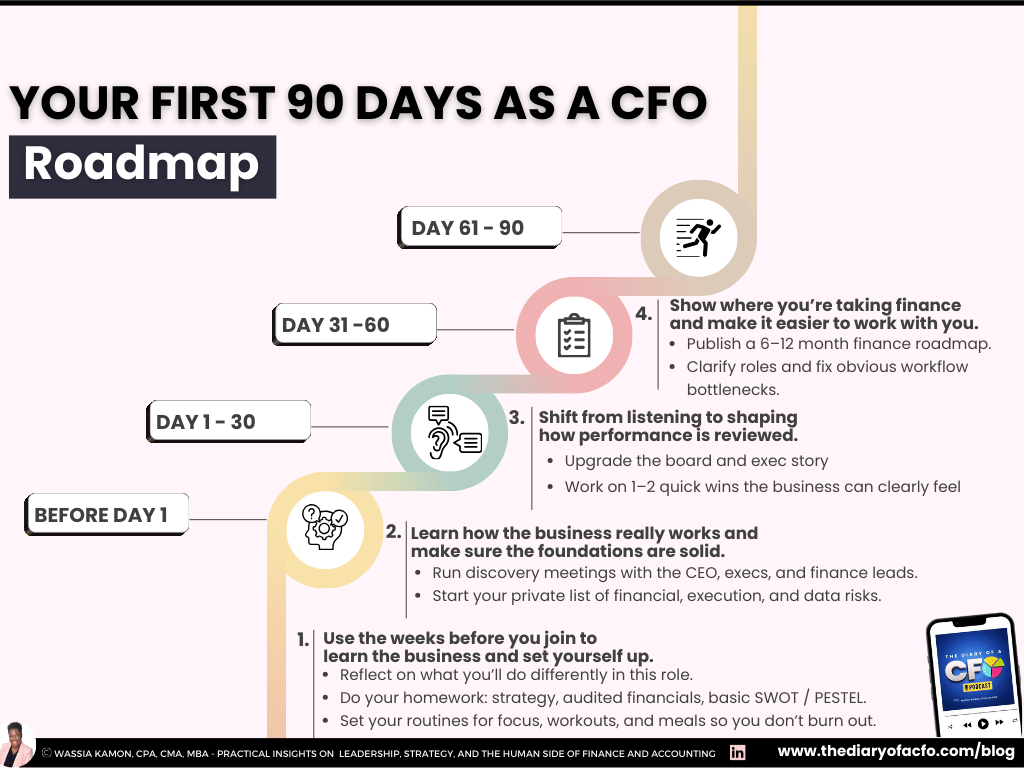

Executive Summary
A new CFO’s first 90 days should leave the company feeling, “We can finally trust the numbers and the finance leader behind them,” because you’ve spent that time learning the business, building credibility, and becoming the trusted point of reference in the midst of chaos.
To get there:
Start before day one. The 30 days between accepting the role and your first day are just as important as the 90 days themselves. Use that time to work with mentors, do your strategic homework, and get your routines in place.
Identify quick wins in your first 30 days, deliver them in days 31–60, then build a simple cadence so decisions happen faster.
Avoid early traps like trying to fix everything at once, changing too much before trust exists, or letting weak definitions persist.
This playbook is for new CFOs and anyone inheriting a finance function that urgently needs credibility and control.
If you are the a first-time CFO, check out this additional article on how to navigate imposter syndrome and other challenges first-time CFOs typically face during their first 90 days.
Getting started
In your first 90 days as CFO, you inherit numbers that already have a story.
Some of them are solid. Some of them aren’t. The problem is you don’t know which yet.
That'why the first 90 days is not the time to show how much you know.
It is the time to listen, understand, create trust, establish control of the fundamentals, and set a leadership rhythm you can sustain without burning out.
If you rush into big changes too early, you create resistance and risk.
If you move too slowly, you lose momentum and people assume you are passive.
The best CFOs thread the needle: they listen intensely, make a few visible fixes that matter, and build a decision cadence that makes performance clearer every week.
When I started as CFO, I learned this the hard way. I imposed deadlines on myself that I didn't need to.
I wanted to have the right answers immediately. But I was in my first few weeks in the role, so I had to get comfortable not having the right answers right away.
What credibility actually means in your first 90 days
CFO credibility is not a personality trait. In practice, leaders decide whether to trust you based on four things:
You act as a strategic business partner
You tell the truth without drama.
You understand what drives the business, not just the reporting.
You handle sensitive topics with maturity and control.
That is the foundation of a leadership transition plan. Your first 90 days should be designed to earn those signals repeatedly.
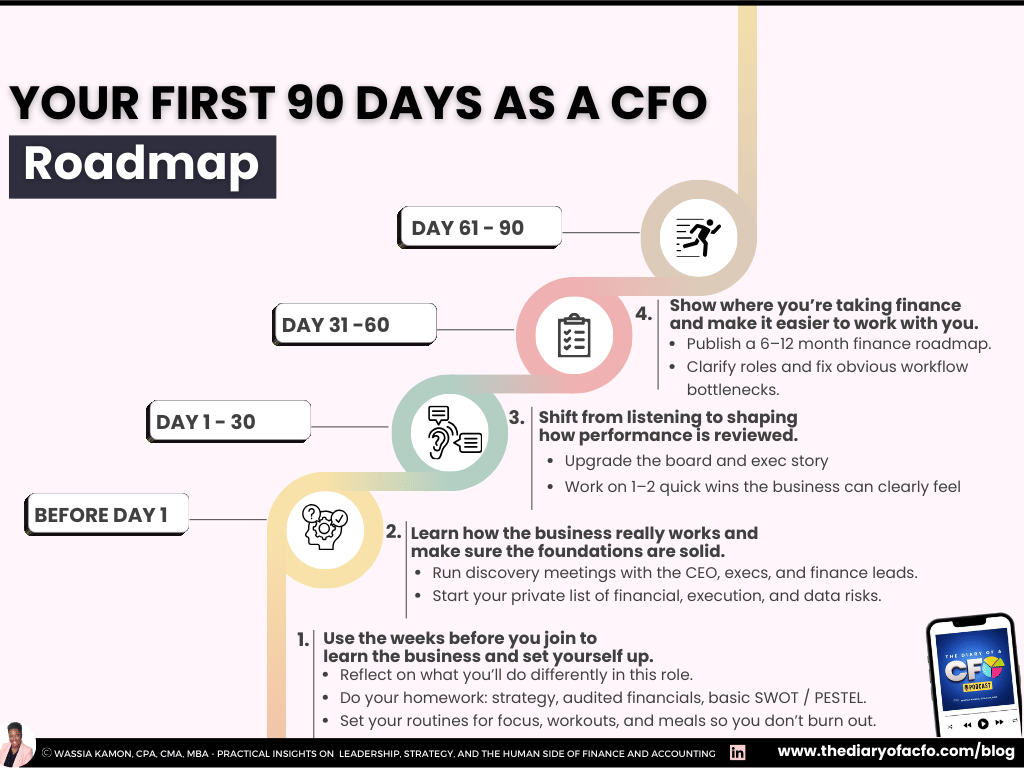
Start before day one: The 30 days that set you up for success
The 30 days before the first 90 days are just as important as the 90 days themselves.
The period between accepting the role and your first day is critical preparation time.
✅Decide what you'll do differently
Before I started as CFO, I met with my executive coach Jeannine K. Brown and my mentor Carol Naughton.
That preparation helped me stay grounded.
Carol's advice was particularly powerful:
Decide before you start what habits you won't repeat from previous roles and what you'll do instead.
For me, that meant committing to boundaries around work hours, blocking my calendar for focus time and lunch, and establishing a daily reflection practice.
✅Do your strategic homework
Use those 30 days to conduct your own analysis of the business.
Research the company, study the five-year strategic plan and audited financials, and develop initial hypotheses.
In a recent conversation with Kevin Appleby, a CFO mentor who works with hundreds of finance leaders, he walked me through strategic analysis tools that proved invaluable:
SWOT Analysis: Your initial view of the company's strengths, weaknesses, opportunities, and threats
Porter's Five Forces: What competitive pressures exist from customers, suppliers, substitutes, new entrants, and industry rivalry
PESTEL Analysis: What external factors (Political, Economic, Social, Technological, Environmental, Legal) will impact the business
Kevin told me:
"The first 90 days is all about understanding the company."
Start that understanding before day one.
Then test these assumptions in your first 30 days.
Use your one-on-ones to ask: "What do you see as our biggest opportunities? Our biggest threats?"
→ Get the full framework: The First-Time CFO Playbook with Kevin Appleby
✅Get your personal routines in order
This sounds basic, but it matters more than you think.
Before you start, lock in your calendar blocking for focus time, your workout schedule, and how you'll handle meals during the week.
I didn't take this seriously enough. Within three months, I'd gained three pounds, was eating Chick-fil-A multiple times a week, and completely fell off my workout routine. I even raided my kids' Halloween candy at out of stress.
The things you already have working well will save you. The things you don't have figured out will fall apart fast.
✅Get clear on how you'll show up
Before you walk in the door, think through how you'll introduce yourself in those first stakeholder meetings.
Not a rehearsed elevator pitch, but a clear way to talk about your background, what you care about, and how you think about the CFO role.
Next, prepare for the questions you know are coming.
What's your leadership style?
What are you planning to change?
What's your experience with whatever this company cares most about (fundraising, transformation, cost management)?
You don't need scripted answers, but you should know what you actually think.
Then make sure your online presence matches.
Your new team will Google you. They will check your LinkedIn. They will ask their networks about you.
Update your headline and summary to reflect the CFO you are now, not the finance manager you were five years ago.
For practical ways to update your LinkedIn profile for maximum impact, check out our free LinkedIn guide.
Try this in the 30 days before you start:
Meet with your executive coach or mentor to identify what habits to keep and what to change.
Conduct your own SWOT, Porter's Five Forces, and PESTEL analysis of the business.
Research the company: study the five-year strategic plan and audited financials.
Review your personal routines: what should you keep doing, stop doing or do differently to make room for the demands of your new role.
→ Listen to the full story: Behind the Scenes of My First 90 Days as CFO
Days 1 to 15: Listen hard, map reality, stabilize the basics
Your first two weeks should be heavy on listening and light on judgment.
You are collecting context and identifying where the real risks live.
✅Stakeholder map: who needs what from finance
Meet the CEO, COO, head of sales, head of product, head of operations, HR, and your controller or finance lead.
Do not treat these as intro meetings. Treat them like discovery calls.
Ask questions that reveal how decisions are made:
What are the two or three decisions you wish finance helped with more?
Where do you feel blind today?
What is the biggest finance pain point in the monthly cycle?
What is one thing that would make your life easier within 30 days?
Come to these meetings prepared!
I spent significant time before each one-on-one researching the person and preparing thoughtful questions.
Here is another great conversation with two-time CFO Matt Ziegler on how to start strong as a new CFO.
✅Ask "why" multiple times to get to truth
In my conversation with Kevin, he shared that you often need to ask "why" up to seven times to get past surface answers to real truth.
When someone says the marketing budget is overspent, the first "why" might reveal extra presentations.
The second "why" uncovers a new campaign.
By the seventh "why," you understand the strategic shift driving everything.
Just asking the why question once isn't enough.
This questioning approach transforms you from scorekeeper to business partner.
✅Stabilize the trust layer first
Before you change anything, confirm whether the fundamentals are solid:
Is the close reliable and repeatable?
Do metrics match across systems?
Are there known control gaps?
Is cash visibility trustworthy week to week?
Is the forecast credible, or just an optimistic ritual?
If any of these are weak, treat them as priority zero.
Strategy conversations go nowhere if leaders doubt the numbers.
✅Start building your risk inventory
By day 15, you should have a short, private list of:
Top financial risks (cash, margin, concentration, covenant, controls)
Top execution risks (pipeline quality, churn, delivery capacity, hiring)
Top data risks (definitions, master data, reporting delays)
This is not for broad distribution. It is your internal map so you can build your risk register.
✅Record everything to build independence fast
One practical habit that paid dividends: recording any training sessions.
When someone shows you how to access the accounting system, pull a report, or navigate internal tools, ask if you can record that portion of the meeting.
Sooner you can get that independence and be able to dig into stuff the way you want to, the better off you'll be.
This became especially valuable when my controller went on vacation a few weeks into my role.
That's why you should record those early meetings whenever possible so it is easier to leverage AI to keep track of what you learn.
Days 16 to 30: Identify wins, define your rules, start building rhythm
The next two weeks is where you start to tighten the room without making a big show of it.
✅Identify one or two wins to pursue
Based on your stakeholder conversations, identify the quick wins you'll pursue over the next 60 days. The best early wins are visible, measurable, and low risk:
A cleaner weekly cash and runway view
A simplified KPI snapshot that reduces debate
A tighter close calendar that reduces last-minute chaos
A clear forecast driver view that exposes what changed
These reduce uncertainty and friction. They do not require a reorg.
You're not delivering these yet. You're identifying what matters most and starting the work.
✅Establish operating rules that prevent repeat chaos
Without being heavy-handed, define a few rules that protect finance and the business:
A clear calendar for close and reporting
Clear owners for KPI definitions
A simple intake method for ad hoc requests
A standard way to escalate risks early
This is not bureaucracy. It is protection against noise.
Days 31 to 60: Create cadence and earn confidence
This phase is where you shift from new CFO to operating CFO.
The work becomes less about learning and more about shaping how decisions happen.
✅Work on your quick wins
Now you can identify the building blocks to deliver the one or two wins you identified in days 16 to 30.
Communicate your intentions early so the business can start feeling the difference finance is making.
✅Deliver bad news early and often
Kevin shared a case study that stuck with me.
One of his CFO mentees joined a company fresh from a fundraising round.
Within weeks of reviewing the financial model, he identified a fundamental flaw. The company would breach bank covenants in 12 months.
"One of your key roles as CFO is to tell the leadership team, tell the board that bad news as soon as possible," Kevin said.
The ability to forecast forward, spot problems early, and communicate them clearly separates good CFOs from great ones.
✅Upgrade the board narrative
Many CFOs wait too long to improve board communication because they fear rocking the boat.
You can improve narrative quality without changing the entire deck.
A simple upgrade is to begin every board or executive view with:
What changed since last time
Why it changed
What we are doing
What we need a decision on
That's the difference between presenting numbers and telling a story.
Kevin also shared something he learned from a director at PwC: ask three questions before any presentation.
What do we want them to know?
How do we want them to feel?
What do we want them to do?
The human brain can only take in three bits of information. Focus on those three things and you will be fine.
Days 61 to 90: Set the medium-term plan, align the team, scale the system
By this point, people are watching for where you are taking finance. This is when you formalize the plan.
✅Communicate a clear 6 to 12 month finance roadmap
Your roadmap should be short and practical:
Improve close reliability and cycle time
Stabilize KPI definitions and reporting
Strengthen forecast process and scenario cadence
Improve cash visibility and working capital discipline
Upgrade systems and workflows where needed
This is your leadership transition plan made visible. It tells the business you are not just reacting, you are building capability.
✅Address org design without rushing into reorganizations
Reorganizations in the first 90 days can backfire unless there is a clear performance reason.
A safer approach is:
Clarify roles and expectations first
Fix workflows and bottlenecks
Then adjust structure where it improves outcomes
If you do need to hire, prioritize roles that increase reliability and leverage:
A strong controller or close owner
A finance ops or systems leader
An FP&A leader who can drive driver-based planning
✅Improve forecasting by focusing on drivers
Most new CFOs inherit a forecast that has history and politics.
Your job is not to replace it immediately. Your job is to make it more useful and less emotional.
Start by tightening three things:
Driver clarity: what actually moves revenue, margin, and cash
Input discipline: consistent assumptions and owners
Scenario range: base, downside, and what triggers a change
You are building trust in the process, not only the output.
✅Own risk management
Kevin affirms that risk management should sit squarely with the CFO. Every company should have a decent risk register.
"We have the skills that we should be really owning risk," he said.
If half of the CFO's job is partnering and looking forward, the other half is what can go wrong.
Risk management doesn't mean eliminating risk. It means knowing what could go wrong, what mitigations you can put in place, and what you'd do if it happens.
By the end of the first 90 days as a CFO, you should better understand the business so you can feel more confident owning this area, especially if you start building your risk inventory early as mentioned above.
The 7 common mistakes that hurt new CFOs
Here are the traps that show up repeatedly:
Trying to fix everything at once.
Focus on 1-2 visible wins, not wholesale transformation.
Overcorrecting with big changes before trust exists.
Earn credibility through steady, repeatable clarity first.
Getting pulled into operational detail instead of decision framing.
As Kevin pointed out: "The role of CFO has got nothing to do with number crunching. You've probably got somebody else doing that for you."
Avoiding hard truths to stay liked early.
Deliver bad news as soon as possible.
Letting weak definitions and inconsistent metrics persist.
These cause leaders to debate reality instead of making decisions.
Being too hard on yourself.
As Kevin said, nobody is 100% ready for their first CFO role.
If you've got around 60% or so, you're going to go in there and do a good job. And you're going to have some fun while you're learning that balance of 40%.
Neglecting yourself.
I skipped workouts, relied on Chick-fil-A three times a week, had inadequate stress management.
The fastest way to lose credibility is inconsistency. The fastest way to build credibility is calm, repeatable clarity.
A simple checklist to keep you on track
By day 30, you should have reliable visibility on cash, KPIs, and forecast drivers.
By day 60, you should have delivered your first quick wins and established a clear operating cadence.
By day 90, you should have a practical roadmap for yourself and your team.
And most importantly, you should not feel burnout.
FAQs
Should a new CFO reorganize the finance team in the first 90 days?
Only if there is a clear performance or control risk. In most cases, role clarity and workflow fixes should come before structural changes.
How does a CFO build credibility with a CEO quickly?
Reduce uncertainty. Provide clear weekly visibility on cash, KPIs, and forecast drivers. Bring decisions forward with tradeoffs and recommendations.
What's the biggest mistake CFOs make in their first 90 days?
Changing too much before trust exists, or letting weak definitions and inconsistent metrics persist, which causes leadership to debate reality instead of making decisions.
How can I manage imposter syndrome as a new CFO?
Imposter syndrome is nearly universal. I certainly felt it. Kevin Appleby suggests keeping a "success diary." Write down everything you achieve, and when imposter syndrome hits, review the list.
Also, look backward at all the successes in your career. As Kevin asked: "Are you really being asked to do anything that's that much different from what you've done in the past?" You've likely business-partnered, managed projects, and solved complex problems, just not at this exact level.
→ Listen to his full advice on The Diary of a CFO Podcast: Kevin’s episode.
And read this article for more tips.
Should I meet with mentors or coaches before starting?
Absolutely. I credit my executive coach and mentors with setting me up for success before day one. They helped me identify what worked in previous roles and what not to repeat.
It takes a village to be successful in this role. Having an executive coach and being part of a community is incredibly helpful because you get practical solutions that you need.
Conclusion and next steps
Your first 90 days succeeds when leaders trust the numbers and feel like the business is in good hands.
Stabilize fundamentals first, deliver a few targeted wins, and you earn the credibility that makes bigger transformation possible later.
Be kinder to yourself than you think you need to be. The role is demanding enough without self-imposed impossible standards. I crashed at the end of every day, even when I was working just eight hours.
Try this in your first 90 days:
Come to stakeholder meetings prepared with researched questions.
Ask "why" multiple times to get past surface answers to real truth.
Record all training sessions so you can build independence fast.
Identify your quick wins in days 16-30, start work on them in days 31-60.
Want to hear these lessons in practice?
→ Behind the Scenes of My First 90 Days as CFO
I share my full story, including what I did right, what I'd do differently, and how I navigated the biggest challenges.
→ The First-Time CFO Playbook: The First 90 Days, Imposter Syndrome and Leading the Business
My conversation with GrowCFO mentor and COO Kevin Appleby about frameworks, strategies, and what actually matters in the seat.
For more CFO conversations and leadership insights, explore the Episodes library.
P.S.: If becoming a CFO is in your 5-year plan, get your free CFO Readiness Scorecard here: http://thecfo.scoreapp.com
About The Author:
Wassia Kamon is a CFO and the host of The Diary of a CFO, where she interviews finance and business leaders on strategy, risk, and leadership. She writes about finance leadership and governance in small and mid-sized organizations, including what works, what breaks, and how leaders manage growth and complexity without burning out.