


Executive Summary
Almost every first-time CFO steps into the role carrying imposter syndrome, a calendar full of expectations, and a skill gap no training program fully closes.
This article turns Kevin Appleby’s frameworks from The Diary of a CFO podcast into a practical playbook for new CFOs who want to build credibility fast and move beyond the ‘numbers person’ label.
You will learn what to do in Month 1 (listening and mapping the business), Month 2 (quick wins and stakeholder presence), and Month 3 (resetting expectations and leading the agenda).
You will leave with a practical, week-by-week sense of what to actually do in your first 90 days, and the confidence to move from feeling like an imposter to leading the agenda.
Why the First 90 Days Matter More Than Your First Budget Cycle
Most finance leaders spend years preparing for the CFO seat. Then they take the job and realize nothing in their preparation covered what the first three months actually feel like.
Kevin Appleby has mentored hundreds of CFOs through the Grow CFO program. His observation: the transition is not mainly a skills gap. It is a context gap. Three things change at once:
The work changes
The visibility changes
The person who excelled at executing someone else’s agenda now has to set their own
“You’ve been the internal face of finance, doing the monthly reporting all your career. Hang on. Suddenly you’re the external face of finance. You are where the buck stops. There’s nobody else in finance at your level.” — Kevin Appleby
The budget cycle will come. But the credibility you either establish or fail to establish in those first three months shapes every conversation you have for the next year.
Month 1: Listening Tours and Mapping Power in the Business
The most common mistake first-time CFOs make in Month 1 is trying to prove they belong by diving straight into the numbers. Kevin’s recommendation is almost the opposite: treat the first 30 days as structured discovery.
Bonus tip: Make the best use of the time you get before your first day in office.
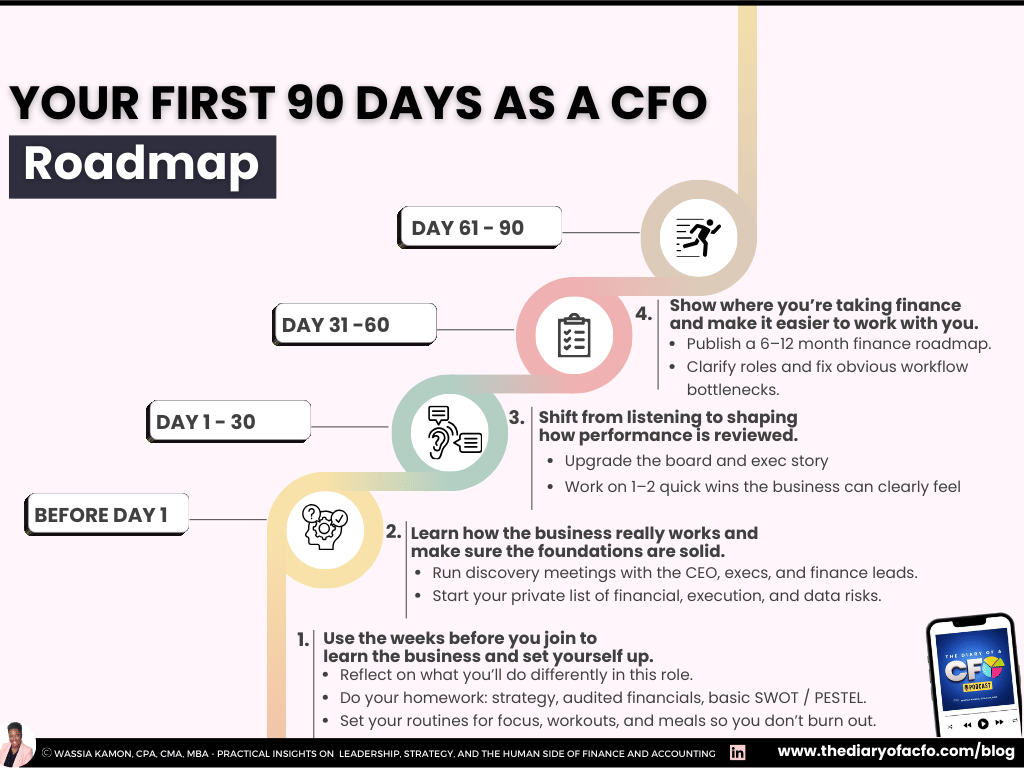
✅️ Start before Day 1. Use the gap between handing in your notice and starting your new role to research the business. Build a SWOT analysis from the outside. Then add:
A Porter’s Five Forces view: what competitive pressures will shape your agenda?
A PESTLE view: what political, economic, social, technological, legal, and environmental factors matter?
Arrive with that framework in your back pocket. Test it against every conversation you have in Month 1.
For more insights on what to do before day 1, check out this first 90 days roadmap.
Run a listening tour. Go see the CMO, COO, and head of sales. Ask:
What do you think the opportunities are?
What keeps you up at night?
What do you wish finance understood better?
Kevin frames these conversations around what is not working: where are the systems broken, where are the workarounds, where are the relationships with other teams strained?
Bring your finance team off-site. Within the first 30 days, hold a workshop to surface the same questions internally. The output is not a risk register yet. It is a wishlist of what needs fixing, which becomes the raw material for your agenda in Months 2 and 3.
The discipline of Month 1 is resisting the pull toward doing. Listening well is the most strategic thing a new CFO can do in their first 30 days.
Want to hear this firsthand? In Behind the Scenes of My First 90 Days as CFO, I share what those early weeks actually looked like in practice, including what I got wrong and what I would do differently. Listen to the episode on The Diary of a CFO podcast.
Month 2: Quick Wins That Prove You’re More Than ‘the Numbers Person’
Month 2 is where discovery converts into early action. You have enough context to identify things that are:
Clearly broken
Clearly fixable
Clearly visible to the people who matter
The framing matters as much as the substance. Kevin draws a sharp distinction between finance teams that present results and finance teams that partner with the business.
“A really good finance team know what is keeping their internal customer within the business awake at night. They’re there to support and advise and help with those real business problems, as opposed to just constantly talking about the financial result.” — Kevin Appleby
In practice, this means shifting from reporting to advising. When someone asks a question, the answer is not just the number. Kevin’s frame: instead of saying no, say “here are three options and the pros and cons of each.” That posture is what gets a CFO pulled into strategic conversations rather than handed the slide to check.
Think about every presentation through three questions:
What do I want them to know?
How do I want them to feel?
What do I want them to do?
Kevin learned this from a senior colleague at PwC early in his consulting career. The human brain processes about three pieces of information reliably. Walk in with twelve points and nothing lands. Walk in with three, supported by the right emotional context and a clear ask, and something changes.
🎧 Also worth listening to: Christina Ross on How the Best Finance Leaders Operate, Plan, and Forecast goes deep on what genuine business partnering looks like in practice and how finance teams shift from explaining results to shaping decisions.
Month 3: Resetting Expectations and Leading the Agenda
By Month 3 you have enough credibility to start changing things. Now the question is what kind of CFO you are going to be. This is a choice worth making deliberately rather than letting the role define you by default.
Kevin identifies three broad archetypes:
Business partnering CFO: the CEO’s strategic co-pilot, focused on planning and the forward view
Operational CFO: leads transformation, cost improvement, and business change
Wall Street CFO: specializes in fundraising, M&A, and exits
Knowing where your instincts are strongest helps you staff the gaps rather than pretend they do not exist.
Build or rebuild the risk register. Kevin recommends this as one of a new CFO’s first structural contributions. Ask each business leader to name their biggest risks. That conversation alone repositions you from someone who reports on what happened to someone who shapes what happens next.
Own the forward view. Kevin shares the story of Jeremy, a CFO who joined a company after a major fundraising round and quickly identified a fundamental flaw in the financial model. The flaw would breach bank covenants within 12 months. He delivered the difficult news early. That gave the business options. Delivering it late would not have. The CFO who owns the realistic forward view of where the business is heading is the one the board cannot afford to ignore.
How to Handle Imposter Syndrome When You Take the Seat
Kevin names imposter syndrome as the thing that keeps almost every new CFO up at night. The feeling that you are about to be found out. That the people who promoted you made a mistake.
“Look back at the rest of your career. Are you really being asked to do anything that’s that much different from what you’ve done in the past? Look at all of your successes. Suddenly you realize you’ve done all of the stuff that’s necessary for this role. You just haven’t done it in this environment.” — Kevin Appleby
Keep a success diary. Write down everything you achieve. Not just the big moments, but:
Conversations that moved a relationship forward
Analysis that changed a decision
Team members who stepped up because you gave them room
Kevin’s head of mentoring at Grow CFO recommends reviewing the list whenever imposter syndrome flares. His observation: when people share their list with a peer, the peer almost always adds more to it than the person put there themselves.

Accept that 60% ready is enough. Kevin is direct: nobody is fully ready when they take their first CFO role. A certain amount of what the role requires, you can only learn in practice. If you have 60% of what is needed, you can do good work and learn the rest. Spending energy on the 40% gap rather than the 60% you already have is focusing in the wrong direction.
Not sure where your gaps are? The free CFO Readiness Assessment at diaryofacfo.com walks you through 25 questions across nine competencies and gives you a personalized score.
🎧 Also worth listening to: Learning and Leading as a Modern CFO, Basem Waheed, CFO of Golden Chicken Farms in Saudi Arabia, shares how he cut his month-end close to one day through digital transformation, and why communication and trust-building matter more than technical skills as you grow into senior leadership. A great companion listen for any new CFO thinking about how to lead beyond the numbers from day one.
Want To Go Deeper?
Once you’re past the first 90 days, the board conversations start. The CFOs who feel calm in those rooms are the ones who prepared before the pressure arrived. If you want a practical playbook for the three conversations that come for every new CFO, read 3 Board Conversations Every New CFO Should Pre-Game (With a Reusable Script) on The Diary of a CFO blog. It includes a seven-step reusable structure and word-for-word examples for each scenario.
Listen to the full episode with Kevin Appleby on The Diary of a CFO podcast. Explore Kevin’s CFO Competency Framework at growcfo.net. And start with the free CFO Readiness Assessment to see where your own gaps are.
To learn more on the practical side of the first 90 days, read The First 90 Days as CFO: How to Quickly Build Credibility and Take Charge on The Diary of a CFO blog. It covers everything from what to do in the 30 days before you start, to the seven most common mistakes new CFOs make, with a day-by-day checklist to keep you on track.
FAQs
What should a first-time CFO prioritize in their first 30 days?
Listening and learning, not proving. Run a listening tour with the leadership team, hold a team workshop to surface what is broken, and build your SWOT, Porter’s Five Forces, and PESTLE read ideally before Day 1. Resist the pull toward action until you understand the context well enough to act on the right things.
How does a new CFO build credibility without overstepping?
By demonstrating you understand the business, not just the numbers. Present options instead of just reporting results. Use the three-question frame: what do I want them to know, feel, and do, in every key conversation. Show up where decisions are being made, not only in conversations about what already happened.
Is imposter syndrome normal for first-time CFOs?
Kevin says it is almost universal. The antidote is not confidence. It is perspective. Looking backward at how far you have come, keeping a success diary, and finding a mentor who has navigated the same transition are the three most practical tools he recommends.
What is the single most important thing a new CFO should do in their first 90 days?
Build the relationship with the business before you try to change it. Every interaction in the first 90 days is either building or spending credibility. The CFOs who listen first, ask genuine questions, and surface pain points before proposing solutions earn the right to shape the agenda in Month 3 and beyond.
Want to hear what the first 90 days looks like from someone who just lived it?
Listen to my conversation with Matt Ziegler, CFO of GovExec, on Starting Strong as a New CFO on The Diary of a CFO podcast. Matt shares what his first 90 days looked like in practice, from building relationships before day one to leading beyond finance and setting a clear vision early.
About The Author:
Wassia Kamon is a CFO and the host of The Diary of a CFO, where she interviews finance and business leaders on strategy, risk, and leadership. She writes about finance leadership and governance in small and mid-sized organizations, including what works, what breaks, and how leaders manage growth and complexity without burning out.