
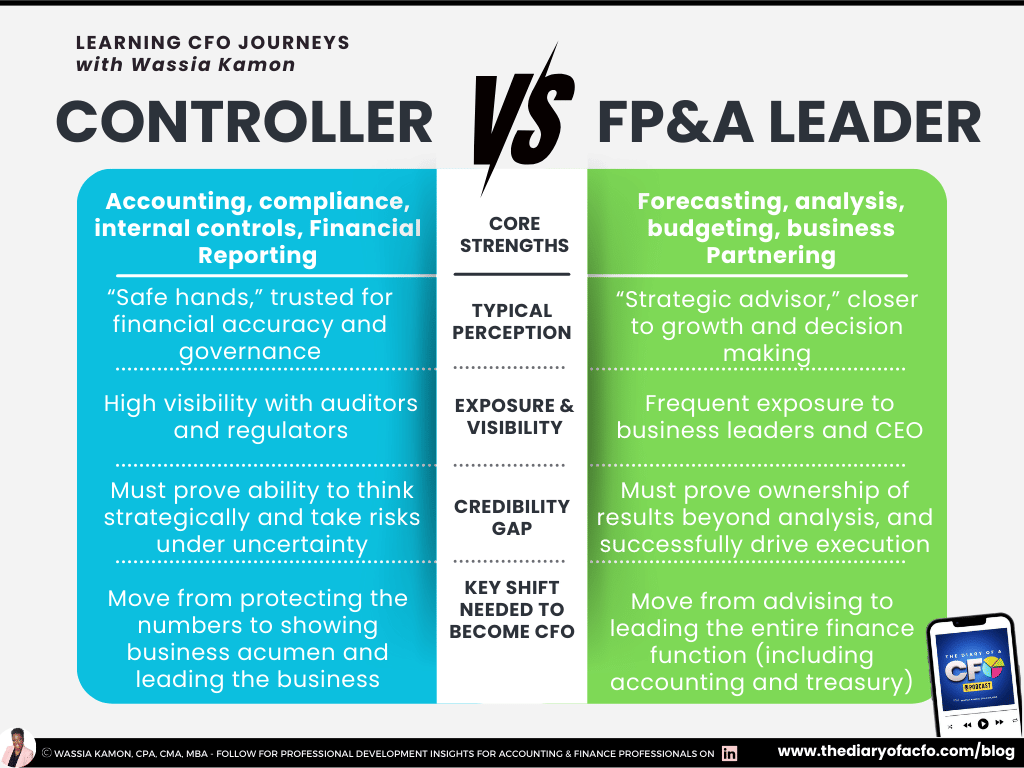

Most finance professionals reach the CFO role through one of two primary tracks: the Controller/Accounting route or the Financial Planning & Analysis (FP&A) route.
Each path has its own strengths and challenges. Knowing the differences can help you choose the best route for your career.
Table of Contents
Controller vs. Head of FP&A: What's The Difference
When people ask about the CFO career path, the two titles that come up the most are Controller and Director of FP&A. Both sit just below the CFO on the org chart, but the day-to-day work and focus are very different.
Controller = Accuracy and Compliance → Ensures the numbers are right, systems are sound, and risks are managed.
Head of FP&A = Strategy and Forecasting → Uses the numbers to tell the business story and guide decisions.
A Controller looks backward to record and protect, while FP&A looks forward to plan and advise. Companies need both to run effectively
Understanding the difference helps you decide which track fits your strengths, and what gaps you’ll need to close if the CFO seat is your goal.
What Does a Controller Do?
A Controller is responsible for the accuracy and integrity of financial reporting.
They run the accounting side of the house. Their job is to make sure every dollar is tracked correctly and the company can stand behind its financial statements. Their team makes sure the books are closed correctly each month, that the company complies with accounting standards, and that auditors, regulators, and the board can trust the numbers.
Typical responsibilities include:
Managing the month-end and quarter-end close process
Overseeing accounting policies, internal controls, and compliance
Working with external auditors and audit committees
Producing financial statements and regulatory reports
Leading accounting teams and ensuring smooth operations
Think of the Controller as the company’s financial backbone. They make sure nothing breaks in the system and that leaders have a solid foundation of reliable numbers.
What Does a Head of FP&A Do?
The Director of FP&A runs the planning and forecasting side of finance. Their job is to help the company plan where it’s going and explain how performance lines up with expectations.
Typical responsibilities include:
Building budgets, forecasts, and multi-year financial plans
Analyzing business performance and explaining variances
Partnering with department heads on resource allocation
Creating financial models to support strategy and growth initiatives
Presenting insights to senior leadership, investors, or the board
In short, FP&A leaders are the company’s strategic business partners, helping leadership see what’s coming and make smarter choices with data.
In short: Controllers answer “Are the numbers right?” while FP&A leaders answer “What do the numbers mean, and what should we do next?”
What is The Controller Path to Become a CFO?
Typical ladder:
Staff Accountant → Senior Accountant → Accounting Manager → Assistant Controller → Controller → (optional CAO) → CFO
Salary progression (U.S. averages)
Staff Accountant: $55K–$70K
Senior Accountant: $90K–$110K
Accounting Manager: $100K–$130K
Assistant Controller: $120K–$140K
Controller: $150K–$200K
Chief Accounting Officer (optional step at larger companies): $250K–$335K (Salary.com)
CFO: $195K–$320K+ (median ~$268K) (Robert Half)
Why this path is good:
You become an expert in accounting and financial reports.
You build trust with boards and audit committees.
You learn a lot about following rules and managing risks.
You get experience leading big accounting teams.
Typical Challenges for Controllers to Become a CFO
Sometimes, Controllers are seen only as number crunchers and may miss chances to learn about strategy or work closely with other parts of the business. This can make it harder to become a CFO who handles many different tasks.
Being a Controller, to me, is one of the hardest jobs in finance outside of the CFO seat.
On the upside, it builds stamina like nothing else.
On the downside, you have to be very intentional about carving out time to invest in your career, not just your job. Month-end closes come one after another, and if you don’t step back to build new skills and relationships, you can wake up years later with great experience but no clear path forward.
How to Improve Your Chances to Become a CFO:
Try to get experience or education in FP&A (Financial Planning & Analysis).
The Wharton Online Program which I'm a guest faculty on is a great way to start. It is a 8-week cohort based program that goes through all you need to know about FP&A. Use code "THECFODISCOUNT " for $300 off your tuition at checkout.
Build connections outside finance.
Take on tasks like talking to investors or presenting to the board to get better at communicating with top leaders.
Consider taking The CFO Readiness Assessment to get more personalized recommendations.
Here are few episodes of The Diary of CFO podcast from controllers who became CFOs.
What is The FP&A Path to Become a CFO?
Typical ladder:
Financial Analyst → Senior Financial Analyst → FP&A Manager → Director of FP&A → (optional VP Finance) → CFO
Salary progression (U.S. averages)
Financial Analyst: $60K–$75K (some markets report ~$138K averages) (Abacum)
Senior Financial Analyst: $90K–$110K
FP&A Manager: $120K–$150K (Finance Alliance)
Director of FP&A: $160K–$200K
VP Finance (optional step before CFO): $180K–$310K total comp (AlpineMar)
CFO: $195K–$320K+ (median ~$268K) (Robert Half)
Why this path is good:
You work directly with business operations and think strategically.
You often meet and work with CEOs and senior leaders.
You gain skills in financial modeling and planning different scenarios.
You learn how to analyze business performance and find growth chances.
Typical Challenges for a FP&A Professional to Become a CFO
FP&A leaders may not have as much depth in accounting rules and audits, which matter most in certain public or highly regulated companies. They also face the shift from being an advisor / business partner to becoming the decision maker who is directly accountable.
When I worked in FP&A for a very large pharma company, all I was responsible for was the P&L. Thankfully, I had done FP&A in other organizations, so I understood how business decisions flowed through all three statements. That may sound basic, but it makes a huge difference.
Later, I had an FP&A Director reporting to me who didn’t know how to model all three statements because he never had to. That’s the risk on either path: it’s easy to get comfortable while your title gets fancier, but without the right foundation, you won’t be ready for the CFO seat.
How to Improve Your Chances to Become a CFO
Learn about accounting and reporting processes.
Strengthen relationships with Controllers and accounting teams.
Learn the financial rules and compliance standards that matter most in your industry.
And, if possible, take on rotations or projects in operations to broaden your experience.
For more recommendations, read How To Become a CFO: What Research and CFOs Say
Here are few episodes of The Diary of CFO podcast from FP&A leaders who became CFOs.
Controller or FP&A - Which One Is Better?
Of course, it depends. You should consider what kind of work energizes you, the kind of environment you know you would thrive in and money $$$ of course.
Choose the Controller Path if you:
Excel at detail-oriented work and process improvement
Can stay on top of multiple things at once.
Are willing to go for a certification like the CPA, CMA, or CGMA
Enjoy ensuring accuracy and compliance in financial reporting
Want a more predictable career progression with clear milestones
Thrive in structured environments with defined procedures
Choose the FP&A Path if you:
Enjoy strategic analysis and business problem-solving
Want earlier exposure to senior leadership and business units
Prefer forward-looking analysis over historical reporting
Excel at communication skills and stakeholder management
Adapt quickly to changing business conditions
Feel energized by cross-functional collaboration and business partnership
Accounting vs FP&A Salaries

It's good to note that some Controllers step into Chief Accounting Officer at large public companies before CFO. CAO pay often sits above 300K because these are complex, regulated environments. This can even be more than a CFO at a smaller private company.
Is It Faster to Become a CFO Through FP&A or Controller Roles?
The short answer: No.
Both paths usually take 15–20 years, depending on company size and industry.
Each path builds different muscles. Here’s a quick side-by-side comparison:

As you can see, both paths create strengths and blind spots. Neither one fully prepares you for the top finance seat on its own. That’s why making the leap to CFO is less about which path you took and more about how you grow beyond it.
What really makes the difference in terms of speed is how you work on the things that will make you the obvious choice for top finance roles, i.e. your leadership, your brand and your network. If you want a deeper dive on that, read How to Become a CFO: What Research and CFOs Say Work.
You can also take The CFO Readiness Assessment to see how close you are to the CFO role today.
FAQs About Controller vs FP&A
What does a Controller do every day?
A Controller manages the company’s accounting, ensures compliance, and produces accurate financial reports. Their main job is to safeguard the integrity of the company’s numbers.
What does a Director of FP&A do every day?
A Director of FP&A leads budgeting, forecasting, and financial analysis. They help executives make better decisions by showing how choices affect the company’s future.
Which path pays more: Controller or FP&A?
Both paths pay well, but FP&A leaders often earn more at the Director and VP levels due to their strategic exposure. Controllers may earn more if they step into Chief Accounting Officer roles at large public companies.
Which is better, FP&A or accounting for CFO?
Neither is automatically faster. FP&A may seem more strategic, but some roles are narrow. Controllers may seem slower, but they gain credibility with boards. What matters most is broadening your perspective, building visibility, influence and network.
Can you switch between the two paths?
Yes. I personally started in accounting before transitioning to FP&A. Even a short rotation can help close gaps and make you a stronger candidate.
The Bottom Line:
Both Controller and FP&A paths can take you to the CFO seat. What matters is not where you start, but how you grow.
In the very first episode of my podcast, What They Don’t Tell You About Becoming a CFO, I said this: you are never hired to keep the status quo.
Even if you did a great job selling yourself, people expect you to hit the ground running.
For FP&A leaders, that might mean suddenly leading a month-end close you’ve never done before. For Controllers, it might mean owning a company-wide budget exercise you’ve never run. That’s why preparation matters as much as getting the seat. Because once you’re in, the expectation isn’t to learn slowly. It’s to deliver immediately.
Subscribe to the newsletter and stay tuned for upcoming deep dives on:
Making The Transition from Controller to CFO
Making The Transition from FP&A Leader to CFO
Planning Your First 100 Days as CFO
About The Author

Wassia Kamon, CPA, CMA, MBA, is the Chief Financial Officer of Access to Capital for Entrepreneurs (ACE), a leading Community Development Financial Institution (CDFI) based in Georgia. She brings over 15 years of experience across manufacturing, technology, pharmaceuticals, and the nonprofit sector, holding leadership roles in accounting and FP&A.
Named the 2025 CFO of the Year by the Atlanta Business Chronicle and a two-time CPA Practice Advisor 40 Under 40 Honoree, Wassia is a sought-after keynote speaker and serves as Guest Faculty for the Wharton Online FP&A Certificate Program. Her insights on leadership, change, and strategic influence have been featured in The Wall Street Journal, Accounting Today, Fast Company, and Strategic Finance Magazine.
With a LinkedIn following of over 28,000 professionals, Wassia is an active voice in the finance community. She serves on the AICPA Women’s Initiatives Executive Committee and the AICPA Future of Finance Leadership Advisory Group. She is also the host of The Diary of a CFO podcast, where she shares real-world lessons from finance leaders shaping the future of business.