


Decades ago, boards wanted CFOs who could keep them out of jail. Today, they want someone who can help them grow and compete.
So, how to become a CFO has changed dramatically.
Today, boards and CEOs are open to a wider set of backgrounds than ever before. The traditional accounting-only route no longer guarantees success. Finance leaders need strategic thinking, leadership skills, and business insight that goes far beyond spreadsheets. While there is no single path to the CFO seat, every successful route now shares common elements.
Table of Contents
How Do You Become a CFO? The Short Answer
To become a CFO, you typically need 10–15 years of progressive finance experience, cross-functional exposure in accounting and FP&A, and leadership skills that show you can operate at the executive level. Degrees and credentials help, but what matters most is showcasing how your background fits the company’s needs.
Key Takeways:
There is no single playbook for how to become a CFO.
Many come from accounting, FP&A, strategy, operations, or investment banking.
Credentials and years of experience help, but they do not guarantee the role.
Experience in accounting and FP&A helps. Cross-functional exposure even more
Relationships and executive brand matter as much as relevant experience.
Let's dive in!
The CFO job has changed a lot over the past twenty years. Today's finance executives need more than technical expertise. We're expected to drive strategy. We lead digital transformations. We partner closely with business operations.
I am a CFO who has walked this path. I have talked with dozens of finance executives on my podcast. I've seen what works versus what sounds good on paper. Success depends more on how you develop as a leader. You need the right mix of skills, relationships, and business know-how.
This guide breaks down the real pathways to the CFO position. It covers the qualifications that actually matter. It shows the strategic moves that set future finance executives apart.
What Does a CFO Do Today?
Deloitte has studied the CFO role for over a decade. Their research shows that today's finance leaders wear four hats. These are: steward, operator, strategist, and catalyst (Deloitte CFO Program).
Steward: Safeguard the company's assets. Manage risk. Ensure compliance.
Operator: Run a reliable, efficient finance organization. This includes overseeing accounting, tax, treasury, and FP&A.
Strategist: Partner with the CEO and board on capital allocation. Work on growth bets and long-term direction.
Catalyst: Lead change. This could be digital transformation, process improvements, or using data to push the business forward.
These groups are helpful. They capture how the job has grown beyond accounting. What's interesting is how quickly the strategist and catalyst side are taking over the traditional side of the role.
The Expanding Scope of CFO Responsibilities
An Egon Zehnder study looked at nearly 600 finance leaders. It found that 82% say their duties have grown in recent years. Many now handle areas like ESG, M&A, strategy, cybersecurity, and risk. They do this alongside finance basics.
I noticed this in my first year as CFO. During my first 100 days, I had spent way more time with the COO and other parts of the organization than with my own finance team. The same is true for so many CFOs today.
We're pulled into strategy, operations, technology, and risk. This would have been unthinkable twenty years ago.
That's why knowing what the CFO role looks like now is critical to chart your path.
How Do You Become a CFO?
Most CFOs don't follow just one clear path. A study by Spencer Stuart looked at Fortune 500 companies. They found that many CFOs had worked in more than one type of finance job before reaching the top.
The Most Common CFO Backgrounds
About 4 out of 10 had experience in Financial Planning & Analysis (FP&A).
3 out of 10 worked in accounting or Controller roles.
3 out of 10 had treasury experience.
The path to becoming a CFO depends on the industry. It also depends on the company's maturity stage.
Sheryl Shaw offered another angle to that in her Diary of a CFO podcast interview. She said:
There are operational CFOs, and there are fundraising CFOs. Trying to be both can backfire.
Her career is a reminder that you do not need to be everything to everyone to become CFO.
She never worked in public accounting, investment banking or FP&A.
Yet, she became CFO three times!!!
And it was all because she knew what she was good at (i.e. accounting, building scalable systems, and leading teams through change), and she focused on companies that needed exactly that.
Industry-Specific CFO Paths
A 2025 study by JM Search looked at 300 CFOs in private equity and venture-backed companies. It showed clear patterns.
In consumer and tech companies, about half of the CFOs came from FP&A backgrounds.
In healthcare and industrial companies, more CFOs came from Controller roles.
Another study focused on top-performing public tech companies. It found that about half of CFOs started in accounting. 22% came from FP&A. 21% came from investment banking. 9% came from consulting.
This means that even within tech, the background of CFOs can vary. Companies that are growing quickly may prefer CFOs with FP&A experience. Larger public tech firms often choose CFOs with accounting or capital markets experience.
The Two Dominant Routes
The exact route varies across industries. But two routes dominate: accounting and FP&A. Each develops different strengths.
Controllers gain credibility in compliance and reporting. FP&A leaders build strategic visibility with CEOs and business partners.
Neither path alone is perfect. The leap to CFO depends on how you grow beyond your starting point.
Want to see the full side-by-side breakdown? This includes the typical career ladders, strengths, blind spots, and timelines. Check out the detailed guide: Controller vs. FP&A: Which Path Leads to CFO Faster?
Common CFO Qualifications and Education Requirements
Essential Educational Foundation
Most CFOs begin with a bachelor's degree. Common majors include finance, accounting, economics, or business.
It is the basic requirement for almost any finance or accounting role. It's the starting point for most CFO careers.
Many then choose to pursue an MBA. This is especially true for those who began in accounting. I did the same after earning my CPA and CMA.
Another great option is the Wharton Online FP&A certificate. I'm actually one of a guest faculty so of course I'm biased.
I do encourage you to check it out especially if you have never worked in FP&A. Use code "THECFODISCOUNT " for $300 off your tuition if you decide to go for it. You're welcome :)
The Value of an MBA
For me and many CFOs I have spoken with, the MBA mattered less for the coursework. It mattered more for how it changed perception. It signaled readiness to lead at a broader level.
Jack McCullough is the founder of the CFO Leadership Council. He shared a similar experience on The Diary of a CFO:
"Before I was just a guy who'd been a Controller at a company nobody had heard of and a CPA. And suddenly, you know, I had an MBA and I was treated like the whiz kid. It opened up doors and I became a CFO."
The Shift from CPAs to MBAs
Jack also pointed to the Crist|Kolder Volatility Report. It showed that for the first time there were more Fortune 500 and S&P 500 CFOs with MBAs than with CPAs. As he said:
"Amongst the Fortune 500 CFOs… it was the first time that there were more MBAs than CPAs… and while it's not like it's six to one, that gap's widened a little."
For some boards and investors, the perception is even sharper. One investor told him:
"CPAs make great Controllers… great chief accounting officers… I don't value them as a CFO unless there's something else about them."
Often, that "something else" is the MBA.
In short: A bachelor's degree gets you started. An MBA is not required. But for many CFOs, it has been the extra signal. This is particularly true for those with accounting roots or coming from outside finance. It helped open the door to the top finance role.
3 Critical Skills CFOs Need Beyond Finance and Accounting
Technical finance skills get you in the conversation. What separates those who actually become CFOs are different skills. These show you can lead like an executive, not just a specialist.
There are 3 main skills that make someone successful as a CFO beyond accounting. These are: leadership, business acumen, and communication.
1. People Leadership
CFOs don't just manage spreadsheets. They lead teams. Whether you have 10 people or 100, the role requires building talent. You need to set direction. You need to create a culture where the finance function runs smoothly without you doing every detail yourself.
2. Business Acumen
Controllers and FP&A leaders are rewarded for accuracy and analysis.
CFOs are judged on judgment. The leap is rewiring your instincts. You need to move from "What happened?" to "What do we do next?"
That means understanding the business deeply enough to weigh risks, see opportunities and help shape direction.
Here is a snippet of what that rewiring looks like in practice:
3. Communication
As CFO you spend much of your time explaining numbers to people who are not finance experts. This includes CEOs, boards, investors, and operators. Success depends on clarity.
You have to translate data into stories that drive decisions. Don't just create reports that describe results.
Plus, tech fluency is increasingly non-negotiable. This is because of the increased focus on AI and digital transformation.

How CFOs Get Noticed and Chosen for the Role
Having the right degrees and technical skills gets you in the door. What actually moves finance leaders into the CFO seat are different signals. Decision-makers look for how you show up. They want to know who knows and trusts you. They look at how you influence at the top table. They also want to see whether you have the track record to back it up.
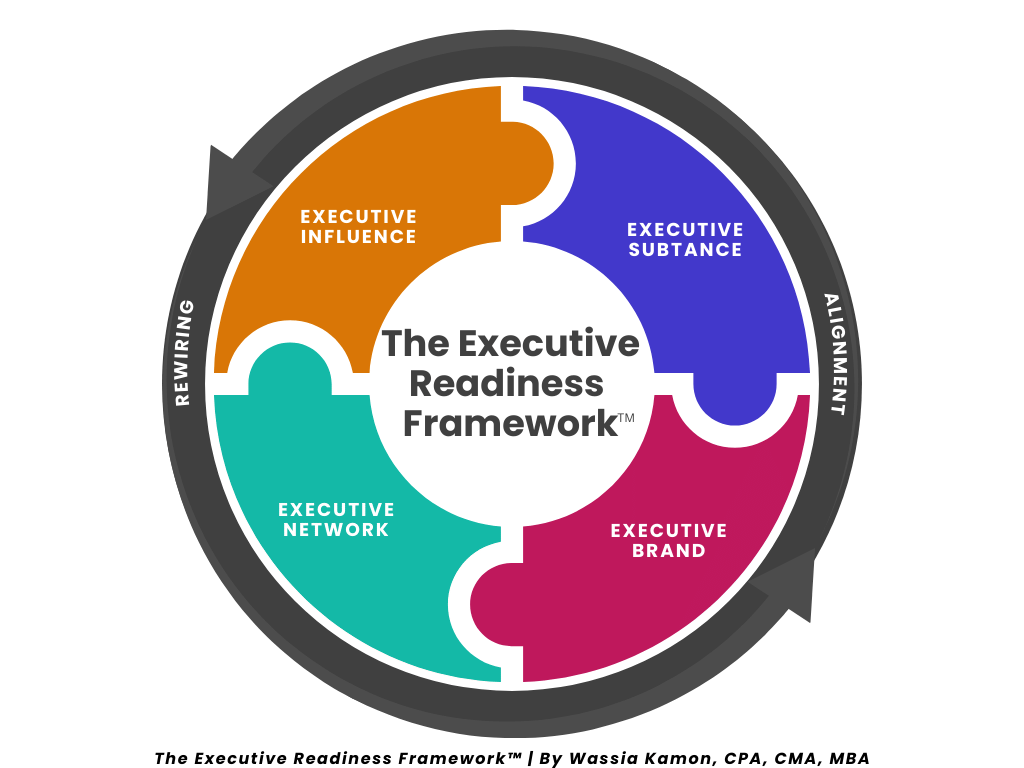
The Executive Readiness Framework™
I call this The Executive Readiness Framework™. I developed it from my own experience. I also drew from conversations with CFOs, CEOs, and executive recruiters. It focuses on four core areas:
Executive Brand: How you position yourself as an executive, both online and offline, so you can be found.
Executive Network: The mentors, peers, and decision-makers who know you and recommend you.
Executive Influence: How you think, lead, and communicate at the top table so you are trusted.
Executive Substance: The depth of your experience that proves you can handle the scope of the role.
This is how executives get found, recommended and chosen.
Real-World Impact of an Executive Brand
I have seen the impact of this firsthand. By 2021 I already had my CPA, CMA, and MBA. But I still felt invisible to executive leadership.
So I invested in an executive résumé. I reworked my LinkedIn profile. I positioned myself as a finance executive ready for more. I was not even posting yet. But those two changes got me noticed by a recruiter. This led to my first VP role.
The Power of Networking
Networking proved just as important. My executive coach, Jeannine Brown, once asked me:
"You want to be a CFO? How many CFO friends do you have?"
That pushed me to attend CFO gatherings before I had the title. This stretched my thinking. It gave me peers to lean on once I was in the seat.
That is why brand and network matter so much. You cannot be chosen for the seat if people do not see you as ready for it. Once you are in the seat, you need trusted peers to help you succeed.
Want to see where you stand? Take this free CFO Readiness Assessment. It is built on The Executive Readiness Framework™ by Wassia Kamon (yours truly). It will show you where you are today. It will show you what to do next to keep moving forward.

Timeline: How Long Does It Take to Become a CFO?
For most finance leaders, reaching the CFO seat is not quick. The timeline depends on company size. It depends on industry complexity. It depends on the opportunities you take along the way.
Typical Timeline
In large public companies: It usually takes 15 years+ of progressive finance experience.
In smaller or mid-size organizations: The path is often shorter. Usually around 8 to 12 years.
3 Ways to Move Faster
Take stretch assignments.
Volunteer for projects that expand your leadership scope. Examples include leading a system rollout, M&A integration, or global expansion.
Move across company sizes.
Start-ups build agility. Mid-size firms sharpen process skills. Large enterprises teach scale and governance.
Look at private equity portfolio companies.
These often provide accelerated learning. You manage intense growth. You work with multiple stakeholders. You handle different business models and fast change.
Even with shortcuts, it still takes time to build both technical depth and business leadership. Moving too fast without a strong base often backfires.
The CFOs who last are the ones who also invest in their brand, network, and influence along the way.
The Biggest Myths About How to Become a CFO
Myth: You Need an MBA from a Top School
A prestigious MBA can help. But many successful CFOs advance through experience and results. Don't get me wrong. Having an MBA from a top school is still a nice perk. But it's not a necessity. What you really benefit from is the network.
What matters most at the CFO level is having real business acumen. You need relevant industry experience. Boards want leaders who can drive strategy and influence business outcomes. They don't just want someone to manage financial operations.
Myth: The FP&A Path to CFO is Faster Than the Controller Path
Both Controller and FP&A routes have similar timelines when executed properly. Keep in mind that FP&A is a broad spectrum.
For example, most FP&A professionals in larger organizations may have only been exposed to a P&L. They may not be comfortable modeling all three financial statements. They might not understand how business decisions affect them.
So it is not just FP&A for the sake of FP&A. You have to make sure you build the right substance as well.
For a deeper comparison of the two paths, you should read: Controller vs. FP&A: Which Path Leads to CFO Faster?
Practical Steps to Advance Toward the CFO Role
1. Create a Development Plan
Study CFO job postings in your target industry and company size. To round it out, take the CFO Readiness Assessment. This will help pinpoint other areas you may need to consider. These include network, brand, and influence.
From there, choose 2–3 areas to focus on. Don't try to improve everything at once.
2. Get Comfortable With Technology
AI, automation, and data tools are changing finance. Show you can lead digital transformation. Don't resist it. Even small wins help. Examples include implementing dashboards. These prove you can move the function forward.
3. Strengthen People Leadership
As you rise, less of your job is spreadsheets. More of it is leading people. Look for chances to manage, coach, and guide teams through change. Even managing a small group prepares you for bigger leadership later.
4. Improve Communication and Storytelling
Practice translating numbers into insights. Make sure non-finance leaders can act on them. CEOs and boards don't want the variance report. They want to know what it means for the business.
5. Build Your Brand and Network
Many CFO roles are filled through relationships, not job postings. How you're seen matters. Keep your LinkedIn current. Share your perspective. Build genuine connections with peers, mentors, and executive recruiters.
The Bottom Line: How to Successfully Become a CFO
There is no single path to the CFO seat. But every successful path includes the same elements:
Having the right background for the right company
Knowing how to influence outcomes
Building a strong executive brand
Cultivating the right network
In my own journey, it was never one degree or one job that moved me forward. It was a series of choices. I stretched beyond my comfort zone. I built trust with decision-makers. I showed up as the executive I wanted to become, not just the role I held.
That same opportunity is in front of you now. Will you take it?
Frequently Asked Questions About How to Become a CFO
How do I know if I'm ready to be a CFO?
Compare your experience to what CEOs, boards, and recruiters seek. Searching job descriptions is a good way to pick up on that. The free CFO Readiness Assessment can also give you a quick snapshot and next steps.
Do I need to get an MBA to become a CFO?
An MBA can help but isn't required. Many Fortune 500 CFOs don't have one. This is according to the Crist|Kolder Volatility Report. If you started in accounting, an MBA can help signal broader leadership potential.
Do you need a CPA to be a CFO?
Not always. A CPA helps in regulated industries. These include healthcare, manufacturing, and banking. What matters most is how your background fits the company's needs.
How many years does it take to become a CFO?
Large companies: Often 15+ years.
Smaller or faster-growing firms: 8–12 years if you're intentional about breadth, brand, and network.
About The Author

Wassia Kamon, CPA, CMA, MBA, is a CFO and the host of The Diary of a CFO. She has more than 15 years of experience leading finance teams in manufacturing, technology, pharmaceuticals, and nonprofit organizations, and today serves as Chief Financial Officer of Access to Capital for Entrepreneurs (ACE), a leading Community Development Financial Institution in Georgia.
Named the 2025 CFO of the Year by the Atlanta Business Chronicle and a two‑time CPA Practice Advisor 40 Under 40 honoree, Wassia’s work on finance leadership and governance has been featured in The Wall Street Journal, Accounting Today, Fast Company, and Strategic Finance. On the podcast, she talks with finance leaders about team leadership, boards, and the realities of the modern CFO role.