
Executive Summary
Many CFOs are hired to be strategic, but their direct reports spend most of their time on transactions and compliance.
This article explains how controllers, FP&A, treasury, and tax and compliance can create strategic lift so the CFO is not the only strategist in the finance organization.
It uses practical insights from conversations on The Diary of a CFO podcast to show what this shift looks like in real life.
You will learn simple conversation prompts and focus areas that help each CFO direct report move from reporting outcomes to shaping decisions.
Why CFO Direct Reports Matter More Than Ever
When people talk about the evolving CFO role, they usually focus on the top job: strategy, storytelling and transformation.
If expectations change at the top and stay the same everywhere else, you end up with a strategic CFO sitting on a transactional leadership bench.
The CFO spends time translating, reframing and filling the gaps instead of focusing on the work only they can do.
In “Closing the Gap: Strategic CFO vs. Transactional Finance Function” I wrote about this mismatch at the functional level and how a CFO can be asked to lead strategy while the finance organization is still built for processing and reporting.
This article zooms in on the people closest to the CFO. It looks at what changes when controllers, FP&A, treasury, and tax and compliance leaders start to treat their work as part of the strategy engine, not only the reporting engine.
From “keeping the lights on” to creating lift
The CFO can’t be the only one doing strategic work on the finance team.
I’ve led controllership, FP&A, treasury, and tax across different companies, and the pattern is familiar:
Strategy talks stay in the CFO’s calendar.
Everyone else stays buried in deliverables.
A strategic CFO needs everyone and everything within their organization to also be strategic.
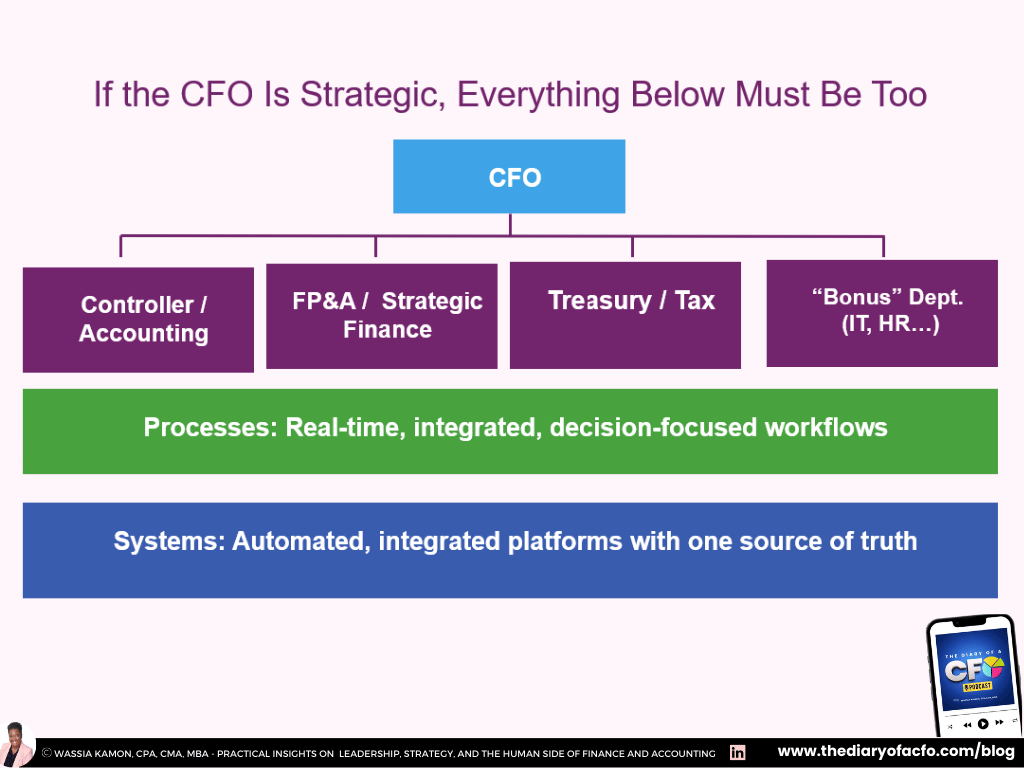
Unfortunatedly, most CFO direct reports were designed for stability: close the books, protect cash, stay compliant and avoid surprises.
Those mandates are still non negotiable.
What is different now is that these same roles are also some of the best places to:
Spot pattern changes before they show up in the P&L
Pressure test strategy with real numbers instead of gut feel
Bring the business clear options, not just clean reports
The core work does not disappear.
The lens on that work changes from “What happened?” to “What does this mean and what should we do?”
What changes for the CFO when direct reports level up
When controllers, FP&A, treasury and tax and compliance leaders work this way, the CFO’s role changes in three meaningful ways:
Less translation
Conversations move faster because leaders speak in the language of trade offs and scenarios, not only in lists of transactions.
Earlier visibility
Issues surface through exception patterns, cash signals or regulatory changes before they show up in the board deck.
A stronger bench
Future CFOs get real repetitions in shaping decisions and telling the story, not only in preparing reconciliations and decks.
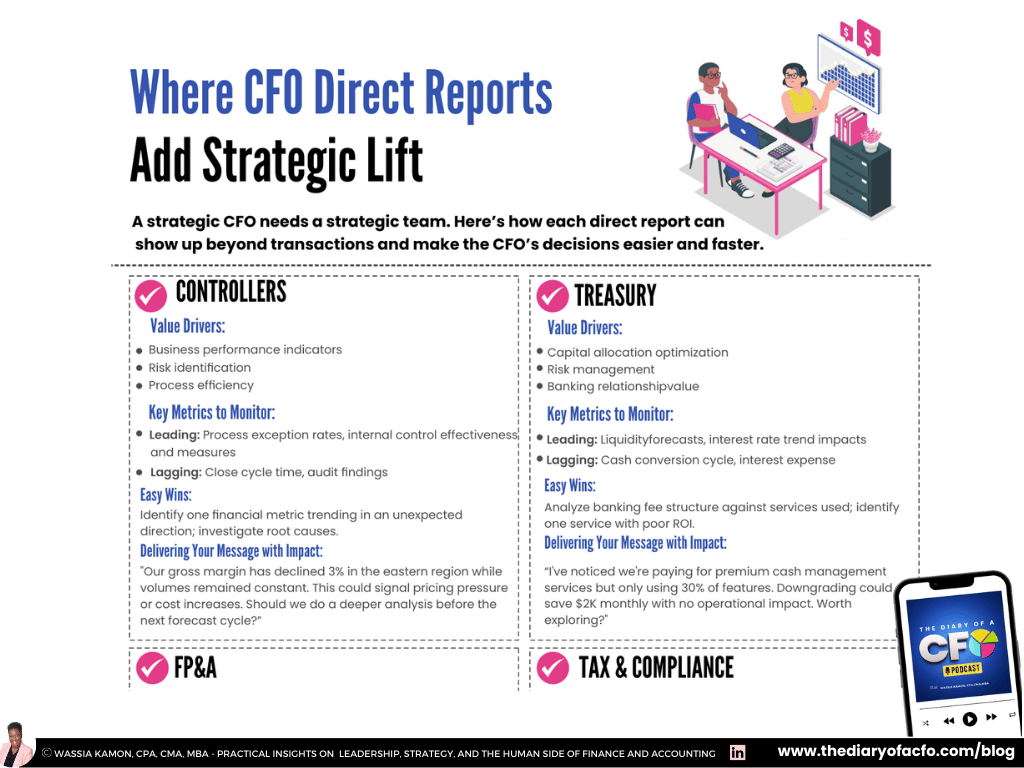
Controllers: accounting as an operating system
In my conversation with Ramp Controller, Edwine Alphonse, she described joining a high growth company as the first internal accountant and inheriting books that were technically correct but not very helpful. The chart of accounts was not aligned to how the business actually made money.
Her first step was not only to clean up the past. She redesigned the accounting structure so leaders could see performance by product, customer and unit economics in real time. That meant executives could ask better questions and make faster calls.
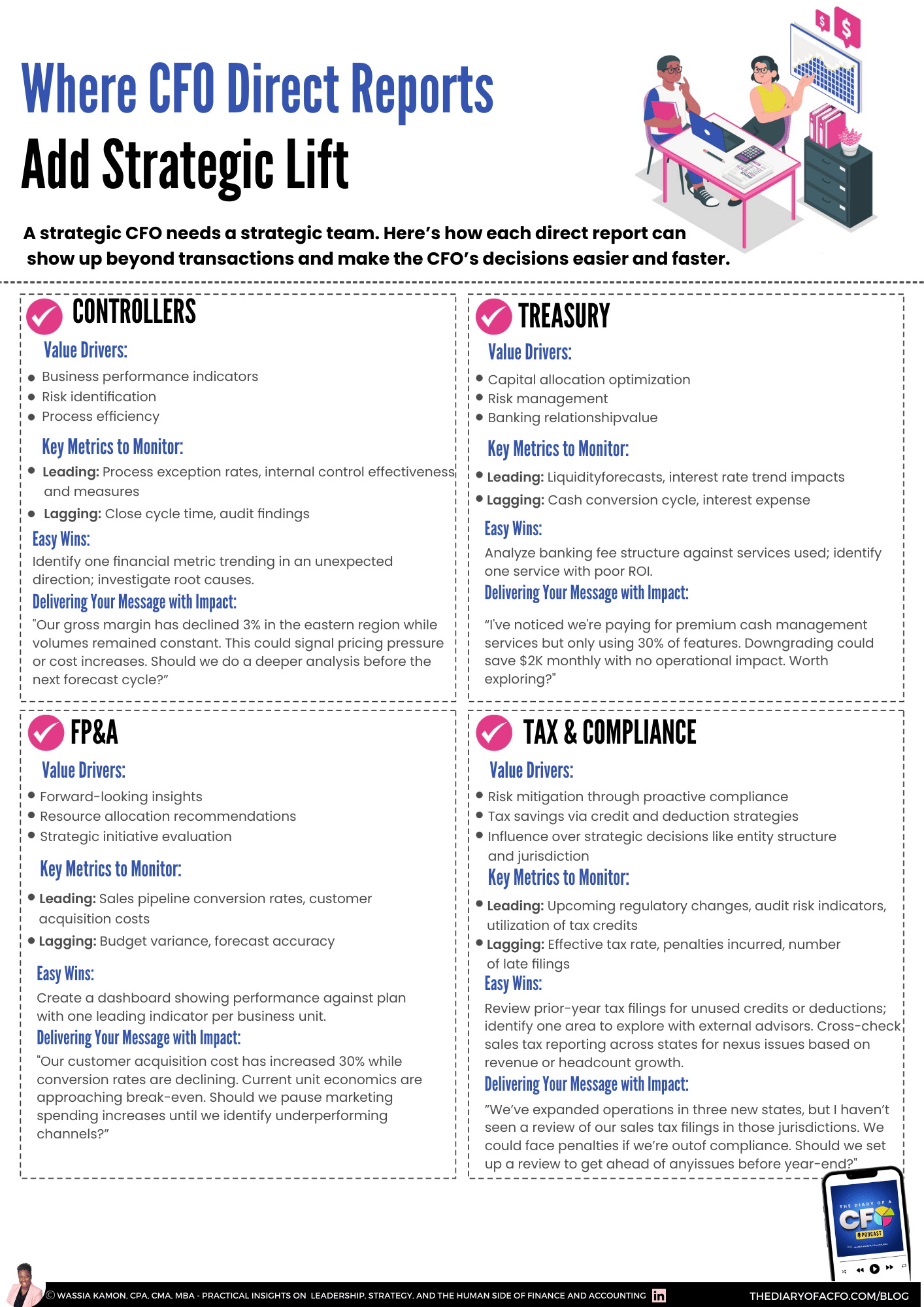
Strategic lift from controllership looks like:
Designing the books so that business questions are easy to answer
Treating close and audit issues as early warning signals, not just items to fix
Bringing a short list of hypotheses and next steps when something moves unexpectedly
You can hear Edwine talk through this evolution in detail here:
FP&A: from explaining variances to shaping choices
FP&A is often labeled the “strategic” part of finance, yet many teams still spend most of their time fixing templates and explaining why results missed the plan.
Strategic lift from FP&A looks like:
Designing analysis around the decisions leaders need to make, not around the calendar or the chart of accounts
Using scenarios to test growth, margin and cash choices before they are locked in
Showing the impact of options side by side instead of presenting a single recommended number
In practice, that can mean:
Tracking leading indicators such as pipeline health, win rates or unit economics, not only budget variances
Bringing a simple options view to key discussions, for example: “If we slow hiring by one quarter, here is the impact on runway, revenue and retention”
Turning monthly reviews into conversations about trade offs, not only post mortems on last month’s performance
When FP&A works this way, it becomes the place where strategy is rehearsed in numbers, not just where the plan is stored.
Tax and compliance: putting structure and risk on the table early
Tax and compliance teams often show up in conversations only at filing time or when something goes wrong. That timing limits their ability to influence decisions.
Strategic lift from tax and compliance looks like:
Monitoring upcoming regulatory and tax changes that could affect pricing, expansion or hiring plans
Reviewing business moves such as new entities, markets or products for structural options, not just downstream reporting impacts
Framing recommendations in terms of risk, cash and flexibility so leaders can choose between clear alternatives
Examples include:
Flagging how entering a new state or country will affect nexus, indirect tax and compliance overhead before the move is finalized
Identifying underused credits or incentives that could fund strategic initiatives
Bringing a perspective such as: “You can structure this acquisition in one of two ways. Here is what each means for effective tax rate, cash timing and compliance risk over the next three years.”
Handled this way, tax and compliance become partners in how the business is built, not just how it is reported.
Treasury: the backbone behind strategic cash moves
Treasury is often seen as the place that moves money around. After speaking with AVP of Treasury at Victoria's Secret, Summa Simmons, it is hard to keep that narrow view. She described treasury as the backbone behind every major choice, from M&A to store openings to how employees experience payroll.
She highlighted how late information from the business shows up in the cost of funds, covenant pressure and lost flexibility. When cash surprises appear, the organization does not just miss a forecast. It loses options.
Strategic lift from treasury looks like:
Owning a clear view of cash runway under different scenarios
Quantifying the impact of timing, interest rates and bank fees on strategic choices
Joining big decisions early so risk and liquidity are designed in, not patched in later
For a deeper dive into how treasury supports strategy and M&A, listen to “The Role of Treasury in M&A and Business Strategy” here:
How to start this shift on Monday
You do not need a new organization chart to move in this direction. You need clearer questions and slightly different expectations.
If you are a CFO, sit down with one direct report this month and ask:
Which three to five decisions should your function help me and the business make better and faster
What are the earliest signals that those decisions need to change
What would it look like to bring options, not just results, to our next discussion
If you report to a CFO, you can use the same questions as a self assessment before your next one on one. Over time, these small shifts compound into a finance leadership team that lifts the whole organization, not only the CFO seat.
For more finance leadership insights, explore the Episodes library.
When you want to be more strategic but do not feel you can
There is another layer to this conversation that I explore in “How to Do Strategic Work When You Are Swamped” on The Diary of a CFO blog.
That article looks at the personal side of this shift: what to do when you want to contribute more strategically, but your calendar, your processes or your confidence make it feel impossible. It offers simple ways to reframe existing work, carve out thinking time and bring one strategic insight to each conversation, even if your role still feels very operational.
If you are wondering whether your own experience and finance setup are ready for a truly strategic CFO role, start with the free CFO Readiness Assessment. It will give you a structured view of where you are strong, where you have gaps, and what to focus on next in your development

FAQ
What should CFO direct reports focus on to be more strategic?
CFO direct reports should focus on the decisions they support, not just the processes they run. That means knowing which business choices their work informs, which metrics signal that a decision needs to change, and how to present clear options instead of raw data.
How can a controller support a strategic CFO?
A controller supports a strategic CFO by turning the close, reconciliations, and audit findings into an early warning system. For example, they can highlight exception trends, unusual margin movements, or control issues and explain what those patterns might mean for pricing, cost structure, or risk.
How can FP&A move beyond budgeting and forecasting?
FP&A becomes more strategic when it frames work around scenarios and trade offs. Instead of only explaining why results missed the plan, FP&A should show what happens under different growth, cost, or investment options so leaders can choose the path that best fits their goals and risk appetite.
What does a strategic treasury function look like?
A strategic treasury function connects cash and capital decisions to business strategy. It gives the CFO clear insight into cash runway, covenant headroom, and the cost of timing surprises, and it shows how different funding or investment choices affect growth, flexibility, and risk.
How can tax and compliance add strategic value, not just handle filings?
Tax and compliance add strategic value when they surface structural choices early. That includes highlighting the implications of entering new markets, M&A activity, or headcount growth, and recommending approaches that balance risk, compliance, and long term value.
What is one practical step a CFO can take to make their team more strategic?
One practical step is to ask each direct report, “Which decisions should your team help me make better and faster, and what are the earliest signals that those decisions need to change?” Then agree on one change in how they present information that turns existing work into clearer options.
Where can I learn more about the controller and treasury perspectives mentioned here?
You can hear the controller perspective in my conversation with Edwine Alphonse on reimagining accounting for business success, and the treasury perspective in my episode with Summa Simmons on treasury’s role in M&A and strategy on The Diary of a CFO podcast.
About The Author:
Wassia Kamon is a CFO and the host of The Diary of a CFO, where she interviews finance and business leaders on strategy, risk, and leadership. She writes about finance leadership and governance in small and mid-sized organizations, including what works, what breaks, and how leaders manage growth and complexity without burning out.